
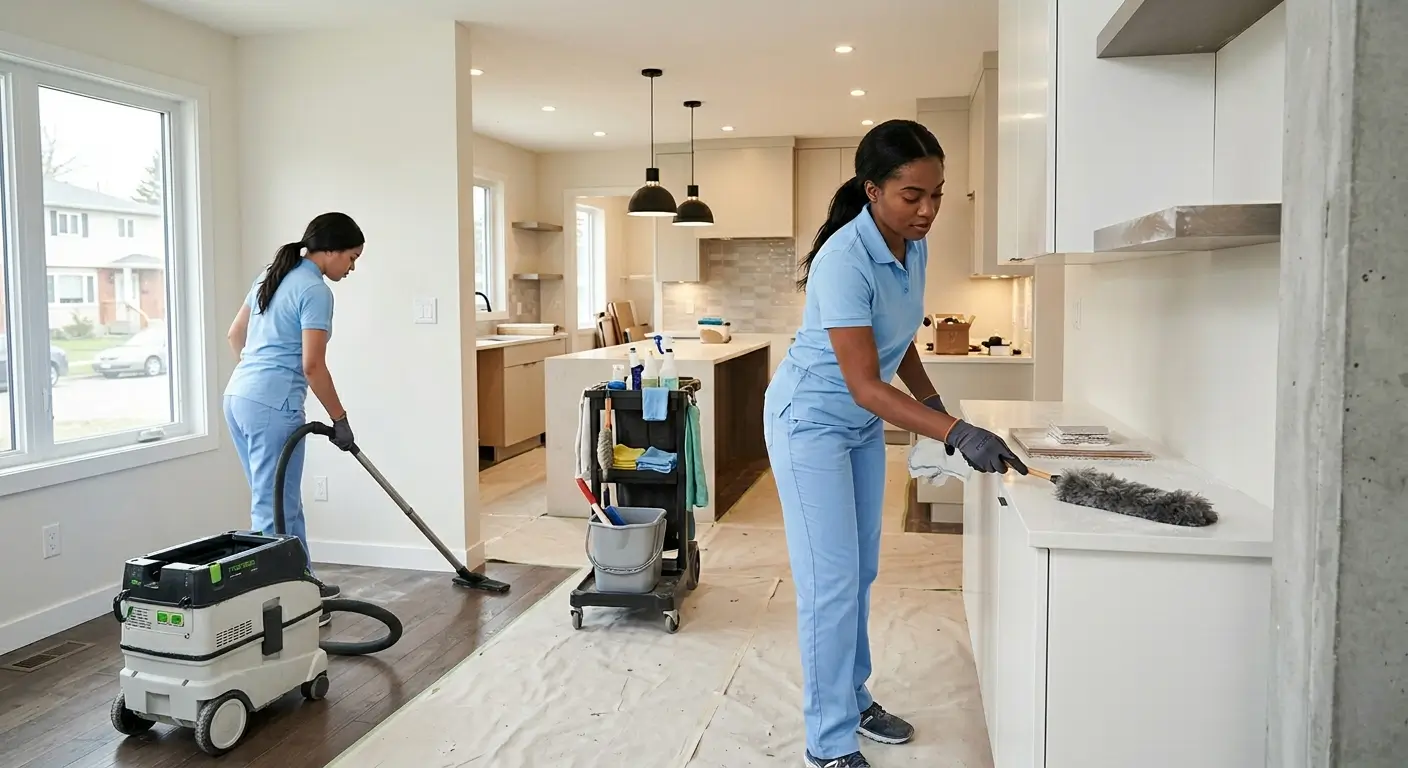
Construction leaves behind drywall dust, adhesive residue, and fine particulates that standard cleaning cannot remove. This guide covers why professional post-construction cleaning matters, what the three phases include, and what to confirm before booking.
What Construction Leaves Behind That a Broom Cannot Address
A freshly renovated space looks finished when the contractors leave. What remains is not visible from a walkthrough. It is in the HVAC ducting, on every horizontal surface below eye level, embedded in carpet fibres, and settled on every light fixture in the space.
Construction debris falls into three categories:
- Coarse debris: wood scraps, nails, screws, insulation fragments, and drywall offcuts. Removable by hand and vacuum during the rough clean phase.
- Fine particulate dust: drywall dust, cement dust, and sawdust that becomes airborne during standard vacuuming and resettles on every surface it contacts. Requires HEPA filtration to capture rather than redistribute.
- Surface contamination: adhesive residue from protective films, paint splatter on fixtures, grout haze on tile, and caulk smears on glass. Requires specific removal products for each material.
According to the EPA’s guidance on construction dust management, fine construction particulates including drywall dust and cement powder pose documented respiratory risks when not removed with filtration-grade equipment.
The Three Phases of Professional Post-Construction Cleaning
Professional post-construction cleaning does not happen in a single pass. A property that has undergone significant renovation requires three sequential phases, each addressing a different layer of contamination.
Rough Clean
The rough clean removes coarse debris before surface cleaning begins.
- Debris removal: all construction waste including wood scraps, nails, insulation, and packaging collected and removed.
- Surface preparation: floors swept and large debris cleared so the detailed phase addresses the surface itself.
- Vent inspection: HVAC registers checked for debris before the system is operated post-construction.
Detailed Clean
The detailed clean is the most time-intensive phase, addressing fine particulate and surface contamination.
- HEPA vacuum throughout: all floors, surfaces, window sills, baseboards, and cabinet interiors vacuumed with HEPA filtration before any wet cleaning begins.
- Surface wiping: countertops, appliances, cabinet fronts, doors, and hardware wiped with appropriate cleaners per surface material.
- Fixture polishing: newly installed light fixtures, faucets, and hardware polished free of adhesive residue and installation marks.
- Window cleaning: glass surfaces cleaned of construction film, paint splatter, and adhesive residue.
- Bathroom and kitchen sanitation: all surfaces disinfected to occupancy-ready standard.
Touch-Up Clean
Drywall dust stays suspended in air for 24 to 48 hours after the detailed clean, then resettles on cleaned surfaces.
- Re-vacuum all horizontal surfaces: after the resettlement window.
- Re-wipe any surfaces: showing visible resettlement before handover or occupancy.
Why Professional Post-Construction Cleaning Protects the Property
- HVAC system protection: drywall dust drawn into an HVAC system during first operation coats coils and clogs filters immediately. Addressing vent registers before the system runs prevents this.
- New floor protection: fine construction grit acts as an abrasive under foot traffic on new hardwood, tile, and vinyl. Removing it before occupancy prevents scratching in the first weeks.
- New fixture protection: adhesive residue from protective films hardens over time. Removing it during post-construction cleaning takes minutes. Removing hardened adhesive later risks surface damage.
- Paint protection: fresh paint splatter responds to standard removal products. Cured paint splatter requires solvents that can damage the underlying surface.
For more on deep residential cleaning standards, see our guide on deep cleaning service.
The Equipment That Makes the Difference
The gap between DIY post-construction cleaning and professional results comes down to equipment.
- HEPA vacuum systems: capture 99.97 percent of particles at 0.3 microns or larger. A standard household vacuum recirculates fine construction dust back into the air during vacuuming.
- Microfibre cleaning systems: trap dust on contact rather than redistributing it. Standard cotton cloths push dust from one surface to another.
- Adhesive removers: commercial-grade products that dissolve protective film adhesive, paint overspray, and caulk residue without damaging the underlying surface.
- Industrial wet-dry vacuums: for coarse debris and any liquid contamination from plumbing or wet trades.
According to the Occupational Safety and Health Administration, construction sites generate airborne silica and fine particulates that require specific filtration standards during cleanup. Professional crews operating with HEPA systems meet that standard.
Who Needs Professional Post-Construction Cleaning
- Homeowners after kitchen or bathroom remodels: the highest dust-generating renovations in residential properties. Drywall work, tile cutting, and plumbing rough-in produce fine particulate that spreads beyond the immediate work zone.
- Homeowners after full renovations: multi-room work requires phased cleaning to prevent cross-contamination between areas.
- Commercial property managers: office spaces, retail environments, and medical suites require occupancy-ready sanitation before staff or clients enter.
- Contractors handling project handover: professional post-construction cleaning is the standard final step before key handover on any renovation project.
For eco-friendly post-construction cleaning using non-toxic products, CR Maids applies the same HEPA and microfiber standard with biodegradable solutions throughout.
What to Confirm Before Booking Post-Construction Cleaning
- Confirm HEPA equipment is used: ask specifically whether the crew uses HEPA-filtered vacuums. Without HEPA, drywall dust gets redistributed rather than removed.
- Confirm the cleaning sequence: rough clean before detailed clean, HEPA vacuum before wet mopping.
- Confirm surface-specific products: adhesive removal, paint splatter treatment, and grout haze removal each require different products.
- Confirm the touch-up clean is included: a single-pass clean without a follow-up for dust resettlement is incomplete for drywall projects.
- Confirm liability insurance: a crew working around fresh paint, new fixtures, and new flooring must carry general liability insurance.
For a full list of pre-booking verification questions, see our FAQ page.
Why You Need Professional Post-Construction Cleaning Before Anyone Moves In
Professional post-construction cleaning removes what a renovation leaves behind that a standard clean cannot address. Fine particulate drywall dust requires HEPA filtration. Adhesive residue requires commercial-grade removers. Paint splatter requires surface-safe solvents. The three-phase process, rough clean, detailed clean, touch-up clean, is the only approach that delivers a property that is genuinely occupancy-ready rather than visually clean with contamination still present in the surfaces, ducts, and air.
How CR Maids Handles Post-Construction Cleaning
CR Maids has served Castle Pines and Douglas County for over a decade, with the same background-checked dedicated crews also servicing neighboring communities including Highlands Ranch and Lone Tree. Every post-construction cleaning visit follows the three-phase sequence using HEPA vacuum systems, microfiber cleaning throughout, and surface-specific products for adhesive, paint, and grout residue. Every visit is backed by a written satisfaction guarantee.
To schedule a post-construction clean or discuss a project handover package, visit our Castle Pines page or book through our online booking system.
Frequently Asked Questions
1. What does professional post-construction cleaning include?
Three phases: rough clean to remove coarse debris, detailed clean covering HEPA vacuuming, surface wiping, fixture polishing, and sanitation, and a touch-up clean 24 to 48 hours later to address drywall dust resettlement.
2. Why can’t I just use a regular vacuum for post-construction cleaning?
Standard vacuums have no HEPA filtration and recirculate fine drywall dust back into the air during use. HEPA-filtered vacuums capture 99.97 percent of fine particulates rather than redistributing them.
3. How long after construction should cleaning begin?
The rough clean can begin as soon as coarse construction debris has been removed. The detailed clean should begin only after all trades have finished. Beginning detailed cleaning while any construction work continues produces immediate recontamination.
4. How much does post-construction cleaning cost?
Most residential post-construction cleaning runs between $200 and $600 depending on property size, project complexity, and scope. Commercial projects vary based on square footage and the number of phases required.
5. Does post-construction cleaning include HVAC duct cleaning?
Standard post-construction cleaning includes clearing HVAC registers and checking for debris accumulation. Full duct interior cleaning is a separate service. Confirm the scope at booking if duct cleaning is required.
6. Is one post-construction cleaning visit enough?
For projects involving drywall work, no. Drywall dust resettles for 24 to 48 hours after the detailed clean. A touch-up clean during that window is required to deliver a property that stays clean after occupancy begins.
Key Takeaways
- Three phases required: rough clean, detailed clean, and touch-up for dust resettlement. A single-pass clean is incomplete for drywall projects.
- HEPA filtration is non-negotiable: standard vacuums redistribute fine construction dust. HEPA systems remove it.
- HVAC first: vent registers must be addressed before the system operates post-construction to prevent drywall dust from coating coils and filters.
- Surface-specific products: adhesive removal, paint splatter treatment, and grout haze each require different chemistry. One all-purpose cleaner does not address all three.
- Touch-up clean is the final step: drywall dust resettlement after the detailed clean is predictable, not a cleaning failure. The touch-up clean is the standard response.
- Confirm HEPA before booking: ask specifically. A crew without HEPA filtration will not deliver a post-construction standard result regardless of time spent.

Karina Cohen is the owner of CR Maids, a local cleaning company serving the Greater Denver area. With a background as a global executive in fashion, software, retail, and financial services, she has led business strategy, mergers and acquisitions, and cross-cultural teams across the US, Europe, and Asia.
Karina holds a Global Executive MBA from Duke University’s Fuqua School of Business and a Bachelor of Science in Finance and Marketing from Fordham University. She brings this strategic expertise into CR Maids, where her mission goes beyond spotless homes—she is committed to empowering her team, creating financial security, and giving back to the community.
When she’s not leading CR Maids, Karina homeschools her daughter, serves on the board of Duke University Colorado, and supports initiatives that strengthen families and small businesses.