
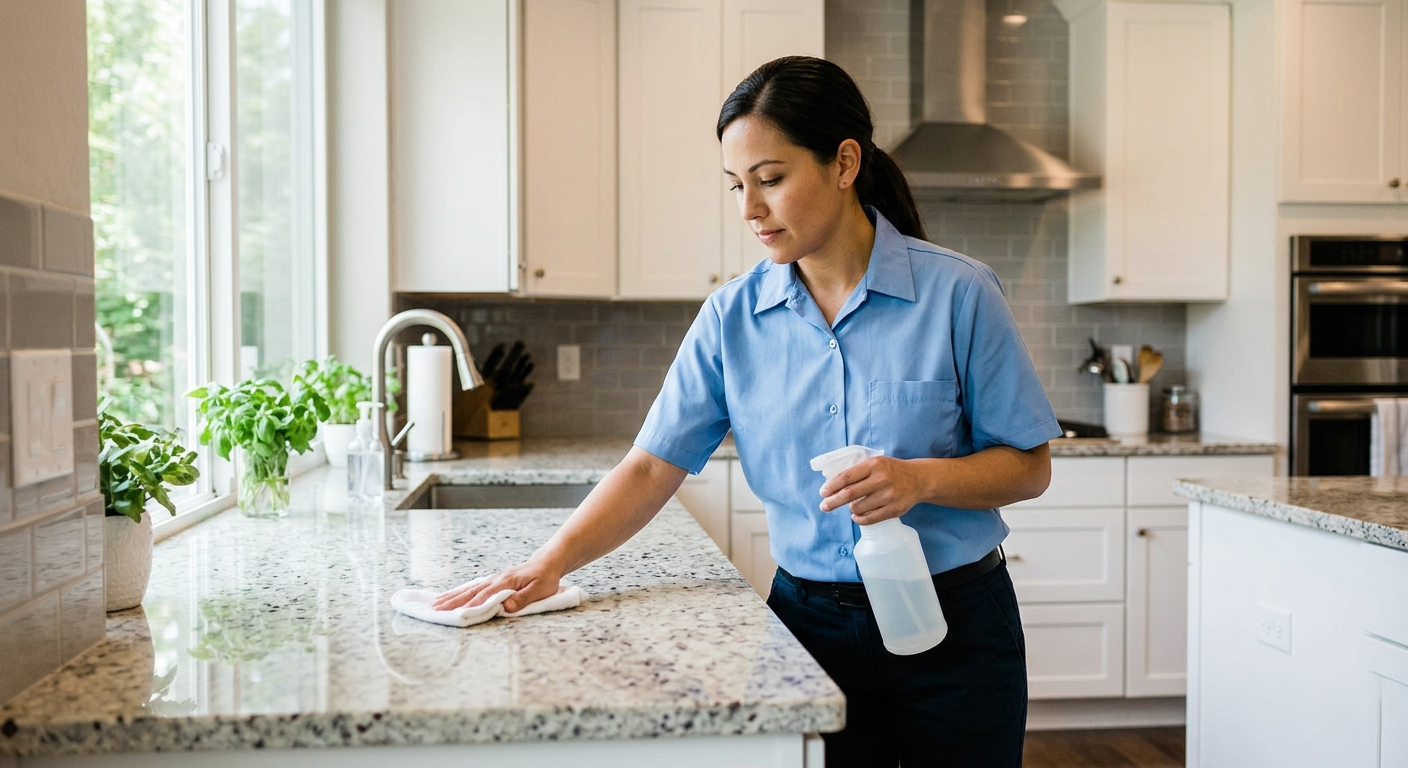
Most Castle Pines parents and pet owners worry that professional home disinfecting services put their family at risk. Households with children, cats, or birds need safe products and correct timing. This guide covers which products are safer, how timing works, and what to ask before booking.
Home Disinfecting Services: the Short Answer for Castle Pines Families
Home disinfecting services are safe for kids and pets when the provider uses EPA-registered products at the correct concentration, honors dwell times, ventilates properly, and allows surfaces to dry fully before the household resumes normal activity. The risks are real but controllable, and they come almost entirely from misuse, not from the category of service itself.
The danger zones are narrow: direct contact with a wet disinfectant, inhalation during application in poorly ventilated rooms, and residue left on surfaces that pets lick or children put in their mouths. Every one of these is preventable with the right product selection and protocol. The question is whether the service hired follows that protocol, or whether it treats disinfection as a spray-and-go routine.
Why Kids and Pets Are More Vulnerable
The safety conversation matters more for children and animals because their bodies process chemicals differently than adult humans do. A dose that is harmless to an adult can be disruptive to a 20-pound toddler or a 12-pound cat, and this is a function of biology rather than fragility.
Four factors make the difference:
- Body weight and surface area: A child’s skin-to-mass ratio is much higher than an adult’s, which means topical absorption of any residue is proportionally greater per kilogram.
- Breathing patterns: Infants and small children breathe faster than adults, drawing in more air per minute relative to body size, and they spend hours a day closer to the floor where heavier disinfectant vapors settle.
- Hand-to-mouth and paw-to-mouth behavior: Toddlers engage in frequent hand-to-mouth behavior throughout the day. Cats groom themselves by licking every surface they walk on. Dogs sniff, lick, and chew. This behavior compounds any residue risk that would be trivial in an adult-only home.
- Metabolic differences in pets: Cats lack a key liver enzyme needed to process certain phenolic compounds found in some disinfectants, which is why products safe for dogs can be toxic to cats. Birds are extraordinarily sensitive to airborne chemicals because of their efficient respiratory anatomy.
Which Disinfectants Are Safer for Households With Kids and Pets
Not all EPA-registered disinfectants carry the same safety profile. For Castle Pines homes with young children or animals, four product categories form the safer tier:
- Hydrogen peroxide-based disinfectants: They break down into water and oxygen after doing their job, leaving no toxic residue. Products at 0.5% to 3% concentration are effective against most household pathogens and are widely used in pediatric and veterinary settings.
- Accelerated hydrogen peroxide (AHP) formulations: A newer category that combines hydrogen peroxide with surfactants to speed up kill times while maintaining a low-toxicity profile. Many appear on the EPA Safer Choice list.
- Citric acid and lactic acid-based disinfectants: Plant-derived, food-grade acids registered as disinfectants against specific viruses and bacteria. Generally safe around pets at labeled concentrations and leave minimal residue.
- Alcohol-based disinfectants (60% to 90% isopropyl or ethanol): Evaporate quickly and leave no residue, which makes them favorable for surfaces pets contact. Flammability and ventilation during application are the main considerations.
Two categories warrant extra caution: quaternary ammonium compounds (quats), which can cause respiratory irritation in birds and skin irritation in cats if residue is left behind; and phenol-based products such as Lysol concentrate, which are specifically toxic to cats. Sodium hypochlorite (bleach) at undiluted strength is corrosive to paw pads and toxic if ingested. Properly diluted and fully rinsed bleach is acceptable on non-porous surfaces away from pets.
Choosing between pet-friendly disinfectants comes down to the active ingredient, not brand name or marketing label. This is one reason many Castle Pines families use the eco-friendly house cleaning service from CR Maids, which defaults to hydrogen peroxide and plant-derived actives.
The EPA Safer Choice Program Explained
The EPA Safer Choice program certifies cleaning and disinfecting products that meet stringent standards for human health and environmental safety. Products carrying the Safer Choice label have been reviewed ingredient-by-ingredient, and every component must meet specific toxicity, irritation, and environmental benchmarks.
For a disinfectant to appear on both the EPA efficacy list and carry Safer Choice recognition, it has cleared both an efficacy and a safety bar. This intersection is the gold standard for households with children and pets.
When evaluating a Castle Pines disinfecting service, ask whether their eco or family-safe protocol uses Safer Choice-certified products. The answer should be specific, not vague.
Dwell Time and Dry Time: Why Timing Matters for Safety
The same principle that makes disinfectants work is also what protects your family afterward. A disinfectant is most chemically active when it is wet on a surface. Once it dries, the active ingredient has either done its job and degraded, or settled into residue that can be wiped or rinsed.
Three timing windows matter:
- Dwell time: The period the product must stay visibly wet to kill pathogens, typically 30 seconds to 10 minutes depending on the product.
- Dry time: The additional period needed for the surface to dry fully before it is safe for a child or pet to touch.
- Ventilation time: The span during which fresh air should be moving through the space to clear any airborne residue.
A safe protocol keeps kids and pets out of a room from the moment application begins until every treated surface is fully dry and the room has been ventilated for at least 10 to 15 minutes after drying. For most residential disinfecting visits, this means a two-to-four hour window from start to re-entry. Many Castle Pines clients schedule service during a park trip, a school day, or a day trip to Denver.
The Cross-Contamination Rule: Color-Coded Cloths and Why They Matter
One of the less-discussed safety protocols in professional disinfection is cloth management. Using the same cloth in multiple rooms spreads pathogens from high-risk zones to low-risk zones, the opposite of what disinfection is meant to accomplish.
Professional services use color-coded microfiber systems:
- Red: Toilets only
- Yellow: Bathroom surfaces
- Blue: General surfaces
- Green: Kitchen and food-contact zones
Each cloth is used in only one category and laundered separately. For households with pets, this matters because pet bowls, crate interiors, and bedding sit in zones where cross-contamination from a bathroom cloth would be a direct health risk.
Special Considerations for Households With Cats, Dogs, and Birds
Each species has its own safety profile, and a service that treats every household the same is not serving pet owners well.
- Cats: The most sensitive common pet to household disinfectants. Their liver lacks the enzyme needed to metabolize phenols, and they groom compulsively. Avoid Lysol concentrate, pine oil cleaners, and undiluted bleach on any surface a cat walks on. Hydrogen peroxide, alcohol (once dry), and citric acid products are safer choices.
- Dogs: More resilient than cats but still at risk from bleach ingestion, quats on paw pads, and essential oil-based cleaners that contain tea tree oil, eucalyptus, or pennyroyal, all of which are toxic to dogs. Labels that say “natural” are not automatically safe.
- Birds: Extraordinarily sensitive to aerosols and volatile compounds. No spray disinfectant should be used in the same room as a bird. For households with parrots, finches, or other pet birds, birds should be moved to a separate, well-ventilated area during service and for two to three hours after.
- Reptiles, rabbits, and small mammals: Follow the same caution as birds. Move them out of the room and ventilate thoroughly before return.
Special Considerations for Homes With Infants, Toddlers, and Pregnant Family Members
Households in these categories need individualized attention around residue, airborne exposure, and contact time after the service ends.
- Infants under 12 months: Surface residue is the primary concern because babies mouth everything within reach. Opt for hydrogen peroxide and Safer Choice products, and request that high-contact zones such as crib rails, changing tables, and play mats be rinsed with water after disinfection. This step is often included in our deep cleaning service when a newborn is part of the household.
- Toddlers ages 1 to 3: Floors are the key surface. Toddlers spend hours on floors, crawl, sit, and touch surfaces then their mouths. Request that the service focus ventilation and dry time on floor zones, and confirm that any floor treatment is fully dry before toddlers return.
- Pregnant family members: The concern is inhalation of volatile organic compounds during application. Pregnant residents should not be in the home during the service, and ventilation should run for at least 30 minutes after the job ends before return.
Questions to Ask Any Castle Pines Disinfecting Service Before Booking
A trustworthy provider should welcome these questions and answer them specifically. Vague answers are a reason to look elsewhere:
- Active ingredients: Which active ingredients are in your standard and eco product lines? A good answer names compounds such as hydrogen peroxide or citric acid and provides the EPA registration number on request.
- Safer Choice certification: Are your eco products certified under EPA Safer Choice standards? Both the safety and efficacy status should be answerable.
- Dwell time: What is the dwell time for the products used in my home? This should be a number in minutes.
- Re-entry window: How long should my kids and pets stay out of treated rooms? A specific window, typically two to four hours, should be provided.
- Color-coded cloths: Do you use color-coded cloths to prevent cross-contamination? Yes or no.
- Pet-specific training: Are your team members trained on pet sensitivities, including cat liver metabolism and bird respiratory risk? A trained team will know.
- Insurance and background checks: Is your crew background-checked and insured? This is a baseline, not an upgrade.
CR Maids answers all seven of these in the affirmative, and the team walks any new Castle Pines client through the specific protocol for their household at the intake stage.
Reducing Your Own Risk Between Professional Visits
Most Castle Pines families book disinfection every 30 to 90 days, which leaves many days in between when DIY cleaning happens. Keeping kids and pets safe during that period means following a few straightforward rules:
- Never mix cleaners: Bleach and ammonia produce chloramine gas. Bleach and vinegar produce chlorine gas. Both happen accidentally when people assume more cleaning power is better.
- Store all disinfectants securely: In a locked cabinet above hip height, away from pets and children.
- Keep pets and children out: Of any room where disinfection is underway, and let surfaces fully dry before re-entry.
- Rinse high-contact zones: Pet bowls, high chairs, and crib rails should be rinsed with water after disinfection.
- Check labels carefully: Natural does not mean safe. Tea tree oil, pennyroyal, and pine oil are natural and toxic to pets.
The EPA’s indoor air quality guidelines confirm that proper ventilation and surface maintenance reduce indoor chemical exposure for all household members. Between professional visits, the CR Maids recurring cleaning service handles routine upkeep that prevents buildup and reduces how much disinfection any single visit requires. CR Maids serves Castle Pines and surrounding communities including Highlands Ranch and Parker.
Are home disinfecting services safe for kids and pets in Castle Pines: what Castle Pines families confirm every visit
Are home disinfecting services safe for kids and pets comes down to one gap: the difference between a generic disinfection job and a protocol built around the specific humans and animals living in your home. That gap is measured in product selection, dwell times, ventilation, cross-contamination controls, and the willingness of a service to answer pointed questions honestly. When those pieces are in place, the service is not only safe, it is one of the most meaningful ways to protect a Castle Pines household from the seasonal illnesses that cycle through Colorado every year.
Book a Family-Safe Disinfecting Visit in Castle Pines
Ready for a cleaner home without the worry? Book your visit or call 720-713-1920 to discuss your household’s specific needs before your first visit.
Frequently Asked Questions
1. Are home disinfecting services safe if kids and pets return the same day?
Most Castle Pines disinfecting visits require a two-to-four hour window from the start of service until full re-entry, covering application, dwell time, drying, and post-service ventilation.
2. Which disinfectant ingredients should I avoid if I have a cat?
Cats are sensitive to phenol-based products including Lysol concentrate, pine oil cleaners, and essential oils such as tea tree and eucalyptus. Hydrogen peroxide, citric acid, and alcohol once fully dry are safer choices for cat households.
3. Are EPA Safer Choice products as effective as conventional disinfectants?
Yes, when the product also appears on the EPA efficacy list for the specific pathogen targeted. Safer Choice certifies the safety profile and the efficacy list certifies the kill performance. Many modern hydrogen peroxide and citric acid formulations meet both standards.
4. Can my newborn come home the same day as a disinfecting service?
Yes, provided the service completed its full dry time and ventilation cycle and high-contact surfaces were rinsed with water after disinfection. A four-hour buffer between service end and newborn re-entry is a reasonably conservative window.
5. Are natural and green cleaners automatically safe for pets?
No. Several natural ingredients including tea tree oil, pennyroyal, and pine oil are toxic to cats and dogs. Natural is a marketing term with no regulatory definition. The EPA Safer Choice label is a more reliable indicator.
Key Takeaways
- Safe when done correctly: Home disinfecting is safe for kids and pets when the service uses EPA-registered products correctly, honors dwell times, and ventilates. The risks come from misuse, not the service itself.
- Higher vulnerability: Kids and pets are more vulnerable than adults due to body weight, breathing rate, hand-to-mouth behavior, and species-specific metabolism.
- Safer product tier: Hydrogen peroxide, accelerated hydrogen peroxide, citric acid, and alcohol-based disinfectants are the safer tier. Phenol-based products and pine oil cleaners warrant caution around cats.
- Re-entry window: Two to four hours from service start covers dwell time, dry time, and post-dry ventilation.
- Seven questions to ask: Active ingredients, Safer Choice certification, dwell time, re-entry window, color-coded cloths, pet-specific training, and insurance status before booking any Castle Pines disinfecting service.

Karina Cohen is the owner of CR Maids, a local cleaning company serving the Greater Denver area. With a background as a global executive in fashion, software, retail, and financial services, she has led business strategy, mergers and acquisitions, and cross-cultural teams across the US, Europe, and Asia.
Karina holds a Global Executive MBA from Duke University’s Fuqua School of Business and a Bachelor of Science in Finance and Marketing from Fordham University. She brings this strategic expertise into CR Maids, where her mission goes beyond spotless homes—she is committed to empowering her team, creating financial security, and giving back to the community.
When she’s not leading CR Maids, Karina homeschools her daughter, serves on the board of Duke University Colorado, and supports initiatives that strengthen families and small businesses.