
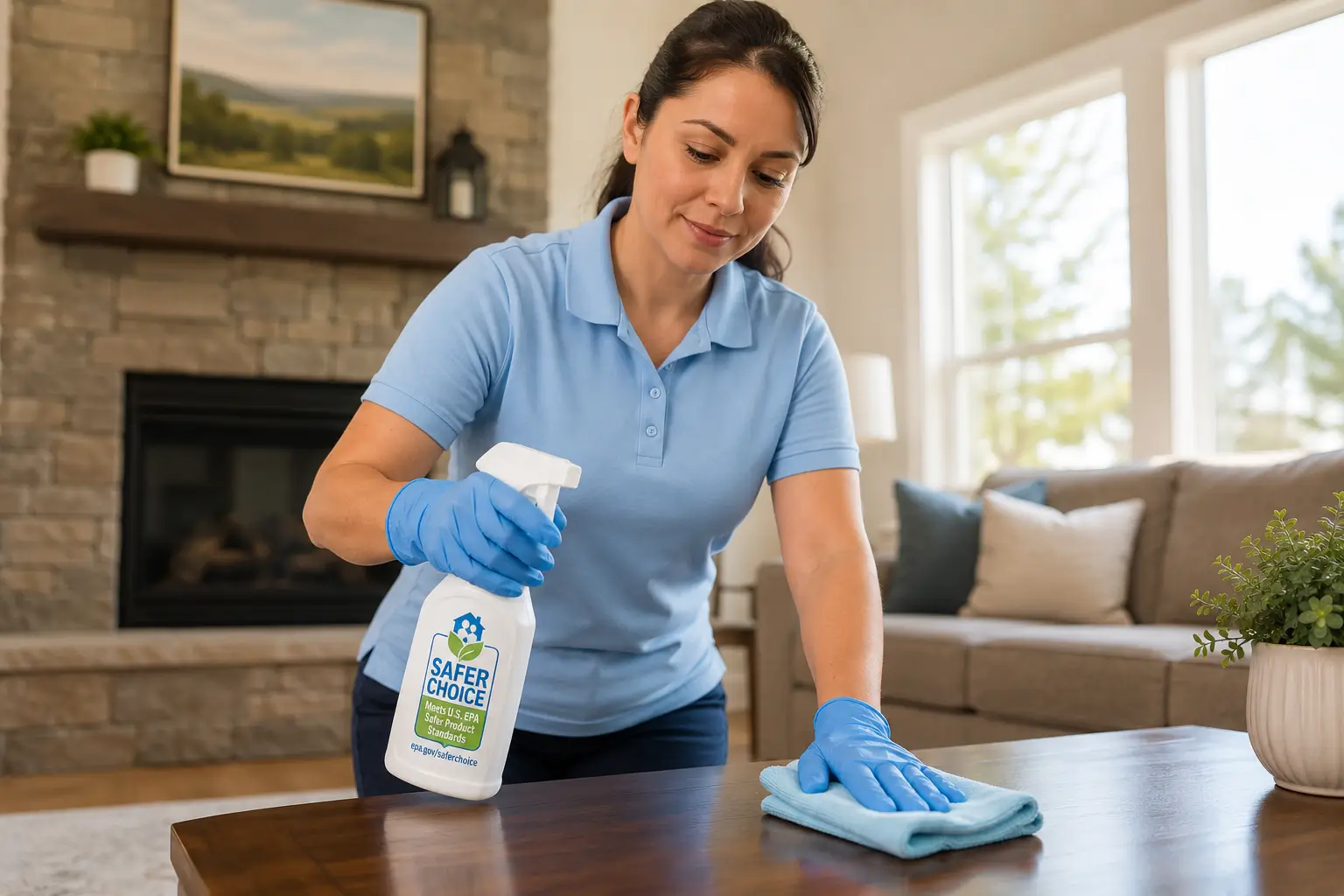
Castle Pines households using conventional products are often making indoor air worse with every cleaning visit. This guide explains how eco-friendly cleaning benefits indoor air quality, which ingredients cause the problem, and what a low-VOC protocol actually changes.
The Problem With Conventional Cleaning Products and Indoor Air
Most Castle Pines homes are cleaned regularly. Floors get mopped, bathrooms get scrubbed, counters get wiped. What most residents do not realize is that the products doing the cleaning are often the biggest source of indoor air pollution in the home after the visit is done.
Conventional cleaning products release volatile organic compounds into the air during and after use. These compounds include formaldehyde, ammonia, chlorine, and synthetic fragrance chemicals that linger in enclosed spaces for hours after the crew leaves. In a well-sealed Castle Pines home during winter, that lingering concentration can be significantly higher than outdoor air pollution levels.
According to the EPA’s guide on indoor air quality, indoor air can be two to five times more polluted than outdoor air, with cleaning products being a major contributor. Understanding how eco-friendly cleaning benefits indoor air quality is what makes the difference between a clean home and a healthy one.
How Eco-Friendly Cleaning Benefits Indoor Air Quality: The Four Mechanisms
The direct answer to how eco-friendly cleaning benefits indoor air quality comes down to four specific mechanisms, each of which removes or reduces a different category of indoor air pollutant.
The four mechanisms are:
- Eliminating VOC-releasing ingredients: plant-derived and certified formulations release fewer volatile compounds into the air during and after application.
- Removing synthetic fragrance: the single largest source of fragrance-related VOCs in conventional cleaning products.
- Reducing ammonia and chlorine exposure: two of the most irritating airborne compounds released by conventional bathroom and glass cleaners.
- Improving residue profiles: eco-friendly products leave fewer surface residues that off-gas over time between cleaning visits.
The rest of this guide walks through each mechanism, what it means for the air quality inside a Castle Pines home, and what to look for in a genuine eco-friendly cleaning protocol.
How Eco-Friendly Cleaning Benefits Indoor Air Quality Beyond the Visit Itself
The air quality benefit of eco-friendly cleaning is not limited to the hours immediately after the visit. Conventional cleaning product residues continue to off-gas from surfaces, fabrics, and grout between visits. A home cleaned with low-VOC, fragrance-free formulations produces a lower cumulative chemical load in the air over weeks and months than one cleaned with conventional products, even when the cleaning frequency is identical.
Eliminating VOC-Releasing Ingredients
Volatile organic compounds are the primary indoor air quality concern associated with conventional cleaning products. They evaporate at room temperature, become airborne, and are inhaled by everyone in the space during and after cleaning. The health effects range from eye and throat irritation for healthy adults to significant respiratory distress for children, elderly residents, and people with asthma or chemical sensitivities.
The EPA’s Safer Choice program certifies cleaning products that meet documented ingredient safety criteria, including limits on VOC content. Products carrying the Safer Choice label have been evaluated ingredient by ingredient, not just at the finished product level.
Common high-VOC ingredients in conventional cleaners to avoid:
- Glycol ethers: found in multi-surface sprays and glass cleaners. Associated with respiratory irritation.
- Perchloroethylene: found in some spot and fabric treatments. A known carcinogen at sustained exposure levels.
- Alkylphenol ethoxylates: found in conventional degreasers. Persist on surfaces and off-gas over time.
- Formaldehyde-releasing preservatives: found in some disinfectants and fabric treatments. Off-gas slowly between cleanings.
Eco-friendly alternatives use plant-derived surfactants, enzyme-based degreasers, and hydrogen peroxide-based disinfectants that break down into water and oxygen rather than lingering as airborne compounds.
Removing Synthetic Fragrance
Synthetic fragrance is the most significant single source of fragrance-related VOCs in conventional cleaning products. The word “fragrance” on an ingredient label can represent a blend of dozens of undisclosed chemical compounds, many of which are known respiratory irritants and some of which are classified as allergens.
In a Castle Pines home, every scented cleaning product applied to surfaces, floors, and bathrooms releases these compounds into the air. Residents with asthma, seasonal allergies, or migraine sensitivity typically experience symptom improvement when their home is switched to fragrance-free or essential-oil-only formulations.
Genuine eco-friendly cleaning protocols use:
- Fragrance-free certified products: verified by the EPA Safer Choice program, not just labeled unscented by the manufacturer.
- Essential oil-scented options: where fragrance is used, single-ingredient essential oils rather than synthetic fragrance blends.
- Unscented dish soap and laundry products: the two highest-use product categories in most homes where synthetic fragrance accumulates fastest.
For more on the specific eco-friendly products professional crews use in Castle Pines homes, see our guide on eco-friendly house cleaning service.
Reducing Ammonia and Chlorine Exposure
Ammonia and chlorine are two of the most common active ingredients in conventional bathroom cleaners, glass cleaners, and disinfectants. Both release airborne compounds that irritate the eyes, nose, throat, and lungs, particularly in bathrooms where ventilation is limited and concentrations build quickly.
Ammonia is the primary ingredient in most conventional glass cleaners. It is effective but releases vapors that linger in enclosed spaces and can trigger asthma symptoms at low concentrations. Chlorine bleach, used in toilet bowl cleaners and surface disinfectants, releases chloramine gases when it contacts organic matter, producing a sharp chemical odor and respiratory irritant load.
Eco-friendly replacements for these two categories:
- Glass cleaners: white vinegar-based or low-VOC certified formulations that produce streak-free results without ammonia off-gassing.
- Toilet bowl cleaners: citric acid-based or enzyme formulations that remove mineral deposits without chlorine gas release.
- Disinfectants: hydrogen peroxide-based products on EPA List N that break down into water and oxygen after the contact time, leaving no chemical residue.
Improving Surface Residue Profiles
Every cleaning product leaves a residue on the surfaces it touches. In conventional cleaning, those residues include surfactant films, fragrance compounds, and preservative chemicals that continue to off-gas at room temperature long after the cleaning visit is complete.
Eco-friendly products formulated under Safer Choice criteria use ingredients selected for lower environmental persistence, which means lower residue loads that off-gas for shorter periods. In practical terms, a home cleaned with low-residue eco-friendly products has a lower cumulative VOC load in the air on day 3 after a cleaning visit than an identical home cleaned with conventional products on the same schedule.
This benefit is especially meaningful for:
- Infants and toddlers who spend more time at floor level where residues concentrate.
- Pets who contact floor and low-surface residues directly through paws and grooming.
- Elderly residents whose respiratory systems are more sensitive to sustained low-level chemical exposure.
For more on how documented cleaning protocols protect residents across all these categories, see our guide on how residential cleaners maintain quality in Castle Pines.
What to Confirm With Any Eco-Friendly Cleaning Provider
Understanding how eco-friendly cleaning benefits indoor air quality is only useful if the provider a Castle Pines household hires is actually delivering a genuine low-VOC protocol. Three things to confirm before booking:
- EPA Safer Choice certification numbers: ask for the specific certification number for each product used by surface category. A provider that cannot supply these numbers is using marketing language, not verified green products.
- Fragrance-free or essential-oil-only formulations: confirm which products contain synthetic fragrance and which do not. A single fragranced product in the kit can undermine the air quality benefit of the rest.
- No ammonia or bleach-based products: confirm these two categories have been replaced with verified alternatives for glass and disinfection applications.
For more on what makes a genuine eco-friendly cleaning service, see our guide on what to expect from house cleaning in Castle Pines.
The Bottom Line: How Eco-Friendly Cleaning Benefits Indoor Air Quality
How eco-friendly cleaning benefits indoor air quality in Castle Pines comes down to four mechanisms: eliminating VOC-releasing ingredients, removing synthetic fragrance, replacing ammonia and chlorine with safer alternatives, and reducing the surface residue load that off-gases between visits. Castle Pines households that make this switch protect the air their family breathes every day, not just the day the crew visits.
How CR Maids Protects Indoor Air Quality in Castle Pines
CR Maids has served Castle Pines and Douglas County for over a decade, with the same dedicated background-checked crews servicing neighboring communities including Highlands Ranch and Lone Tree. Eco-friendly cleaning visits use EPA Safer Choice certified products by surface category, fragrance-free or essential-oil formulations, and no ammonia or chlorine-based products in any zone. Every quote is flat-rate and every visit is backed by a written satisfaction guarantee.
To build an eco-friendly cleaning schedule for your Castle Pines home, visit our eco-friendly house cleaning service page or book through our online booking system.
Frequently Asked Questions
1. How long do conventional cleaning product VOCs linger in a home?
VOCs from conventional cleaning products can remain elevated in indoor air for two to four hours after application in well-ventilated spaces and significantly longer in poorly ventilated areas like bathrooms and laundry rooms. In tightly sealed Castle Pines homes during winter, concentrations can persist through the day.
2. Are eco-friendly cleaning products as effective as conventional ones?
Yes, when chosen correctly. Enzyme-based degreasers break down organic matter as effectively as chemical degreasers. Hydrogen peroxide-based disinfectants on EPA List N kill the same pathogens as conventional disinfectants when applied at the correct dwell time. The key is confirming EPA Safer Choice certification alongside efficacy claims.
3. Can switching to eco-friendly cleaning reduce asthma symptoms?
For many residents, yes. Ammonia, synthetic fragrance, and chlorine compounds are known asthma triggers. Replacing these with certified low-VOC alternatives removes three of the most common indoor airborne irritants that cleaning introduces. Results vary by individual sensitivity and pre-existing conditions.
4. Does fragrance-free mean the product has no smell at all?
Not necessarily. Fragrance-free means no synthetic fragrance compounds have been added. Some fragrance-free products have a mild natural scent from their active ingredients. Unscented products have had masking agents added to cover ingredient odor, which can introduce additional compounds. Fragrance-free certified is the safer choice for air quality.
5. How do I know if my current cleaning service is using low-VOC products?
Ask for the EPA Safer Choice certification number of each product they use. If they cannot provide specific certification numbers, they are likely using conventional products marketed with green language rather than verified low-VOC formulations.
Key Takeaways
- VOC elimination: switching to EPA Safer Choice certified products removes the primary source of chemical air pollution introduced during a cleaning visit.
- Synthetic fragrance: the single largest source of fragrance-related VOCs in cleaning. Fragrance-free certified formulations remove this category entirely.
- Ammonia and chlorine: the two most common respiratory irritants in conventional glass and bathroom cleaners, replaced by hydrogen peroxide and citric acid-based alternatives in genuine eco-friendly protocols.
- Residue off-gassing: eco-friendly products with lower environmental persistence reduce the cumulative VOC load in the air between cleaning visits, not just on the day of the visit.
- Verification matters: EPA Safer Choice certification numbers are the only proof that a product meets documented air quality safety criteria. Marketing language without certification numbers is not a green cleaning protocol.

Karina Cohen is the owner of CR Maids, a local cleaning company serving the Greater Denver area. With a background as a global executive in fashion, software, retail, and financial services, she has led business strategy, mergers and acquisitions, and cross-cultural teams across the US, Europe, and Asia.
Karina holds a Global Executive MBA from Duke University’s Fuqua School of Business and a Bachelor of Science in Finance and Marketing from Fordham University. She brings this strategic expertise into CR Maids, where her mission goes beyond spotless homes—she is committed to empowering her team, creating financial security, and giving back to the community.
When she’s not leading CR Maids, Karina homeschools her daughter, serves on the board of Duke University Colorado, and supports initiatives that strengthen families and small businesses.