
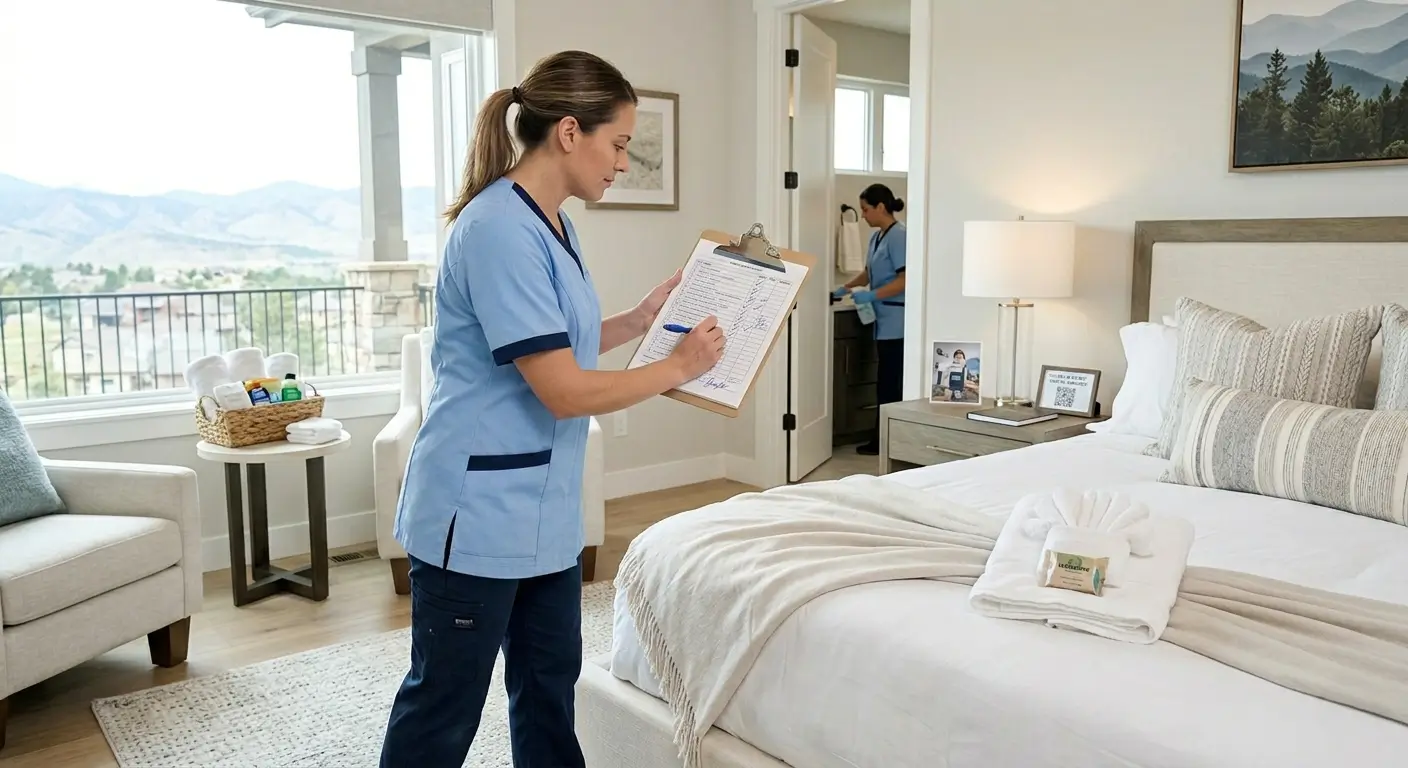
How guest-ready cleaning reduces complaints and refunds in Castle Pines comes down to closing the specific gaps that trigger each complaint category. Staging, disinfection, linen presentation, restocking, and damage documentation each close a different complaint channel before the guest opens the front door.
Why Cleanliness Complaints Cost More Than Hosts Expect
A cleanliness complaint on a short-term rental platform is not just a bad review. It is a refund request, a platform intervention, a drop in cleanliness score, and a reduction in listing visibility, all from a single guest interaction. Castle Pines hosts who track their complaint history almost always find the same pattern: 80 percent of cleanliness disputes trace back to three or four recurring gaps in the turnover protocol.
The answer to how guest-ready cleaning reduces complaints and refunds is not “clean more.” It is “close the right gaps in the right order.” The deeper context on how documented systems prevent these gaps is in our guide on how residential cleaners maintain quality in Castle Pines.
How Guest-Ready Cleaning Reduces Complaints and Refunds: The Six Gap-Closers
The direct answer to how guest-ready cleaning reduces complaints and refunds comes down to six documented standards, each of which closes a specific complaint channel.
The six gap-closers are:
- Listing-photo staging: closes the “not as described” complaint.
- Disinfection with dwell time: closes the “property felt dirty or unhygienic” complaint.
- Hotel-style linen presentation: closes the “linens were not fresh” complaint.
- Restocking to defined par levels: closes the “not fully stocked” complaint.
- Damage documentation: closes the “previous guest damage” dispute.
- Surface-specific cleaning: closes the “surfaces were sticky or scratched” complaint.
How Guest-Ready Cleaning Reduces Complaints and Refunds in Practice
Hosts who see the sharpest drop in complaints after switching to a guest-ready protocol are almost always missing two or three of the six gap-closers, not all six. Closing all six requires a documented checklist, not a more motivated crew.
Gap 1: Staging Closes the “Not as Described” Complaint
The “not as described” complaint is the most common cleanliness dispute, and it is almost never about dirt. It is about drift between the listing photos and what the guest found. A missing throw pillow, a couch angled differently, a bathroom without the branded toiletries shown in the carousel, generates a dispute without a single surface being visibly dirty.
Listing-photo staging closes this channel by resetting every room to the exact booking photos:
- Bedrooms: throw pillows arranged to match the listing shot, bed runner centered, nightstand items in position.
- Living areas: couch cushions fluffed, remotes in the right spots, decor matching the carousel.
- Kitchen: counters clear except for staged items, coffee station set to listing-photo standard.
- Bathrooms: towels folded hotel-style, toiletries arranged as shown, toilet lid down.
Gap 2: Dwell-Time Disinfection Closes the Hygiene Complaint
The “property felt dirty or unhygienic” complaint most frequently traces to improper disinfection. A surface can look clean and still carry pathogens from the previous guest if the disinfectant was wiped immediately rather than allowed to dwell.
According to the CDC’s home cleaning and disinfection guidance, disinfectants must stay wet on surfaces for the contact time on the label, typically 30 seconds to 10 minutes, to kill pathogens. Trained crews spray faucet handles, light switches, remote controls, appliance buttons, and toilet fixtures first, then work elsewhere while dwell time runs.
Gap 3: Hotel-Style Linen Presentation Closes the Linen Complaint
The “linens were not fresh” complaint is entirely preventable with inventory linen swap and hotel-style presentation. A wrinkled duvet, an uneven pillow arrangement, or a towel that clearly was not freshly laundered is enough to trigger it.
Hotel-style preparation includes a full strip of used linens, inventory swap with pre-laundered sets, hospital corner bed-making, a centered and smoothed duvet, and bathroom towels folded to match the listing photo. For more on the linen systems that support this standard, see our guide on same-day vacation rental cleaning in Castle Pines.
Gap 4: Par-Level Restocking Closes the Stocking Complaint
The “not fully stocked” complaint costs more than it looks. Platforms treat consistent stocking failures as a hosting quality issue, not a one-off oversight, and Superhost status goes with it.
Closing this channel requires defined par levels for every consumable:
- Toilet paper: 2 rolls per bathroom, plus 1 spare under each sink.
- Hand soap: full dispenser at every sink.
- Coffee, tea, sugar, creamer: stocked to the host’s branded amount.
- Paper towels: 1 full roll mounted, 2 spares in pantry.
- Trash bags: 5 spares in each bin.
Without defined par levels, restocking is guesswork. For more on how pricing covers restocking scope, see our guide on residential cleaning prices in Castle Pines.
Gap 5: Damage Documentation Closes the Dispute Channel
Damage disputes are almost always won or lost on evidence timing. The Airbnb AirCover damage reporting policy requires evidence submitted before the next guest checks in. A turnover crew that documents damage with timestamped photos at the end of every visit gives the host the evidence to file within the window.
The damage walkthrough covers three categories: items missing, items damaged, and items needing maintenance. Hosts who skip this step discover the cost when a guest files a complaint about damage left by the previous guest and there is no evidence to dispute it.
Gap 6: Surface-Specific Cleaning Closes the Finish Complaint
The “surfaces were scratched or sticky” complaint shows up most often in Castle Pines because the housing stock leans toward premium finishes that punish generic cleaners:
- Stone surfaces: pH-neutral cleaners only. Acidic products etch marble and granite.
- Engineered hardwood: dry or barely damp microfiber only. Wet mopping warps planks.
- Quartz counters: non-abrasive cloths and pH-neutral products to prevent dulling.
- Stainless appliances: wiped with the grain using dedicated stainless cleaner.
For more on the specific products used, see our guide on home disinfecting service products in Castle Pines.
How CR Maids Closes All Six Complaint Channels in Castle Pines
CR Maids has served Castle Pines and Douglas County for over a decade, with background-checked dedicated crews servicing neighboring communities including Highlands Ranch and Lone Tree. Every turnover follows a documented checklist with staging reference photos, every quote is flat-rate, and every visit is backed by a written satisfaction guarantee.
For back-to-back same-day turns during peak season, the team supports inventory linen swap, smart-lock access, and same-day damage reporting with photos sent before the next guest checks in. To see the full vacation rental service, visit our vacation rental cleaning page.
The Bottom Line on How Guest-Ready Cleaning Reduces Complaints and Refunds
How guest-ready cleaning reduces complaints and refunds is not about cleaning harder. It is about closing six specific gaps: staging closes the “not as described” dispute, dwell-time disinfection closes the hygiene complaint, hotel-style linens close the linen complaint, par-level restocking closes the stocking complaint, damage documentation closes the dispute channel, and surface-specific cleaning closes the finish complaint. Hosts who close all six see complaint rates drop within the first booking cycle.
Book Your Guest-Ready Turnover With CR Maids
Ready to close all six complaint channels on every visit? Schedule your first turnover through our online booking system or call 720-713-1920 to walk through your property standards with the office.
Frequently Asked Questions
1. What is the most common cleanliness complaint in Castle Pines vacation rentals?
The “not as described” complaint, which traces to drift between the listing photos and what the guest found. Staging to the exact listing-photo standard closes this channel without any additional cleaning.
2. How does damage documentation prevent refund disputes?
Timestamped photos taken at the end of every turnover and sent before the next check-in give the host evidence to dispute claims that damage was left by the current guest. Without timestamps, the dispute resolves in the guest’s favor.
3. Can a refund request be prevented with better cleaning alone?
Not entirely. Most refund requests trace to one of six specific gaps. Better cleaning addresses one or two. Closing all six requires staging, dwell-time disinfection, linen swap, restocking standards, damage documentation, and surface-specific products.
4. How often do stocking complaints lead to refunds?
Often enough to cost Superhost status. Platforms treat consistent stocking failures as a hosting quality issue. Defined par levels for every consumable prevent the complaint from appearing.
5. What happens if a complaint is filed despite a guest-ready turnover?
CR Maids offers a satisfaction guarantee that includes a free re-clean within 24 hours if something was missed. Flag the concern through the office and the crew will return at no cost.
Key Takeaways
- Staging: closes the “not as described” complaint by resetting every room to the exact listing-photo standard.
- Dwell-time disinfection: closes the hygiene complaint by ensuring disinfectants kill pathogens rather than just looking clean.
- Hotel-style linen swap: closes the linen complaint by removing laundering from the turnover clock.
- Par-level restocking: closes the stocking complaint by replacing guesswork with defined, documented quantities.
- Damage documentation: closes the dispute channel with timestamped evidence before the next guest arrives.
- Surface-specific cleaning: closes the finish complaint by matching the product to the surface.
Karina Cohen is the owner of CR Maids, a local cleaning company serving the Greater Denver area. With a background as a global executive in fashion, software, retail, and financial services, she has led business strategy, mergers and acquisitions, and cross-cultural teams across the US, Europe, and Asia.
Karina holds a Global Executive MBA from Duke University’s Fuqua School of Business and a Bachelor of Science in Finance and Marketing from Fordham University. She brings this strategic expertise into CR Maids, where her mission goes beyond spotless homes—she is committed to empowering her team, creating financial security, and giving back to the community.
When she’s not leading CR Maids, Karina homeschools her daughter, serves on the board of Duke University Colorado, and supports initiatives that strengthen families and small businesses.