
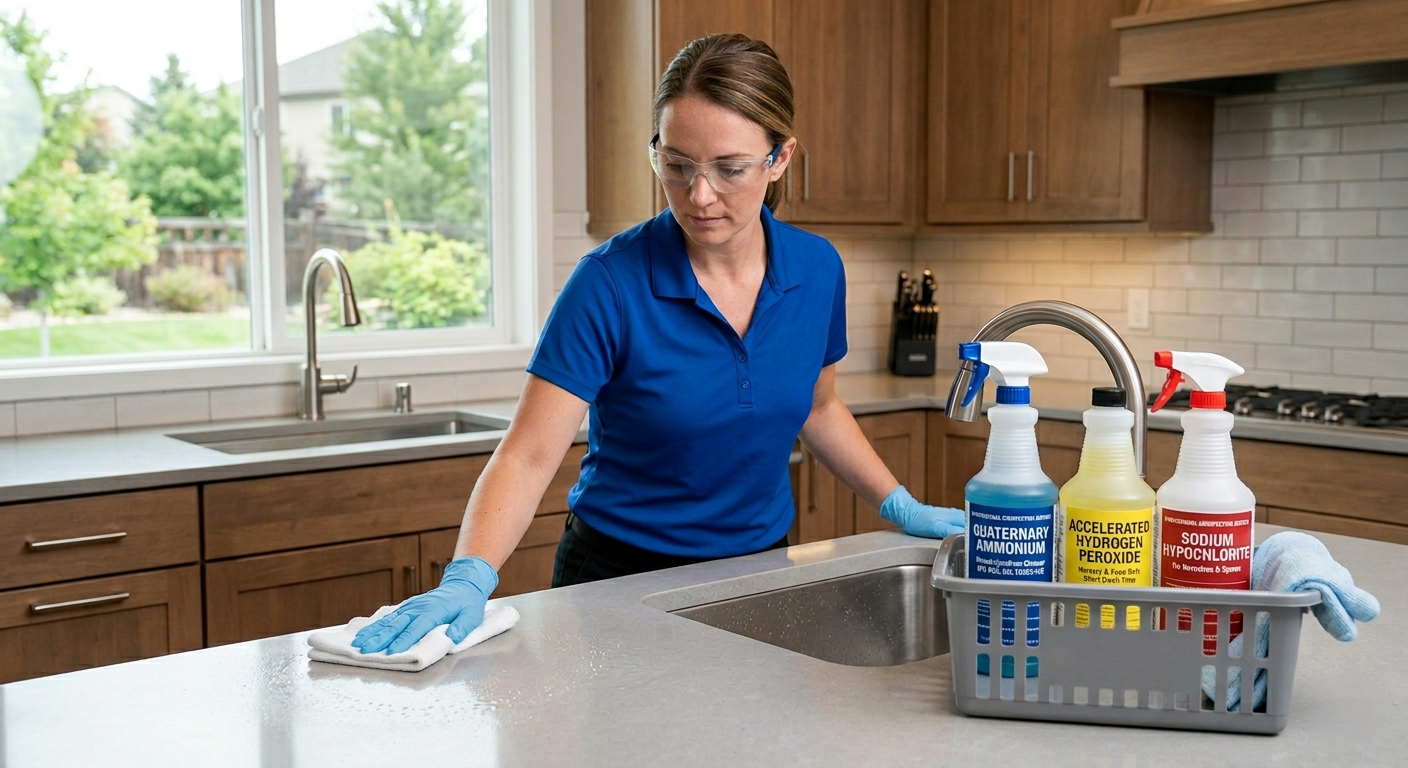
Most professional home disinfecting service products in Castle Pines come from five EPA-registered chemistries: quats, hydrogen peroxide, bleach, alcohol, and plant-derived acids. This guide shows what each one does, where it belongs, and how to spot a service that uses them correctly.
Home Disinfecting Service Products: What to Know
Understanding what professionals actually use helps you make informed decisions about what gets applied to your counters, floors, and nursery furniture. Most professional disinfection services do not advertise their product list, not out of secrecy, but because the average client rarely asks. That leaves families making blind decisions.
By the end of this guide, you will know exactly which disinfectants belong in your home, how each active ingredient works, which surfaces they are matched to, and the questions that separate a trustworthy service from a generic one.
The Five Active Ingredient Categories
Professional disinfection in Castle Pines relies on five main categories of EPA-registered active ingredients: quaternary ammonium compounds (quats), hydrogen peroxide and accelerated hydrogen peroxide, sodium hypochlorite (bleach), alcohol-based products, and plant-derived acids like citric and lactic acid. Most reputable services keep two or three of these on hand and select the right one based on the surface, the pathogen, and the household profile.
No single disinfectant is best for every job. A product that kills norovirus on a stone countertop may be the wrong choice for a home with cats. A product gentle enough for a nursery may not kill the fungal spores left behind in a flooded basement. The skill in professional disinfection is not applying one universal product, it is matching the right chemistry to the situation. The rest of this guide walks through each category and the decisions that surround them.
How the EPA Regulates Disinfectants
Every disinfectant sold in the United States is regulated by the Environmental Protection Agency as an antimicrobial pesticide. This means the product has passed standardized laboratory testing against the specific pathogens it claims to kill, at the concentration on the label, for the dwell time on the label. Cleaning products face no equivalent efficacy testing.
Two pieces of EPA infrastructure matter most for residential work. The first is the product registration number, which appears on every label in the format EPA Reg. No. and confirms the product has been reviewed and approved. The second is List N, a public database maintained by the EPA that identifies products proven effective against emerging viral pathogens including SARS-CoV-2, influenza, and norovirus.
When a professional service uses a product, the label active ingredient, concentration, dwell time, and EPA registration number are the four data points that define what the product can actually do. Everything else, including the scent, the packaging, and the marketing, is secondary.
Quaternary Ammonium Compounds (Quats)
Quats are among the most common professional disinfectants in residential service. They are broad-spectrum, effective against bacteria and enveloped viruses including influenza and coronaviruses, and relatively stable at room temperature. They work by disrupting the cell membranes of microorganisms, causing the cell to break down.
Common active ingredients include benzalkonium chloride, alkyl dimethyl benzyl ammonium chloride, and didecyldimethylammonium chloride. Products like Virex II 256 and similar professional-grade quat formulations dominate commercial and residential service kits.
- Where quats work best: hard non-porous surfaces in kitchens and bathrooms, floors, and high-touch surfaces that need a residual antimicrobial effect. Typical dwell times run three to ten minutes.
- Where quats are the wrong choice: homes with pet birds, which are highly sensitive to airborne quat residue, and homes with cats if residue is not wiped or rinsed after application.
Quats can also irritate respiratory passages during application, so ventilation matters. For these households, professional services typically substitute hydrogen peroxide or eco-friendly, citric acid-based alternatives.
Hydrogen Peroxide and Accelerated Hydrogen Peroxide
Hydrogen peroxide is one of the safer-profile chemistries in widespread professional use. It breaks down into water and oxygen after doing its job, with no toxic residue, no lingering chemical smell, and no surface buildup. It works by oxidizing the cell components of bacteria, viruses, and fungi.
Standard hydrogen peroxide at 0.5% to 3% concentration is effective against most household pathogens but typically requires five to ten minute dwell times. Accelerated hydrogen peroxide (AHP) combines hydrogen peroxide with surfactants and stabilizers to reduce dwell time to as little as 30 seconds while maintaining the low-toxicity profile. Products like Oxivir and Peroxigard use this technology.
- Where hydrogen peroxide works best: nurseries, kitchens, homes with cats or birds, post-illness disinfection, and any surface where residue is a concern. Many products in this category appear on the EPA’s Safer Choice list.
- Where hydrogen peroxide requires care: natural stone surfaces like unsealed marble or granite can etch slightly with prolonged contact, and fabric can bleach at higher concentrations.
Professional services match the formulation strength to the surface, using 0.5% AHP for routine work and 3% hydrogen peroxide for tougher contamination.
Sodium Hypochlorite (Bleach)
Bleach is the most powerful product in the professional toolkit. Sodium hypochlorite destroys proteins and nucleic acids in microorganisms, which means it kills essentially every bacteria, virus, fungus, and spore it encounters at the correct concentration.
The CDC recommends a dilution of one-third cup of household bleach per gallon of water for most disinfection purposes, with a contact time of one minute. Bleach at the right concentration, for the right dwell time, is unmatched against tough contamination like norovirus, C. difficile spores, and black mold. Bleach-grade applications are typically reserved for deep cleaning visits rather than routine maintenance.
- Where bleach works best: bathroom fixtures including toilets, shower grout, and tile; laundry room surfaces; post-flood disinfection; and any scenario involving resistant pathogens.
- Where bleach is the wrong choice: natural stone (etches), wood (discolors and degrades), metal (corrodes over time), colored fabric, and near electronics.
Bleach should never be mixed with ammonia or vinegar. In homes with pets, bleach should be fully rinsed after the dwell time completes because residue on floors and paws is an ingestion risk.
Alcohol-Based Disinfectants
Among home disinfecting service products, alcohol-based disinfectants are the fastest-acting category for specific surface types. Isopropyl alcohol and ethanol at 60% to 90% concentration are effective and leave no residue because they evaporate completely. They work by denaturing the proteins in bacteria and enveloped viruses. Dwell times are short, typically 30 seconds to two minutes, because the alcohol is active only while wet.
- Where alcohol works best: phones, tablets, remote controls, keyboards, light switch plates, stainless steel appliances, and glass surfaces. It is the default choice for electronics and high-touch controls in a modern home.
- Where alcohol falls short: porous surfaces where it evaporates before penetrating, fabric upholstery, and against non-enveloped viruses like norovirus.
Alcohol is also flammable and applied with care near gas appliances. It works best as the specialty product for specific surface categories within a broader protocol.
Plant-Derived Acids: Citric and Lactic Acid
The newest category to gain traction in this space is plant-derived acids. Citric acid, lactic acid, and thymol (extracted from thyme) are registered as disinfectants against specific bacteria and viruses, and carry some of the lowest toxicity profiles of any EPA-registered chemistry.
Products like Seventh Generation Disinfecting Multi-Surface Cleaner (thymol-based) appear on EPA List N for certain pathogens. Lactic acid-based products from manufacturers like Spartan Chemical are also registered disinfectants with broad residential applications.
- Where plant-derived acids work best: homes with infants, pregnant residents, multiple pets, and households prioritizing low-toxicity product choices. Residue concerns are minimal and these products are often Safer Choice-certified.
Where plant-derived acids fall short: dwell times tend to be longer at five to ten minutes, and pathogen coverage is narrower than quats or bleach. They are effective against common bacteria and enveloped viruses but may not cover norovirus, C. difficile, or certain fungal spores.
How Pros Select Home Disinfecting Service Products by Surface
A reputable Castle Pines service does not apply one disinfectant across the entire home. Product selection happens at the surface level based on four factors: what the surface is made of, what pathogens are most likely present, what the household profile requires, and what the EPA label authorizes.
A standard disinfection visit for a healthy Castle Pines home looks like this in practice:
- Bathroom fixtures and tile: sodium hypochlorite at CDC-recommended dilution, with full rinse after dwell time.
- Kitchen counters and high-touch surfaces: accelerated hydrogen peroxide or quat-based product depending on surface material.
- Electronics (remote controls, phones, tablets): 70% isopropyl alcohol on a microfiber cloth, never sprayed directly.
- Nursery or child play areas: accelerated hydrogen peroxide or plant-derived acid, rinsed with water after dwell time.
- Pet food stations and crate interiors: plant-derived acid or dilute hydrogen peroxide, fully rinsed.
- Floors: quat-based floor disinfectant or hydrogen peroxide depending on floor material and household.
The same surface-by-surface approach applies in neighboring service areas like Highlands Ranch, where household profiles and home layouts often closely match those in Castle Pines.
Choosing the Right Disinfecting Service in Castle Pines
The right products only matter if the service applying them knows when and where each one belongs. When you evaluate a provider, ask three questions: which EPA-registered products do you use, how do you decide which one to apply on which surface, and how do you adjust for households with pets, infants, or sensitive residents. A service that can answer all three clearly is one worth hiring. If you are in Castle Pines and want disinfection done by a team that selects products based on your home, your household, and the pathogens that actually need addressing, book a disinfection service today.
Frequently Asked Questions
1. What is the safest disinfectant for a home with infants or pregnant residents?
Plant-derived acids and accelerated hydrogen peroxide are the safest options. Both leave minimal residue and many products are EPA Safer Choice-certified.
2. Can I use the same disinfectant on stone counters that I use in the bathroom?
No. Bleach and prolonged-contact hydrogen peroxide can etch unsealed marble or granite. For stone counters, professionals use a quat-based product or AHP at routine concentrations.
3. Are plant-derived disinfectants as effective as bleach?
Not for every pathogen. Plant-derived acids work well against common bacteria and enveloped viruses but typically do not cover norovirus, C. difficile spores, or stubborn fungal contamination.
4. What questions should I ask a Castle Pines disinfection service before booking?
Ask which EPA-registered products they use, how they choose products based on surface and household, and whether they adjust for pets or sensitive residents.
5. How do I know if a product is actually EPA-registered?
Every legitimate disinfectant carries an EPA Reg. No. on the label. You can verify it on the EPA’s pesticide product label system and check List N for viral pathogen coverage.
Key Takeaways
- Quats are the workhorse for hard non-porous surfaces, but avoid them in homes with birds or cats unless rinsed.
- Hydrogen peroxide and AHP are the safest broad-use option, ideal for nurseries, kitchens, and pet-friendly homes.
- Bleach is unmatched for resistant pathogens like norovirus and mold, but never use it on stone, wood, or metal.
- Alcohol is the right specialty product for electronics and high-touch controls, with short dwell time and no residue.
- Plant-derived acids suit households prioritizing low toxicity, with the trade-off of longer dwell times and narrower pathogen coverage.

Karina Cohen is the owner of CR Maids, a local cleaning company serving the Greater Denver area. With a background as a global executive in fashion, software, retail, and financial services, she has led business strategy, mergers and acquisitions, and cross-cultural teams across the US, Europe, and Asia.
Karina holds a Global Executive MBA from Duke University’s Fuqua School of Business and a Bachelor of Science in Finance and Marketing from Fordham University. She brings this strategic expertise into CR Maids, where her mission goes beyond spotless homes—she is committed to empowering her team, creating financial security, and giving back to the community.
When she’s not leading CR Maids, Karina homeschools her daughter, serves on the board of Duke University Colorado, and supports initiatives that strengthen families and small businesses.