
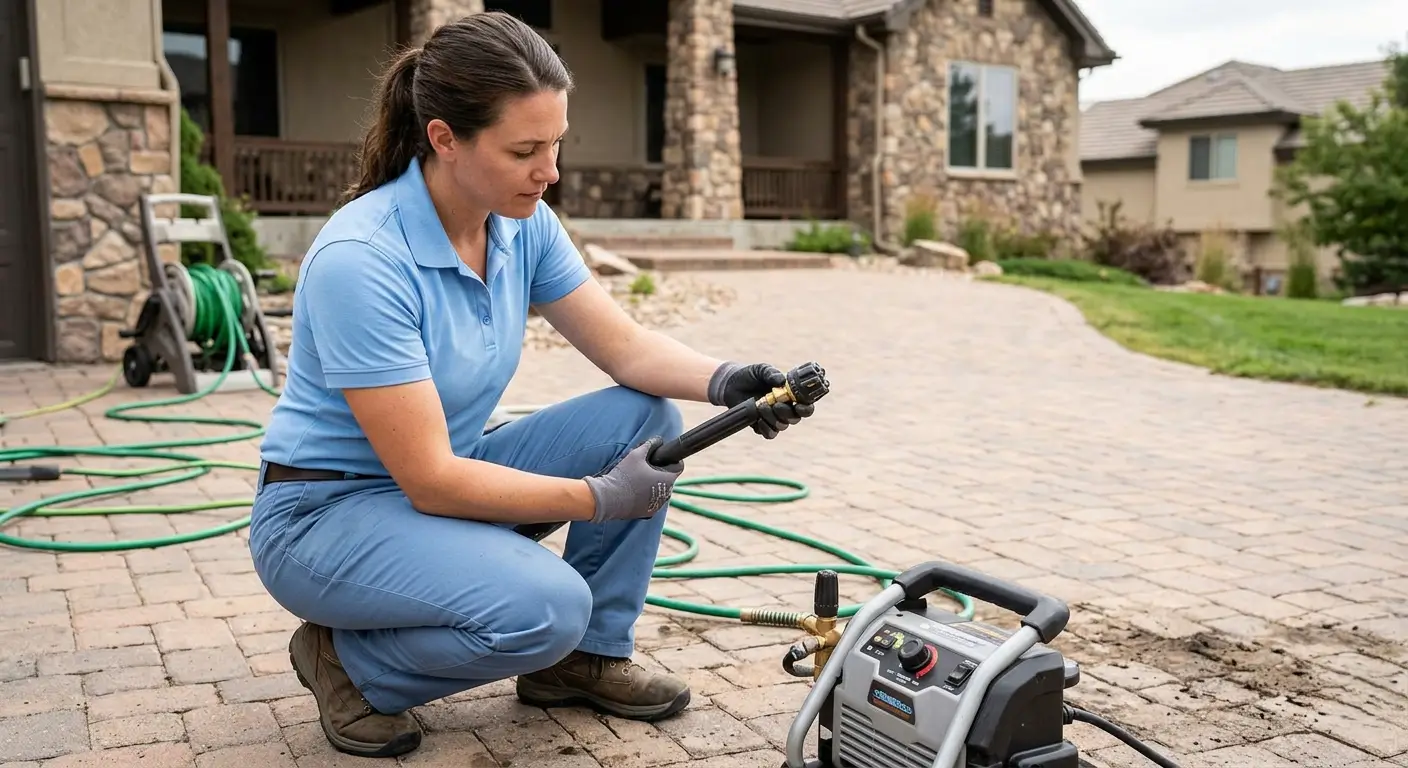
Most Castle Pines homeowners book power washing without knowing why settings differ by surface. Getting clean results without damage means understanding what pressure, heat, and nozzle control actually do. This page explains how does power washing work in Castle Pines, what each surface requires, and what to confirm before booking.
How Power Washing Works at the Mechanical Level
Power washing forces water through a narrow nozzle at high pressure, typically between 1,500 and 4,000 PSI depending on the surface, creating a concentrated stream that physically dislodges contaminants from concrete, wood, siding, and pavers.
The power washing service relies on three forces working together:
- Pressure: The PSI rating determines how forcefully water strikes the surface. Higher PSI breaks through harder deposits like mineral scale and embedded grime.
- Flow rate: Measured in gallons per minute (GPM), this determines how much water flushes the loosened debris away after impact.
- Heat: Hot water power washing, also called steam cleaning, raises water temperature to 180–200°F, which dissolves grease and oil bonds that cold water alone cannot break.
The combination of these three forces is what separates professional power washing from a standard garden hose, which delivers water at roughly 40–70 PSI, far below the threshold needed to remove mold, algae, and calcium deposits.
The Role of Nozzle Angle and Distance
Nozzle selection controls the spray angle and concentration of the water stream. A 0-degree nozzle produces a pinpoint stream for stubborn stains on concrete. A 40-degree nozzle produces a wide fan for rinsing large surface areas without damage.
Distance matters as much as angle:
- Too close: Surface damage, etching on concrete, splintering on wood, torn siding seams.
- Too far: Insufficient pressure to break the contaminant bond, leaving streaks and residue.
- Correct distance: Varies by surface and nozzle, professionals adjust both variables in real time based on surface response.
This is the primary reason DIY power washing with rented equipment frequently causes damage. Rental units often lack variable pressure controls, and the operator has no reference for the correct distance-to-surface combination for each material type.
What Power Washing Removes in Castle Pines
Castle Pines homes face specific contamination patterns driven by local conditions. Understanding what power washing does for your home starts with knowing what it is actually removing:
- Algae and mold: The Front Range humidity cycle encourages algae growth on north-facing surfaces and shaded driveways. Power washing breaks the root attachment point.
- Pine sap deposits: Ponderosa pine sap bonds to concrete and pavers when UV heat activates it. The heat element in power washing softens the sap before the pressure stream strips it.
- Calcium and mineral scale: Hard water from irrigation systems leaves white mineral deposits on pavers, walkways, and pool surrounds. High-temperature water dissolves the calcium carbonate before flushing it clear.
- Oil and grease: Vehicle fluids embedded in driveway concrete require heat above 140°F to break the hydrocarbon bond, cold water pressure alone will not remove them fully.
- General dirt and debris: Wind-carried dust, organic debris, and surface grime that accumulates on patios, sidewalks, and driveways through the season.
Surface-Specific Pressure Settings
Not every surface in a Castle Pines home tolerates the same PSI. A professional technician adjusts settings for each surface type before starting:
- Concrete driveways and walkways: 2,500–3,500 PSI, durable enough for high pressure, requires correct nozzle angle to avoid surface etching.
- Wood decking: 500–1,200 PSI, low pressure only. High PSI raises wood grain and causes splintering on older boards.
- Composite decking: 1,500 PSI maximum, manufacturer warranties often void above this threshold.
- Brick and pavers: 1,500–2,000 PSI, enough to clean mortar joints without dislodging them.
- Vinyl siding: 1,300–1,600 PSI, sufficient to remove algae without forcing water behind panels.
- Windows: 1,000–1,500 PSI with a wide-angle nozzle, higher PSI risks seal damage and frame cracking.
The fence power washing process uses a different setting again depending on whether the material is cedar, pressure-treated pine, or vinyl.
Pre-Treatment and the Cleaning Sequence
How does power washing work when the contamination is embedded? Pre-treatment is applied before the pressure stream to chemically loosen what pressure alone cannot remove.
The standard cleaning sequence for Castle Pines residential jobs:
- Pre-treatment application: A biodegradable cleaning solution is applied to the surface and allowed to dwell for five to ten minutes. The solution breaks the chemical bond between the contaminant and the surface material.
- Low-pressure rinse: A wide-angle, low-pressure pass removes the loosened surface layer and excess cleaning solution before the main wash.
- High-pressure wash: The primary pass at the appropriate PSI for the material type removes embedded contaminants using the correct nozzle angle and working distance.
- Final rinse: A clean water rinse at low pressure flushes residue and confirms no streaking or cleaning solution remains on the surface.
Skipping pre-treatment on heavily soiled surfaces, such as a Castle Pines driveway with two seasons of pine sap and oil deposits, results in incomplete cleaning and often requires a second pass.
How Power Washing Differs From Pressure Washing
The terms are used interchangeably in most contexts, but there is a mechanical difference: power washing uses heated water, while pressure washing uses unheated water at high PSI.
For most Castle Pines residential surfaces, the heat element in power washing produces better results on grease, oil, and biological growth. Cold pressure washing is adequate for general dirt and debris on durable surfaces. Professional technicians carry equipment capable of both and select the appropriate method based on surface type and contamination level.
The EPA’s WaterSense guidance on outdoor water use confirms that heated water systems use less total water to achieve the same cleaning result compared to cold pressure washing, an important consideration for Castle Pines properties under Front Range water-use guidelines.
What How Does Power Washing Work Means for Scheduling in Castle Pines
Understanding how power washing works makes it easier to schedule the service at the right point in the season. Castle Pines properties benefit most from power washing in two windows:
- Late spring: After pollen season and before summer heat activates pine sap and algae growth cycles.
- Early fall: Before the first freeze, which locks contaminants into surface pores and makes spring cleaning significantly harder.
The OSHA surface maintenance standards apply to commercial properties cleaned by professional crews, a relevant consideration for CR Maids clients who schedule both residential and commercial surface cleaning.
CR Maids serves Castle Pines and the surrounding communities including Highlands Ranch and Parker. Every power washing visit uses surface-appropriate pressure settings, pre-treatment where required, and a final rinse pass to confirm clean results before the crew leaves the property. Book through the CR Maids booking page to schedule a power washing visit.
How Does Power Washing Work When It Delivers Results Worth Confirming Before Every Visit
How does power washing work comes down to pressure, heat, flow rate, and nozzle control working together. The mechanical process is consistent, what changes is the surface material, the contamination type, and the operator’s ability to match settings to the job. For Castle Pines homeowners, the difference between a clean driveway and a damaged one is the same variable: whether the technician adjusted the settings correctly for each surface before starting.
Schedule Your Power Washing Visit
CR Maids provides professional power washing across Castle Pines and the Denver metro area. Every visit includes surface assessment, pre-treatment where needed, and a final rinse confirmation. Book your visit through the CR Maids website.
Frequently Asked Questions
1. How does power washing work on concrete driveways?
Power washing uses 2,500–3,500 PSI combined with pre-treatment solution to break contaminant bonds and flush debris from concrete pores, restoring the surface without etching or discoloration.
2. Is power washing safe for Castle Pines wood decking?
Yes, when set to 500–1,200 PSI with a wide-angle nozzle and correct working distance, high PSI above this range raises wood grain and causes splintering.
3. What is the difference between power washing and pressure washing?
Power washing uses heated water to dissolve grease and biological growth; pressure washing uses unheated water at high PSI, which is adequate for general dirt but less effective on oil and mold.
4. How often should Castle Pines homeowners schedule power washing?
Twice per year, late spring after pollen season and early fall before the first freeze, produces the best results for most Castle Pines driveways, patios, and walkways.
5. Does pre-treatment damage plants or landscaping near the cleaning area?
Professional-grade biodegradable pre-treatment solutions are formulated to rinse clear without harming grass, shrubs, or garden beds adjacent to the work area.
Key Takeaways
- Pressure + heat + flow rate: The three mechanical forces that determine how power washing works on any surface.
- PSI varies by material: Concrete tolerates 2,500–3,500 PSI; wood decking requires 500–1,200 PSI to avoid damage.
- Pre-treatment is required: Embedded pine sap, oil, and calcium deposits need chemical loosening before the pressure stream can remove them fully.
- Power washing vs pressure washing: Heat is the key difference, power washing outperforms cold pressure washing on grease, oil, and biological growth.
- Seasonal scheduling: Late spring and early fall are the optimal windows for Castle Pines residential power washing.

Karina Cohen is the owner of CR Maids, a local cleaning company serving the Greater Denver area. With a background as a global executive in fashion, software, retail, and financial services, she has led business strategy, mergers and acquisitions, and cross-cultural teams across the US, Europe, and Asia.
Karina holds a Global Executive MBA from Duke University’s Fuqua School of Business and a Bachelor of Science in Finance and Marketing from Fordham University. She brings this strategic expertise into CR Maids, where her mission goes beyond spotless homes—she is committed to empowering her team, creating financial security, and giving back to the community.
When she’s not leading CR Maids, Karina homeschools her daughter, serves on the board of Duke University Colorado, and supports initiatives that strengthen families and small businesses.