
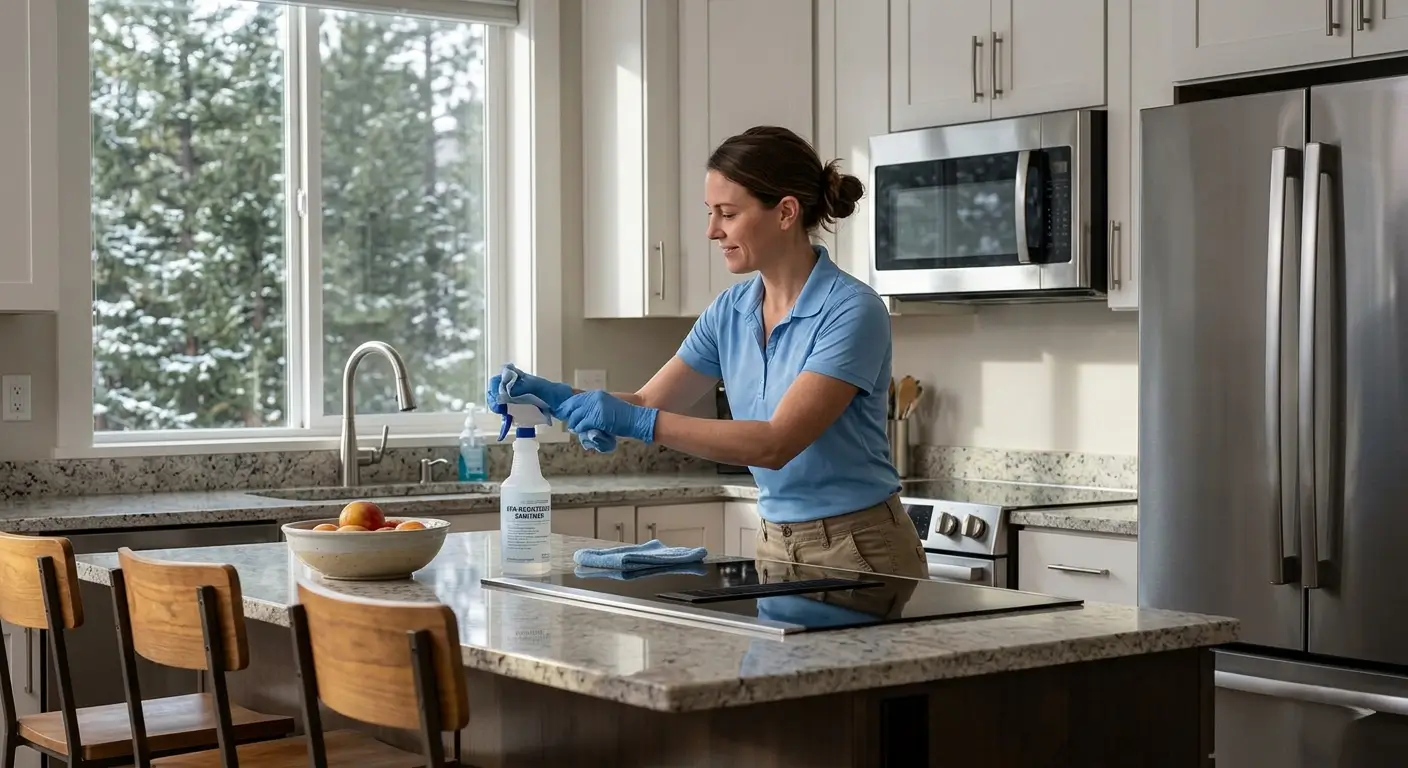
How kitchens are sanitized during vacation rental cleaning in Castle Pines covers more than countertops and appliances. Faucet handles, appliance controls, cabinet pulls, refrigerator handles, and the trash can are the highest-contact surfaces in the kitchen and the ones most frequently missed in a standard turnover.
Why the Kitchen Is the Second-Highest Sanitization Priority
Most Castle Pines vacation rental hosts think of the bathroom as the sanitization priority. The kitchen is a close second, and in some ways a more difficult room to sanitize correctly because the surfaces guests contact most are not the ones that look the dirtiest.
A clean kitchen counter and a sanitized kitchen counter are not the same thing. A crew that wipes the counter with a general cleaner has removed visible debris. A crew that applies an EPA-registered disinfectant to the counter at the correct dwell time has killed the pathogens that survived the wipe. The difference is invisible and decisive for guest health.
The other complication is surface variety. A Castle Pines vacation rental kitchen typically contains stone or quartz counters, stainless appliances, engineered hardwood or tile floors, and a mix of electronic and mechanical controls. Each surface category needs a different product and technique. A crew using one all-purpose cleaner across the entire kitchen is not sanitizing correctly regardless of dwell time.
The deeper context on how documented protocols drive consistent results is in our guide on how residential cleaners maintain quality in Castle Pines.
How Kitchens Are Sanitized During Vacation Rental Cleaning: The Eight Target Surfaces
The complete answer to how kitchens are sanitized during vacation rental cleaning covers eight specific surfaces, each with its own contamination risk and sanitization requirement.
The eight kitchen surfaces are:
- Faucet handle: the most-touched surface in the kitchen, every visit.
- Countertops: full surface area with surface-appropriate disinfectant.
- Appliance controls: microwave, oven, coffee maker, dishwasher panel.
- Cabinet and drawer pulls: every one in the active cooking zone.
- Refrigerator handle: exterior and any interior shelf edges guests frequently use.
- Sink basin and drain area: particularly the areas guests touch while washing hands.
- Light switch: touched on every kitchen entry and exit.
- Trash can lid or foot pedal: touched on every disposal.
The rest of this guide walks through each surface, what contamination risk it carries, and how trained crews sanitize it correctly inside a same-day turnover window.
How Kitchens Are Sanitized During Vacation Rental Cleaning in the Right Sequence
The sequence of kitchen sanitization matters as much as the coverage. According to the CDC’s home cleaning and disinfection guidance, disinfectants must stay wet on surfaces for the label contact time, typically 30 seconds to 10 minutes, to kill listed pathogens. Trained crews spray all kitchen target surfaces before moving to the next room, allowing dwell time to run while they work elsewhere. They return to wipe after the contact time has elapsed. This sequence is what makes sanitization achievable inside the four-hour turnover window without shortcutting the chemistry.
The Faucet Handle: Most-Touched, Most-Missed
The kitchen faucet handle is the highest-risk surface in the kitchen and one of the most frequently under-sanitized. Guests touch it before washing produce, after handling raw proteins, and every time they wash their hands. It is also one of the smallest surfaces in the kitchen and easy to wipe past quickly without observing any dwell time.
Correct faucet handle sanitization requires:
- EPA-registered disinfectant: applied to both the hot and cold handles, the base of each fixture, and the aerator ring.
- Dwell time observed: product stays wet for the full label contact time before wiping.
- Wipe direction: from the top of the handle down, not across, to avoid spreading contamination to adjacent surfaces.
A crew that sprays the handle and wipes immediately has cleaned it. A crew that sprays and observes dwell time has sanitized it.
Countertops: Surface-Specific Sanitization
Countertops are the largest sanitization surface in the kitchen and the most likely to be sanitized with the wrong product. Castle Pines vacation rentals lean heavily toward quartz and granite, both of which are permanently damaged by acidic or bleach-based disinfectants.
Surface-specific sanitization for Castle Pines kitchen counters:
- Quartz: pH-neutral EPA-registered disinfectant only. Bleach etches the surface and dulls the finish over time.
- Granite: same pH-neutral requirement. Acidic products seep into stone and degrade the sealant.
- Tile or laminate: broader product tolerance, but still requires label-appropriate application and dwell time.
- Coverage area: full counter surface, not just the visible food prep zone. Guests set bags, purses, and personal items on every section of the counter.
For more on the specific EPA-registered products used on premium kitchen surfaces, see our guide on home disinfecting service products in Castle Pines.
Appliance Controls: The Most Overlooked Kitchen Surface
Appliance controls are the surface category most consistently missed in standard vacation rental cleaning. The microwave buttons, oven knobs, coffee maker controls, and dishwasher panel are touched by every guest throughout the stay. They are never visibly dirty, which is exactly why they are skipped.
Appliance control sanitization covers:
- Microwave: exterior buttons, door handle, and interior turntable surface.
- Oven controls: all buttons or knobs, the oven door handle, and the range front panel.
- Coffee maker: all exterior buttons, the water reservoir area, and the carafe handle.
- Dishwasher: exterior panel buttons and the door handle.
Electronics-safe disinfectant applied to a cloth rather than sprayed directly onto the control panel is the correct application method. Spraying directly into button gaps introduces moisture that damages the controls over time.
Cabinet Pulls, Refrigerator, Sink, Light Switch, and Trash
The remaining four kitchen surfaces each require targeted sanitization every turnover:
- Cabinet and drawer pulls: every pull in the cooking zone gets disinfectant applied and dwell time observed. Guests open these repeatedly throughout food preparation.
- Refrigerator handle: exterior handle sanitized on every visit. Interior shelf edges where guests frequently reach get addressed on longer stays or deep clean schedules.
- Sink basin and drain area: sanitized after dish clearing and reset, not before. Sanitizing before dish clearing means the basin gets re-contaminated during the reset.
- Light switch: touched on every kitchen entry and exit by every guest. A surface that accumulates cross-contamination from cooking-to-light-switch-to-face contact.
- Trash can: lid or foot pedal sanitized on every visit. One of the most consistently missed surfaces in the kitchen because it looks dirty rather than contaminated.
What to Look for in a Provider’s Kitchen Sanitization Protocol
Hosts who want to verify how kitchens are sanitized during vacation rental cleaning by a specific provider should ask three questions:
- What EPA-registered disinfectant do you use on quartz and granite counters? The correct answer names a pH-neutral product. An answer that mentions bleach or a generic all-purpose spray is a red flag.
- Do you sanitize appliance controls on every turnover? The correct answer is yes, with a specific method for electronics.
- What dwell time do you observe on kitchen surfaces? The correct answer references the product label, typically 30 seconds to 10 minutes. Any answer that does not reference dwell time is a signal the crew is spray-and-wiping.
For a broader list of pre-booking verification questions, see our guide on what to ask a cleaning service before hiring.
How CR Maids Sanitizes Kitchens in Castle Pines Vacation Rentals
CR Maids has served Castle Pines and Douglas County for over a decade, with the same background-checked dedicated crews servicing neighboring communities including Highlands Ranch and Lone Tree. Every kitchen sanitization visit covers all eight target surfaces, uses pH-neutral EPA-registered disinfectants on quartz and stone, observes documented dwell times, and sends photo verification to the host before the next guest checks in.
To see the full vacation rental service, visit our vacation rental cleaning page or book through our online booking system.
The Bottom Line on How Kitchens Are Sanitized During Vacation Rental Cleaning
How kitchens are sanitized during vacation rental cleaning in Castle Pines covers eight target surfaces, each with its own contamination risk and product requirement. Faucet handles, appliance controls, cabinet pulls, and the light switch carry the highest contact risk. Quartz and stone counters require pH-neutral products. Dwell time observed on every surface is what separates genuine sanitization from spray-and-wipe cleaning. Hosts who verify all three with their provider protect their guests and their rating.
Book Your Sanitized Vacation Rental Turnover With CR Maids
Ready to lock in a crew that sanitizes every kitchen surface on every visit? Schedule your first turnover through our online booking system or call 720-713-1920 to walk through your kitchen’s sanitization requirements with the office.
Frequently Asked Questions
1. Why is the kitchen faucet handle a higher sanitization priority than the counter?
Guests touch the faucet handle after handling raw proteins, before washing produce, and every time they wash their hands. It accumulates direct hand contact at the highest-risk moments in kitchen use. The counter accumulates contact but not at the same frequency or contamination level.
2. Can bleach-based disinfectants be used on quartz or granite kitchen counters?
No. Bleach-based and acidic disinfectants permanently etch stone and degrade quartz finish over time. pH-neutral EPA-registered disinfectants are the correct product for both surfaces.
3. How are appliance controls sanitized without damaging the electronics?
Electronics-safe disinfectant applied to a cloth, then wiped across controls. Spraying directly into button gaps introduces moisture that damages electronics over time.
4. Does the sink get sanitized before or after dish clearing?
After. Sanitizing before dish clearing means the basin gets re-contaminated during the reset. The correct sequence is clear dishes, reset the sink area, then apply disinfectant and observe dwell time.
5. How do I verify the kitchen was actually sanitized during my last turnover?
Ask your provider for a sanitization checklist with timestamped photos after every visit. Specifically request photos of the faucet handle, appliance controls, and countertop surfaces. A crew that cannot provide these is not running a verified sanitization protocol.
Key Takeaways
- Faucet handle first: the most-touched and most-missed kitchen surface, requiring EPA-registered disinfectant at full dwell time on every visit.
- Surface-specific products: quartz and granite require pH-neutral disinfectants. Bleach and acidic products cause permanent damage.
- Appliance controls: microwave, oven, coffee maker, and dishwasher panels are touched by every guest and missed by most standard cleaning crews.
- Dwell time is decisive: spray-and-wipe is not sanitization. Product must stay wet for the label contact time.
- Sequence matters: sink sanitization happens after dish clearing, not before, to prevent re-contamination.
- Verification required: timestamped photos of faucet handles, controls, and counters are the only way to confirm kitchen sanitization was completed correctly.

Karina Cohen is the owner of CR Maids, a local cleaning company serving the Greater Denver area. With a background as a global executive in fashion, software, retail, and financial services, she has led business strategy, mergers and acquisitions, and cross-cultural teams across the US, Europe, and Asia.
Karina holds a Global Executive MBA from Duke University’s Fuqua School of Business and a Bachelor of Science in Finance and Marketing from Fordham University. She brings this strategic expertise into CR Maids, where her mission goes beyond spotless homes—she is committed to empowering her team, creating financial security, and giving back to the community.
When she’s not leading CR Maids, Karina homeschools her daughter, serves on the board of Duke University Colorado, and supports initiatives that strengthen families and small businesses.