
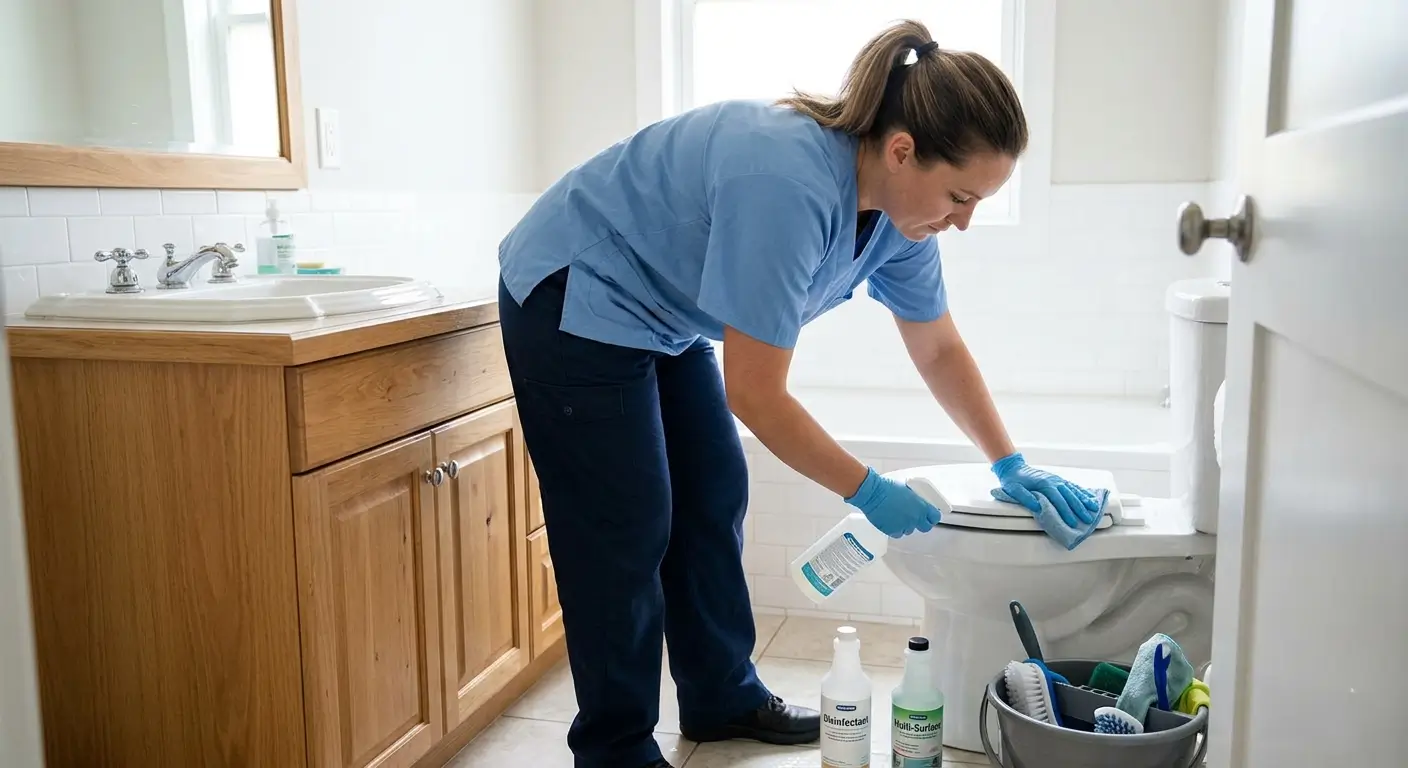
Vacation rental hosts in Castle Pines often miss the highest-risk bathroom surfaces between guest stays. This guide covers how bathrooms are sanitized during vacation rental cleaning across nine surfaces, the correct dwell-time sequence, and why the flush handle carries more risk than the toilet bowl.
Why Bathroom Sanitization Is More Than Scrubbing the Toilet
Most Castle Pines vacation rental hosts measure bathroom cleanliness by the toilet. If the toilet looks clean, the bathroom is clean. That assumption is what causes hygiene complaints, because the surfaces that carry the most pathogen load between guest stays are not the ones that look the dirtiest.
A guest who uses a scrubbed toilet and then touches an unsanitized faucet handle, light switch, or door handle has been exposed to every previous guest who touched those surfaces. Bathroom sanitization covers all of these contact points, not just the fixture that gets the most attention during a standard clean.
Understanding how bathrooms are sanitized during vacation rental cleaning is what separates a turnover that protects guest health from one that only protects the host from visible complaints. The two outcomes look identical at check-in and diverge in the review section after checkout.
The deeper context on how documented protocols produce consistent sanitization results is in our guide on how residential cleaners maintain quality in Castle Pines.
How Bathrooms Are Sanitized During Vacation Rental Cleaning: The Nine Target Surfaces
The complete answer to how bathrooms are sanitized during vacation rental cleaning covers nine specific surfaces in every bathroom, each with its own contamination profile and sanitization requirement.
The nine bathroom surfaces are:
- Toilet: bowl interior, exterior rim, lid, base, and flush handle.
- Faucet handles: hot and cold, including the base of each fixture.
- Sink basin and drain area: particularly the areas guests touch while washing hands.
- Shower and tub controls: handle, spout, and any sliding or hinged door hardware.
- Shower and tub interior surfaces: floor, walls, and any ledge where products are placed.
- Mirror: streak-free glass cleaner, not a disinfectant wipe.
- Light switch: touched on every bathroom entry and exit.
- Door handle and lock: inside and outside.
- Countertop and any shared surface: full area where guests place personal items.
The rest of this guide walks through each surface, the contamination risk it carries, and how trained crews sanitize it correctly inside a same-day turnover window.
How Bathrooms Are Sanitized During Vacation Rental Cleaning in the Right Sequence
Sequence matters in bathroom sanitization. According to the CDC’s home cleaning and disinfection guidance, disinfectants must stay wet on surfaces for the label contact time, typically 30 seconds to 10 minutes, to kill listed pathogens. Trained crews apply EPA-registered disinfectant to all nine target surfaces at the start of the bathroom visit, then work through other tasks while dwell time runs. They return to wipe after the contact time has closed. This sequence is what makes full bathroom sanitization achievable inside the four-hour turnover window.
The Toilet: Most Visible, Not Most Critical
The toilet bowl is the surface guests use to judge bathroom cleanliness on arrival. A visibly clean bowl is necessary. It is not sufficient for sanitization, and it is not the highest-risk surface in the bathroom.
Complete toilet sanitization covers:
- Bowl interior: EPA-registered disinfectant applied inside the rim and allowed to dwell before scrubbing.
- Exterior rim and lid: wiped top and underside with disinfectant at dwell time.
- Base and behind the toilet: the surfaces guests cannot easily see and crews most often skip.
- Flush handle: the highest-risk toilet surface because guests touch it at the most contaminated moment of bathroom use.
The flush handle is the single most important toilet sanitization surface and the one most frequently missed. It is touched after every use, at the moment guests have just handled the toilet, and before they wash their hands.
Faucet Handles: The Highest-Risk Bathroom Surface
Faucet handles carry a higher cross-contamination risk than the toilet in a vacation rental context because guests touch them after using the toilet and before washing their hands clean. The handle is contaminated at the moment guests reach for it, every single time.
Correct faucet handle sanitization requires:
- EPA-registered disinfectant: applied to both the hot and cold handles and the base of each fixture.
- Full dwell time observed: product stays wet for the complete label contact time before wiping.
- Both sides of the handle: the gripping surface and the back of the fixture where guests often grab.
- Drain area: the rim around the drain where water pools and guests rest their hands.
A crew that sprays the handle and wipes immediately has cleaned it. A crew that observes dwell time has sanitized it. The difference is invisible and matters entirely for what the next guest encounters.
Shower and Tub: Sanitization Beyond Scrubbing
Shower and tub surfaces require two distinct steps: scrubbing to remove soap scum and product residue, then disinfectant application at dwell time. Scrubbing without disinfecting produces a visually clean surface that retains pathogen load. Disinfecting without scrubbing first reduces the effectiveness of the disinfectant because organic matter absorbs the active ingredient.
Shower and tub sanitization covers:
- Controls and hardware: handle, spout, and sliding or hinged door hardware, each requiring disinfectant at dwell time.
- Floor surface: the highest-contact zone in the shower, where guests stand barefoot.
- Tile walls at hand contact height: the areas guests touch for balance or while rinsing.
- Any product ledge or shelf: where guests place toiletries during the stay.
- Drain surround: the area most likely to retain hair and organic matter from the previous guest.
Glass shower doors get a dedicated glass cleaner after the disinfectant dwell cycle, not in place of it. A streak-free door that was not disinfected is a sanitization failure dressed as a cleanliness win.
Mirror, Light Switch, Door Handle, and Countertop
The remaining four bathroom surfaces each require targeted attention every turnover:
- Mirror: glass cleaner applied and buffed streak-free. This is a cleaning step rather than a sanitization step, but it is the first surface guests look at and the one that sets the visual impression of the bathroom.
- Light switch: EPA-registered disinfectant applied and dwell time observed. Touched on every bathroom entry and exit, every time, by every guest.
- Door handle: inside and outside, with full dwell time. Guests touch this after using the toilet in both directions of the bathroom visit.
- Countertop: full surface area sanitized with surface-appropriate disinfectant. Guests place toothbrushes, cosmetics, and personal items directly on this surface throughout the stay.
For more on the specific EPA-registered products professional crews use on these surfaces, see our guide on home disinfecting service products in Castle Pines.
What to Verify With a Provider’s Bathroom Sanitization Protocol
Hosts who want to confirm how bathrooms are sanitized during vacation rental cleaning by a specific provider should ask three direct questions:
- What EPA-registered disinfectant do you use in bathrooms, and what is its label contact time? A provider that cannot answer the contact time is not observing dwell time.
- Do you sanitize the toilet flush handle and door handle on every visit? The correct answer is yes, both, every time. Any hesitation is a signal these surfaces are missed.
- Do you send photo verification of the bathroom sanitization before the next guest arrives? Timestamped photos are the only way to verify coverage without being on-site.
For a broader list of pre-booking verification questions, see our guide on what to ask a cleaning service before hiring.
How CR Maids Sanitizes Bathrooms in Castle Pines Vacation Rentals
CR Maids has served Castle Pines and Douglas County for over a decade, with the same dedicated background-checked crews servicing neighboring communities including Highlands Ranch and Lone Tree. Every bathroom sanitization visit covers all nine target surfaces, uses EPA-registered disinfectants at documented dwell times, and sends timestamped photo verification to the host before the next guest checks in.
To see the full vacation rental service, visit our vacation rental cleaning page or book through our online booking system.
The Bottom Line on How Bathrooms Are Sanitized During Vacation Rental Cleaning
How bathrooms are sanitized during vacation rental cleaning in Castle Pines covers nine target surfaces in every bathroom, each requiring EPA-registered disinfectant at documented dwell times. The toilet bowl gets the most attention. The flush handle, faucet handles, light switch, and door handle carry the highest cross-contamination risk between guest stays. A crew that covers all nine consistently, in the right sequence, with the right products, is delivering genuine sanitization. A crew that scrubs the toilet and wipes the counter is cleaning.
Book Your Sanitized Vacation Rental Turnover With CR Maids
Ready to lock in a crew that sanitizes every bathroom surface on every visit? Schedule your first turnover through our online booking system or call 720-713-1920 to walk through your bathroom sanitization requirements with the office.
Frequently Asked Questions
1. Why is the toilet flush handle a higher sanitization priority than the bowl?
The flush handle is touched after every toilet use, at the moment guests have just handled the toilet and before they wash their hands. The bowl is visually cleaned. The flush handle is the surface that carries the actual cross-contamination risk between guests.
2. Does the mirror need to be disinfected or just cleaned?
Cleaned. Mirrors require glass cleaner for a streak-free finish, not a disinfectant. The sanitization priority in the bathroom is contact surfaces, not reflective ones. Applying disinfectant to a mirror typically leaves streaks that guests notice on arrival.
3. Why does the shower need to be scrubbed before disinfecting?
Organic matter like soap scum and product residue absorbs the active ingredient in disinfectants before it can reach the surface. Scrubbing first removes the barrier, making the disinfectant effective when applied.
4. How do I verify bathroom sanitization was completed correctly?
Ask your provider for timestamped photos of the toilet, faucet handles, and door handle after every visit. These three surfaces are the highest-risk sanitization targets and the easiest to verify visually from a photo.
5. Does bathroom sanitization cost more than standard cleaning?
Slightly. Sanitization adds dwell time and product cost to the bathroom visit, typically 10 to 15 minutes of additional time per bathroom. Most providers include it as a standard part of vacation rental scope rather than a separate line item.
Key Takeaways
- Nine target surfaces: toilet, faucet handles, sink drain, shower controls, shower interior, mirror, light switch, door handle, and countertop.
- Flush handle first priority: the most-touched toilet surface at the highest-risk moment, and the one most frequently missed.
- Faucet handles highest risk: touched after toilet use and before handwashing clean, every single guest visit.
- Sequence matters: apply disinfectant to all surfaces first, work elsewhere during dwell, return to wipe after contact time closes.
- Scrub before disinfecting shower: organic matter blocks disinfectant effectiveness. The sequence is scrubbed, then sanitized.
- Photo verification required: timestamped photos of toilet, faucet handles, and door handle are the minimum documentation for verified bathroom sanitization.

Karina Cohen is the owner of CR Maids, a local cleaning company serving the Greater Denver area. With a background as a global executive in fashion, software, retail, and financial services, she has led business strategy, mergers and acquisitions, and cross-cultural teams across the US, Europe, and Asia.
Karina holds a Global Executive MBA from Duke University’s Fuqua School of Business and a Bachelor of Science in Finance and Marketing from Fordham University. She brings this strategic expertise into CR Maids, where her mission goes beyond spotless homes—she is committed to empowering her team, creating financial security, and giving back to the community.
When she’s not leading CR Maids, Karina homeschools her daughter, serves on the board of Duke University Colorado, and supports initiatives that strengthen families and small businesses.