
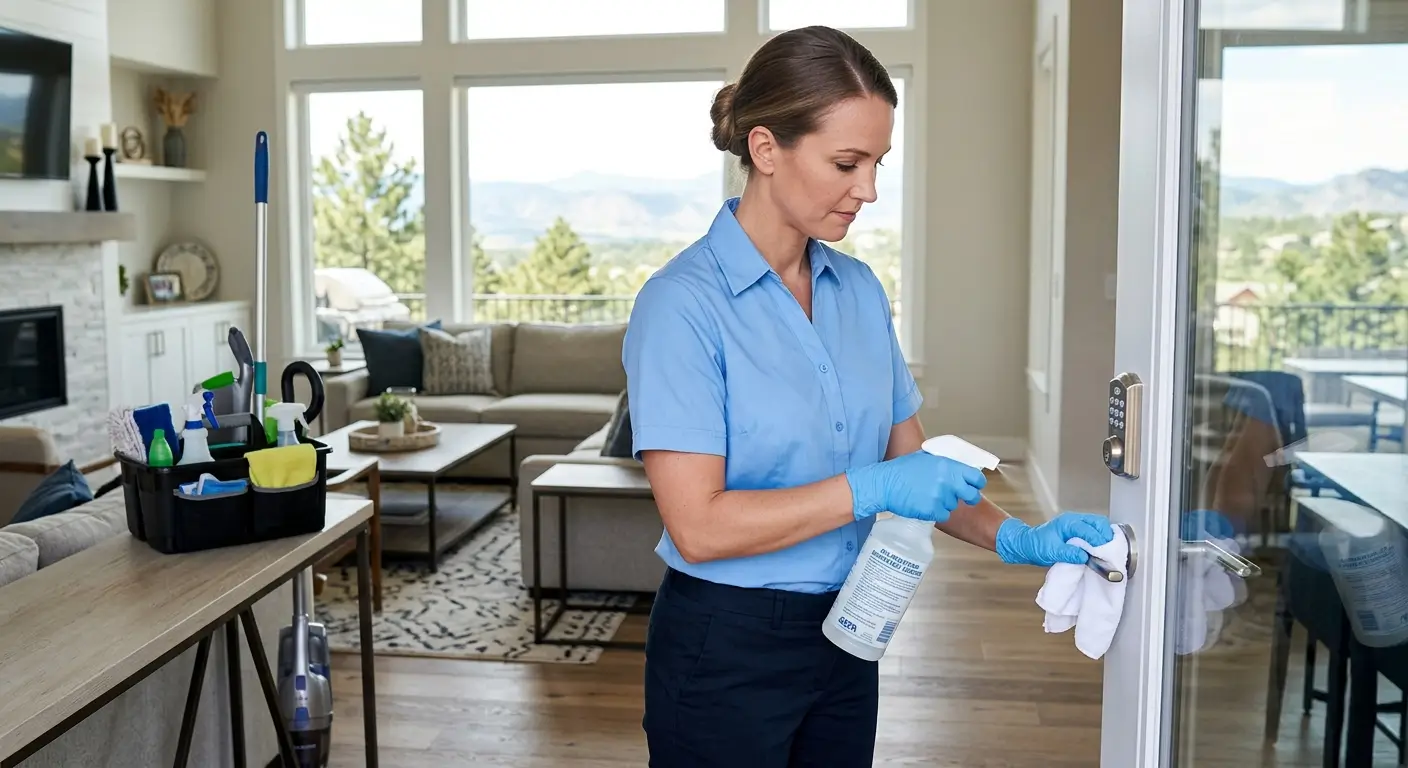
Most Castle Pines turnover crews clean visible surfaces and call it sanitizing. This guide answers does vacation rental cleaning include sanitizing in Castle Pines and what to confirm before booking.
Why the Answer Is Not Always Yes
Most Castle Pines short-term rental hosts assume that professional vacation rental cleaning includes sanitizing. Most of the time, it does not, at least not to any defined standard. A crew that wipes counters, scrubs toilets, and mops floors is cleaning. A crew that applies an EPA-registered disinfectant to high-touch surfaces and observes the label contact time is sanitizing. These are different jobs, and most cleaning companies only advertise the first one while implying the second.
The practical consequence shows up in reviews. Guests who develop illness symptoms mid-stay or post-stay and trace the source to the property write hygiene complaints that platforms treat seriously. That review is not about dust on a baseboard. It is about a missed sanitization step on a faucet handle or remote control that transferred pathogens between guest stays.
The deeper context on how documented systems drive consistent sanitization is in our guide on how residential cleaners maintain quality in Castle Pines.
Does Vacation Rental Cleaning Include Sanitizing: What the Standard Covers
The direct answer to whether vacation rental cleaning includes sanitizing depends entirely on the provider and whether a documented sanitization protocol is part of the service scope.
A standard vacation rental turnover typically covers:
- Visible surface cleaning: counters wiped, floors swept and mopped, bathrooms scrubbed.
- Linen and towel swap: used linens removed and fresh sets installed.
- Trash removal: all bins emptied and bags replaced.
- Kitchen reset: appliances wiped, dishes cleared, fridge checked.
- Restocking: consumables topped up to par levels.
What is not automatically included in most turnover services:
- EPA-registered disinfectant application to specific surface categories.
- Documented dwell times for each product.
- High-touch surface coverage beyond toilets and sinks.
- Fabric and electronics disinfection using surface-appropriate products.
- Verification protocol confirming sanitization was completed.
The separation between cleaning and sanitizing is not a marketing distinction. It is a technical one, and it determines whether a property is genuinely safe for the next guest or only visibly clean.
How to Confirm Does Vacation Rental Cleaning Include Sanitizing With Your Provider
The fastest way to answer whether does vacation rental cleaning include sanitizing for a specific provider is to ask three questions before booking:
- What EPA-registered disinfectant do you use, and what is the registration number?
- What dwell time do you observe for each surface category?
- Which specific surfaces do you sanitize on every turnover?
A provider that can answer all three is running a documented sanitization protocol. A provider that answers vaguely is cleaning and calling it sanitizing.
The Difference Between Cleaning, Sanitizing, and Disinfecting
Three terms get used interchangeably in vacation rental marketing. They are not the same.
- Cleaning: removes visible dirt, debris, and organic matter from surfaces. Does not kill pathogens. Required before sanitizing because organic matter blocks disinfectant from reaching the surface.
- Sanitizing: reduces the number of germs on a surface to a safe level as defined by public health standards. Requires an EPA-registered sanitizer applied at the correct dwell time.
- Disinfecting: kills a higher percentage of pathogens than sanitizing, including viruses listed on EPA List N. Requires an EPA-registered disinfectant applied at the label contact time.
According to the CDC’s home cleaning and disinfection guidance, the correct sequence is clean first, then sanitize or disinfect. Applying a disinfectant to a dirty surface reduces its effectiveness because organic matter absorbs the active ingredient before it can reach the pathogen.
For Castle Pines vacation rental hosts, the relevant standard is disinfection rather than simple sanitization, because the guest population rotates frequently and the risk profile is higher than a private home where the same people live continuously.
Which Surfaces Require Sanitizing on Every Turnover
The surfaces that matter most for sanitization in a vacation rental are not the ones that look dirty. They are the ones guests touch most frequently between stays.
High-touch surfaces that require sanitization on every Castle Pines turnover:
- Faucet handles: kitchen and every bathroom, inside and outside.
- Light switches: every room, including hallways and closets.
- Door handles and knobs: every interior and exterior door.
- Remote controls: living room and bedrooms.
- Appliance controls: microwave, oven, coffee maker, dishwasher.
- Drawer and cabinet pulls: kitchen and bathrooms.
- Toilet flush handles: every bathroom.
- Thermostat controls: every unit.
A standard cleaning visit that scrubs the toilet bowl and wipes the counter but skips the light switches, door handles, and remote controls has missed the highest-risk surfaces in the property. Those are the surfaces that carry cross-contamination between guests, not the toilet bowl that was visibly scrubbed.
For more on the specific EPA-registered products used for sanitization in professional vacation rental cleaning, see our guide on home disinfecting service products in Castle Pines.
What Dwell Time Means and Why It Matters
Dwell time is the most important technical concept in vacation rental sanitization, and it is the most commonly skipped step. Disinfectants only kill pathogens when they stay wet on a surface for the contact time printed on the label, typically 30 seconds to 10 minutes depending on the product and the target pathogen.
A crew that sprays a surface and wipes it immediately is not sanitizing. The product never completes the kill cycle. The surface looks clean and carries the same pathogen load as before the product was applied.
Trained sanitization crews apply product to all surfaces in a zone, move to another task while dwell time runs, and return to wipe after the contact time has elapsed. That sequence is the operational control that separates genuine sanitization from spray-and-wipe cleaning marketed as sanitization.
Does Sanitizing Cost More Than Standard Cleaning
In most cases, yes. Sanitization adds time to the turnover because dwell times require the crew to work in a specific sequence rather than moving linearly through the property. It also adds product cost because EPA-registered disinfectants are more expensive than standard cleaning chemicals.
The price difference between a standard turnover and a sanitized turnover in Castle Pines typically runs 10 to 20 percent, depending on property size and the number of high-touch surfaces in the property. For a full breakdown of what drives turnover pricing, see our guide on residential cleaning prices in Castle Pines.
Most Castle Pines hosts who add documented sanitization to their turnover scope pass the incremental cost through the cleaning fee charged to guests. Guests who see “enhanced cleaning” or “sanitization protocol” on a listing respond positively, and the cost more than covers itself in the reviews it prevents.
How CR Maids Handles Sanitization in Castle Pines
CR Maids has served Castle Pines and Douglas County for over a decade, with the same background-checked dedicated crews servicing neighboring communities including Highlands Ranch and Lone Tree. Every sanitization visit uses EPA-registered disinfectants, documents dwell times, covers the full high-touch surface list, and sends photo verification to the host before the next guest checks in.
Every visit is backed by a flat-rate quote and a written satisfaction guarantee. To see the full vacation rental service, visit our vacation rental cleaning page or book through our online booking system.
The Bottom Line: Does Vacation Rental Cleaning Include Sanitizing
Does vacation rental cleaning include sanitizing in Castle Pines? Not automatically. Standard turnover cleaning covers visible surfaces. Genuine sanitization requires EPA-registered products, documented dwell times, and verified high-touch surface coverage. Hosts who want both need to confirm the sanitization protocol explicitly before booking and verify it with photo documentation on every visit.
Frequently Asked Questions
1. Is sanitizing required for every vacation rental turnover in Castle Pines?
It is not legally required, but it is practically necessary for protecting guest health, preventing illness-related complaints, and maintaining a 5-star cleanliness rating. Most professional turnover services offer it as part of or alongside the standard cleaning scope.
2. What is the fastest way to verify a crew is actually sanitizing?
Ask for the EPA registration number of the disinfectant they use and the dwell time they observe per surface category. A crew that cannot answer both is not running a documented sanitization protocol.
3. Can I request sanitizing as an add-on to a standard turnover?
Yes. Most professional vacation rental cleaning services in Castle Pines offer documented sanitization as either a standard inclusion or an explicit add-on. Confirm the scope in writing before the first visit.
4. Does sanitizing damage premium finishes like quartz or stone?
Only if the wrong product is used. Bleach-based and acidic disinfectants etch stone and dull quartz. Trained crews use pH-neutral EPA-registered disinfectants on premium surfaces and surface-safe formulations on electronics and fabrics.
5. How do I document sanitization for my Airbnb listing?
Ask your turnover crew for a product log with EPA registration numbers, a dwell-time record, and timestamped photos of completed sanitization. These documents support enhanced cleaning certification claims on listing platforms.
Key Takeaways
- Not automatic: standard vacation rental cleaning covers visible surfaces. Sanitization requires explicit confirmation with the provider.
- Three terms, three standards: cleaning removes dirt, sanitizing reduces germs to safe levels, disinfecting kills a higher percentage of pathogens including viruses.
- Dwell time is decisive: disinfectants only work when they stay wet for the label contact time. Spray-and-wipe is not sanitizing.
- High-touch surfaces matter most: faucet handles, light switches, remote controls, door handles, and appliance buttons carry the highest cross-contamination risk.
- Documentation protects the host: product logs, dwell-time records, and timestamped photos make sanitization provable and support platform listing claims.
- Cost: sanitized turnovers run 10 to 20 percent more than standard cleaning in Castle Pines, and the cost passes cleanly through the guest cleaning fee.
Karina Cohen is the owner of CR Maids, a local cleaning company serving the Greater Denver area. With a background as a global executive in fashion, software, retail, and financial services, she has led business strategy, mergers and acquisitions, and cross-cultural teams across the US, Europe, and Asia.
Karina holds a Global Executive MBA from Duke University’s Fuqua School of Business and a Bachelor of Science in Finance and Marketing from Fordham University. She brings this strategic expertise into CR Maids, where her mission goes beyond spotless homes—she is committed to empowering her team, creating financial security, and giving back to the community.
When she’s not leading CR Maids, Karina homeschools her daughter, serves on the board of Duke University Colorado, and supports initiatives that strengthen families and small businesses.