
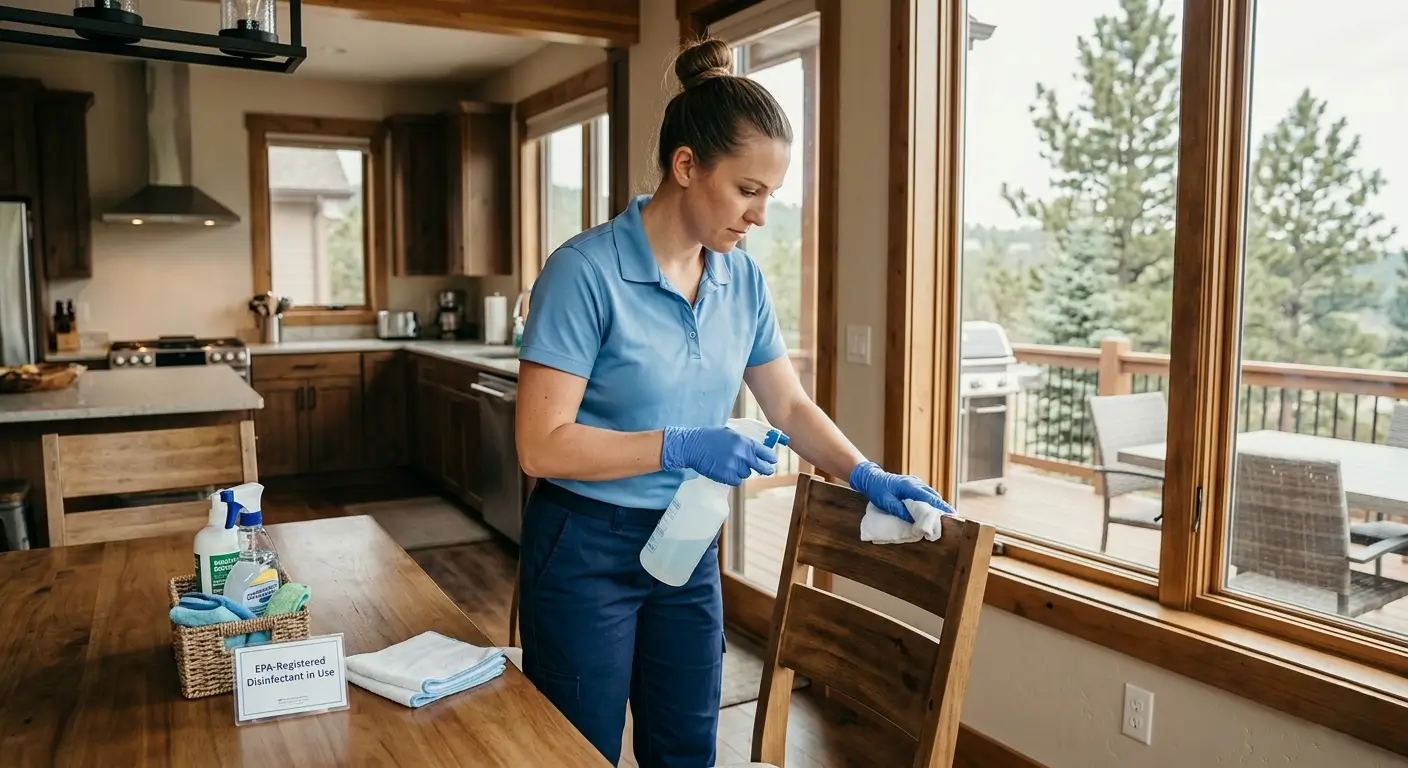
Castle Pines vacation rental hosts who treat sanitation as optional are risking health complaints, rating drops, and lost bookings from a single missed turnover. This guide explains why sanitation matters for vacation rental cleaning, what it protects against, and how a documented protocol prevents the most costly complaints.
The Gap Between Clean and Sanitized
Most Castle Pines short-term rental hosts clean their properties between guests. Far fewer sanitize them. The gap between the two outcomes is invisible at check-in and shows up in review sections, platform flags, and refund requests after checkout.
Clean means visible dirt, debris, and surface residue have been removed. Sanitized means pathogens on contact surfaces have been killed by an EPA-registered disinfectant applied at the correct dwell time. A property can pass a visual inspection and still carry flu virus, norovirus, or RSV on faucet handles, remote controls, and light switches from the previous guest stay. The guest who checks in after a thoroughly cleaned but unsanitized property is exposed to every pathogen load the previous guest left behind.
That exposure is what generates the reviews and refund requests that cost Castle Pines hosts the most. Not dust on a baseboard. Not a crooked throw pillow. Illness symptoms mid-stay and post-stay, traced back to the property, are the hygiene complaints platforms take seriously and guests write about in detail.
Why Sanitation Matters for Vacation Rental Cleaning: The Four Cost Areas
The direct answer to why sanitation matters for vacation rental cleaning comes down to four concrete consequences that hosts experience when sanitation is skipped. Each one has a measurable cost.
The four consequences are:
- Guest health complaints: illness symptoms mid-stay or post-stay traced to the property generate platform interventions that are harder to resolve than any other complaint category.
- Cleanliness rating drops: a single hygiene complaint drops the cleanliness score, which Airbnb and VRBO algorithms use to suppress listing visibility in search results.
- Refund and dispute exposure: hygiene-related disputes are treated differently from staging complaints. Platforms side with guests when hosts cannot document their sanitization protocol.
- Repeat booking loss: guests who have a health-adjacent experience in a rental almost never rebook that property, regardless of how good every other aspect of the stay was.
The rest of this guide walks through each consequence, what drives it, and what a documented sanitization protocol prevents.
Why Sanitation Matters for Vacation Rental Cleaning More Than Any Other Standard
Guest health is the only complaint category in short-term rental hosting where the review is not just about the stay. It is about what the guest experienced physically, and physical experiences produce the most detailed, the most credible, and the most damaging review text on any platform. A staging complaint reads like a preference dispute. A hygiene complaint reads like a health warning. Platforms respond accordingly.
Guest Health Complaints
The most direct reason why sanitation matters for vacation rental cleaning is guest health. Vacation rental properties see a different guest every few days. Each guest brings a different pathogen profile. Without proper sanitization between stays, high-touch surfaces accumulate cross-contamination from every previous guest until the next deep clean.
High-touch surfaces with the highest pathogen load between stays include:
- Faucet handles: touched after toilet use, before hand washing.
- Remote controls: handled repeatedly, usually while eating or resting.
- Light switches: touched on every room entry and exit by every person in the property.
- Door handles: every interior door, every visit, every guest.
- Appliance controls: microwave, coffee maker, oven, used every meal.
According to the CDC’s home cleaning and disinfection guidance, disinfectants must stay wet on these surfaces for the label contact time to actually kill pathogens. A crew that sprays and wipes immediately is not sanitizing, regardless of what product they use.
Cleanliness Rating Drops
Cleanliness scores on Airbnb and VRBO are among the most heavily weighted inputs to listing visibility. A property with a 4.7 cleanliness score competes at a disadvantage against a property with a 5.0 score, even when every other aspect of the listing is equal. One hygiene complaint that drops the score from 5.0 to 4.8 can take months of consistent 5-star reviews to recover from.
The cleanliness rating is also the one area where guests write the most specific review text. A guest who gives 4 stars on cleanliness almost always explains why in the review body. That explanation is indexed by the platform, visible to every future guest, and impossible to remove.
A documented sanitization protocol is what prevents the hygiene complaint before it becomes a rating event. For more on how surface-specific protocols protect both guest health and listing ratings, see our guide on home disinfecting service products in Castle Pines.
Refund and Dispute Exposure
Hygiene disputes follow a different resolution path than other complaint categories on short-term rental platforms. A guest who complains that the throw pillows were missing gets a sympathetic response and perhaps a small credit. A guest who reports illness symptoms and cites the property as the source triggers a platform review of the host’s cleaning documentation.
The Airbnb AirCover damage reporting policy establishes the evidence standards hosts need to defend against guest claims. For hygiene disputes, the relevant evidence is documentation: a sanitization protocol, the EPA registration numbers of the products used, and timestamped photo verification that the protocol was followed on the visit in question.
Hosts without documentation lose these disputes by default. Hosts with a documented protocol, a product log, and photo verification have the evidence to respond. The cost difference between the two outcomes is not just a single refund. It is a platform flag, a potential listing suspension, and the long-term visibility suppression that follows.
Repeat Booking Loss
The fourth and least-discussed consequence of skipping sanitation is the loss of repeat bookings. Guests who have a health-adjacent experience at a property, even a mild one, almost never rebook. They may not file a complaint. They may not leave a negative review. But they never return, and they never recommend the property to their network.
Repeat guests are the most valuable segment of any Castle Pines vacation rental’s booking base. They book earlier, they leave fewer complaints, and they produce lower acquisition costs than first-time guests sourced through platform search. A single sanitation failure that costs one repeat guest costs far more than the one stay it disrupts.
For more on building a turnover protocol that protects this segment, see our guide on same-day vacation rental cleaning in Castle Pines.
What a Documented Sanitization Protocol Covers
A sanitization protocol that protects against all four consequences covers three non-negotiable elements:
- EPA-registered disinfectants: products with verified kill claims against the pathogens relevant to high-turnover properties. Registration numbers should be on file.
- Documented dwell times: contact times observed per product and per surface category, tracked and verifiable per visit.
- Photo verification: timestamped end-of-visit photos confirming protocol completion, sent to the host before the next guest arrives.
Any protocol missing one of these three elements leaves a gap that guest complaints, platform reviews, and refund disputes can exploit.
The Bottom Line: Why Sanitation Matters for Vacation Rental Cleaning
Why sanitation matters for vacation rental cleaning in Castle Pines is not a health argument alone. It is a revenue argument. Guest health complaints, cleanliness rating drops, refund disputes, and repeat booking loss are four measurable costs that follow directly from skipped sanitization. A documented protocol using EPA-registered products at correct dwell times prevents all four. Hosts who treat sanitation as optional discover the cost one bad guest review at a time.
How CR Maids Handles Sanitization in Castle Pines
CR Maids has served Castle Pines and Douglas County for over a decade, with the same dedicated background-checked crews servicing neighboring communities including Highlands Ranch and Lone Tree. Every sanitization visit uses EPA-registered disinfectants, documents dwell times per surface category, and sends timestamped photo verification to the host before the next guest checks in. Every quote is flat-rate and every visit is backed by a written satisfaction guarantee.
To see the full vacation rental service, visit our vacation rental cleaning page or book through our online booking system.
Frequently Asked Questions
1. Is sanitizing legally required for vacation rentals in Castle Pines?
It is not legally mandated, but it is practically necessary for protecting guest health, maintaining cleanliness ratings, and defending against hygiene disputes. Most platforms reward properties with documented cleaning protocols through enhanced visibility.
2. How does a hygiene complaint differ from a standard cleanliness complaint?
A hygiene complaint involves reported illness symptoms or health concerns tied to the property. Platforms treat these more seriously than visual cleanliness complaints and may request documentation of the host’s sanitization protocol before resolving the dispute.
3. Can a property look clean and still fail a sanitization standard?
Yes. Visible cleaning removes dirt and debris. Sanitization kills pathogens on contact surfaces using EPA-registered disinfectants at documented dwell times. A property can pass a visual inspection and still carry pathogens from the previous guest stay.
4. How does sanitation affect a property’s Airbnb cleanliness score?
A single hygiene complaint that drops the cleanliness score from 5.0 to 4.8 can suppress listing visibility for months. The cleanliness score is one of the most heavily weighted inputs to platform search ranking.
5. What documentation protects a host in a hygiene dispute?
A sanitization protocol log with EPA registration numbers, documented dwell times per surface category, and timestamped photos of completed sanitization sent before the next guest arrives. Hosts without this documentation lose hygiene disputes by default.
Key Takeaways
- Clean is not sanitized: visible cleaning removes dirt. Sanitization kills pathogens using EPA-registered disinfectants at label dwell times.
- Guest health complaints: the most damaging review category, generated by high-touch surfaces carrying pathogen loads from previous guest stays.
- Cleanliness rating risk: one hygiene complaint can suppress listing visibility for months through algorithm-driven score weighting.
- Dispute documentation: hosts without a sanitization protocol, product log, and photo verification lose hygiene disputes by default.
- Repeat booking loss: guests with health-adjacent experiences almost never rebook, making sanitation a direct revenue protection measure.
- Three protocol elements: EPA-registered products, documented dwell times, and timestamped photo verification are the minimum standard for a defensible sanitization record.

Karina Cohen is the owner of CR Maids, a local cleaning company serving the Greater Denver area. With a background as a global executive in fashion, software, retail, and financial services, she has led business strategy, mergers and acquisitions, and cross-cultural teams across the US, Europe, and Asia.
Karina holds a Global Executive MBA from Duke University’s Fuqua School of Business and a Bachelor of Science in Finance and Marketing from Fordham University. She brings this strategic expertise into CR Maids, where her mission goes beyond spotless homes—she is committed to empowering her team, creating financial security, and giving back to the community.
When she’s not leading CR Maids, Karina homeschools her daughter, serves on the board of Duke University Colorado, and supports initiatives that strengthen families and small businesses.