
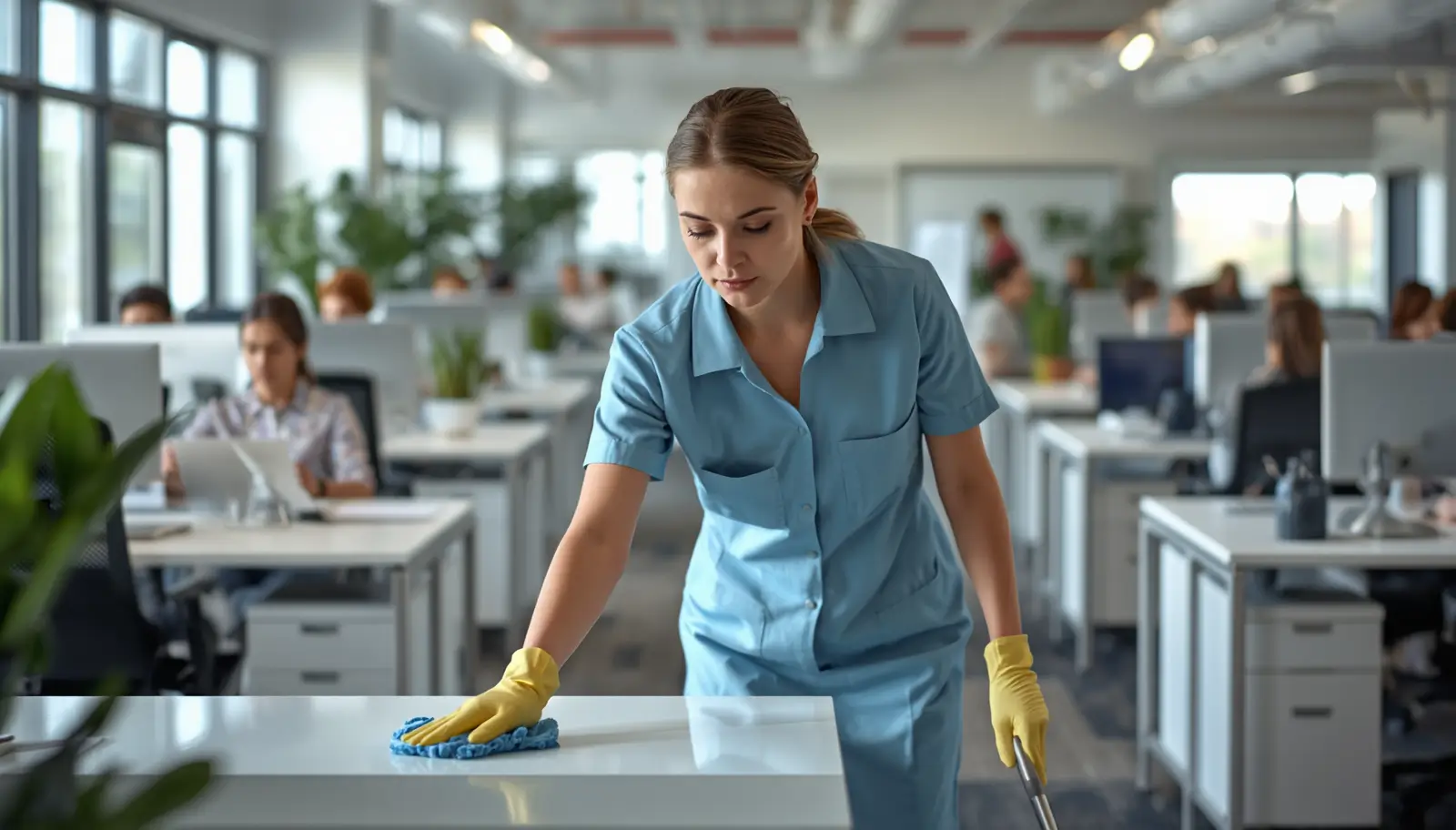
Most Castle Pines businesses measure office cleaning by how the space looks, not by what it costs when it is done poorly. This guide covers how office cleaning affects employee productivity through four measurable channels: absenteeism, focus, morale, and the time staff lose managing a space that should be managed for them.
The Connection Most Businesses Do Not Track
Most Castle Pines office managers think about cleaning as a facilities expense. They track the invoice, compare it to last quarter, and occasionally notice when something was missed. What they rarely track is what a poorly cleaned or inconsistently cleaned office costs on the other side of the ledger.
Staff who work in consistently clean professional environments report fewer sick days, higher focus, and lower frustration with their working conditions than staff in environments where cleaning is irregular or inadequate. Those outcomes are not soft impressions. They are measurable patterns that show up in absence records, output quality, and staff retention conversations.
Understanding how office cleaning affects employee productivity is what converts the cleaning line item from a facilities expense into a business investment with a return.
How Office Cleaning Affects Employee Productivity: The Four Channels
The direct answer to how office cleaning affects employee productivity runs through four specific channels, each of which produces a cost that most Castle Pines businesses absorb without connecting it to the cleaning protocol.
The four channels are:
- Absenteeism: illness cycling through staff driven by high-touch surface contamination that a documented disinfection protocol prevents.
- Focus and cognitive performance: the measurable effect of clutter, visual disorder, and air quality on the brain’s ability to concentrate on complex tasks.
- Morale and engagement: the signal a consistently maintained workspace sends about how the business values the people working in it.
- Lost staff time: the hours staff spend compensating for a space that is not being properly maintained on their behalf.
The rest of this guide walks through each channel, what drives it, and what a professional office cleaning protocol does to address it.
How Office Cleaning Affects Employee Productivity Differently From What Managers Assume
The assumption most Castle Pines managers make is that office cleaning affects productivity primarily through appearance. A clean office looks professional, staff feel better about it, and that translates to slightly better morale. The research tells a more specific story. The productivity effects of office cleaning are driven primarily by illness reduction, cognitive load, and the time economics of maintaining a shared workspace, not by aesthetics alone.
Absenteeism
The most directly measurable way office cleaning affects employee productivity is through illness. An office where high-touch surfaces are not consistently disinfected cycles illness through staff in patterns that are predictable and preventable.
The surfaces responsible for most cross-contamination in a Castle Pines office are not the ones that look dirty. They are the break room faucet handle, the printer control panel, the conference room phone handset, the coffee maker controls, and the shared keyboard in any hot-desk arrangement. Each of these surfaces is touched by multiple staff members throughout the day without handwashing between contacts.
According to the CDC’s cleaning and disinfection guidance, disinfectants must stay wet on surfaces for the label contact time to kill listed pathogens. A cleaning crew that sprays and wipes these surfaces immediately has cleaned them. A crew that observes the dwell time has disinfected them. The difference between those two outcomes is the difference between a surface that looks clean and one that actually breaks the contamination chain.
The productivity cost of one staff member’s illness absence is straightforward to calculate: daily salary plus the cost of redistributed work or temporary coverage. The productivity cost of an illness cycling through three staff members in the same two-week window is harder to track but significantly higher. Castle Pines offices that implement documented disinfection protocols consistently report fewer multi-person illness events during cold and flu season.
Focus and Cognitive Performance
The second channel through which office cleaning affects employee productivity is cognitive. Research consistently shows that visual clutter and environmental disorder increase cognitive load, which reduces the brain’s available capacity for the complex tasks that knowledge workers spend most of their day on.
A Castle Pines office with overflowing wastebaskets, dusty surfaces, and cluttered common areas does not just look like it needs cleaning. It creates a low-level environmental stressor for every person working in it throughout the day. That stressor does not announce itself as a distraction. It shows up as slightly slower task completion, slightly higher error rates, and slightly more frequent attention breaks.
Clean, ordered environments reduce this cognitive load. Staff working in consistently maintained spaces report higher focus and lower frustration with their physical environment. The effect is not dramatic on any single day. It is cumulative across every working day the environment is maintained versus every day it is not.
Air quality is a related factor. Carpeted offices that are not regularly vacuumed with HEPA-filter equipment accumulate allergen particles that affect respiratory comfort and concentration for staff with seasonal sensitivities. Regular professional cleaning with appropriate equipment removes these particles rather than redistributing them. For more on the disinfection products and methods used in professional office cleaning, see our guide on home disinfecting.
Morale and Engagement
The third channel is less quantifiable but consistently reported by staff in workplace surveys. The physical environment of an office communicates something to the people who work in it every day. A consistently maintained workspace signals that the business invests in the conditions its staff work under. An inconsistently maintained one signals the opposite.
Staff who feel their working environment is not being properly maintained are more likely to raise it as a grievance, less likely to raise it as a point of pride, and more likely to factor it into retention decisions during a period when they are evaluating whether to stay or leave. In a Castle Pines professional services market where staff recruitment is competitive, the signal an office environment sends about how the business values its people is not a soft consideration.
According to the U.S. Small Business Administration’s guidance on managing business operations, maintaining a professional and functional workspace is a baseline operational standard that affects both client perception and employee experience. The cleaning protocol is part of what makes that standard visible to staff every day.
Lost Staff Time
The fourth channel is the most overlooked. When a Castle Pines office is not properly cleaned on a professional schedule, staff compensate. They wipe down their own desk before sitting down. They restock the paper towel dispenser themselves. They empty the break room trash when it overflows. They scrub the microwave before using it.
None of those tasks takes long. Together, across a team, across a week, they add up to hours of staff time spent on facilities management rather than the work the business is paying them to do. A professional office cleaning protocol eliminates that compensation and returns that time to productive use.
The math is straightforward: if five staff members each spend 15 minutes per day compensating for inadequate cleaning, that is 1.25 hours of collective lost productivity per day, or 6.25 hours per week, or approximately 300 hours per year. At an average Castle Pines professional services salary, 300 hours of lost staff time costs more than a full year of professional office cleaning service.
For a full breakdown of what office cleaning scope and frequency look like in practice, see our guide on what is included in office cleaning services in Castle Pines.
The Bottom Line: How Office Cleaning Affects Employee Productivity
How office cleaning affects employee productivity in Castle Pines runs through four channels that most businesses do not track until the cost becomes obvious. Absenteeism from preventable illness cycling. Cognitive load from environmental disorder. Morale signals from an inconsistently maintained workspace. And the staff time lost to facilities compensation that a professional cleaning protocol eliminates. Each channel has a cost. Each one is addressed by a documented office cleaning protocol that treats cleaning as a business investment, not a facilities line item.
How CR Maids Supports Productivity in Castle Pines Offices
CR Maids has served Castle Pines and Douglas County for over a decade, with the same background-checked dedicated crews servicing neighboring communities including Highlands Ranch and Lone Tree. Every office cleaning visit follows a documented zone-specific checklist, uses EPA-registered disinfectants at correct dwell times, and closes with completion confirmation before the office opens.
Every agreement is flat-rate with a written scope description and backed by a written satisfaction guarantee. To discuss a cleaning schedule that supports your Castle Pines team’s productivity, visit our Castle Pines house cleaning page or book through our online booking system.
Frequently Asked Questions
1. How does office cleaning reduce absenteeism in Castle Pines offices?
Documented disinfection of high-touch surfaces, printer panels, faucet handles, coffee maker controls, and conference room phones, at EPA-registered dwell times breaks the contamination chain that drives illness cycling through staff. Offices with consistent disinfection protocols report fewer multi-person illness events during cold and flu season.
2. Does a cleaner office actually improve staff focus?
Yes, measurably. Visual clutter and environmental disorder increase cognitive load, which reduces available concentration for complex tasks. Consistently maintained offices reduce this background stressor, producing cumulative improvements in focus quality and task completion across the workday.
3. How much staff time is lost to compensating for inadequate office cleaning?
In most Castle Pines offices with inconsistent cleaning, staff spend 10 to 20 minutes per day on facilities tasks that a professional cleaning protocol would handle. Across a team of five, that adds up to roughly 300 hours per year of lost productive time.
4. Does the morale effect of office cleaning affect staff retention?
Yes, particularly in competitive hiring markets. Staff who feel their working environment is not being properly maintained factor it into retention decisions. The signal a consistently clean office sends about how the business values its people is a real retention variable, not a soft one.
5. Is HEPA vacuuming worth the additional cost for carpeted Castle Pines offices?
For offices with staff who have respiratory sensitivities, yes. HEPA-filter equipment captures allergen particles that standard vacuums recirculate into the air, producing measurable improvements in air quality over successive cleaning cycles that affect the comfort and focus of sensitive staff throughout the workday.
Key Takeaways
- Four channels: absenteeism, cognitive load, morale, and lost staff time are the four ways office cleaning affects employee productivity beyond appearance.
- Absenteeism is most measurable: documented disinfection of high-touch surfaces prevents the illness cycling that drives absence patterns in Castle Pines offices during peak illness seasons.
- Cognitive load is cumulative: visual disorder and environmental clutter create a low-level stressor that reduces focus quality across every working day the environment is not maintained.
- Morale signals matter: a consistently maintained workspace communicates that the business invests in the conditions its staff work in, which is a real retention variable in competitive hiring markets.
- Lost staff time is quantifiable: five staff members compensating 15 minutes daily for inadequate cleaning costs approximately 300 hours of productive time per year.
- Cleaning as investment: a documented office cleaning protocol converts the facilities line item into a business investment with a measurable return across all four productivity channels.

Karina Cohen is the owner of CR Maids, a local cleaning company serving the Greater Denver area. With a background as a global executive in fashion, software, retail, and financial services, she has led business strategy, mergers and acquisitions, and cross-cultural teams across the US, Europe, and Asia.
Karina holds a Global Executive MBA from Duke University’s Fuqua School of Business and a Bachelor of Science in Finance and Marketing from Fordham University. She brings this strategic expertise into CR Maids, where her mission goes beyond spotless homes—she is committed to empowering her team, creating financial security, and giving back to the community.
When she’s not leading CR Maids, Karina homeschools her daughter, serves on the board of Duke University Colorado, and supports initiatives that strengthen families and small businesses.