
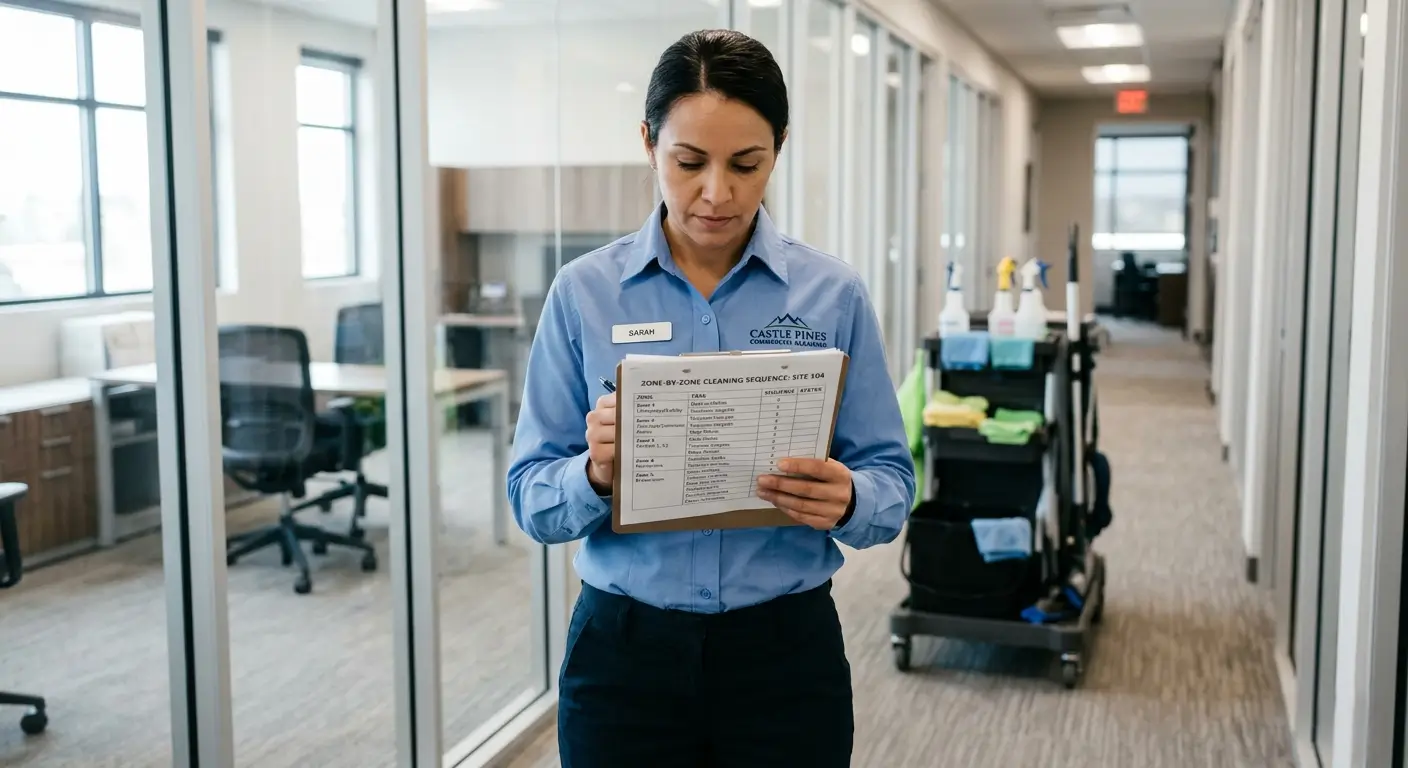
Castle Pines businesses that clean professionally but skip the tasks that protect staff health and client impression are maintaining appearance without maintaining safety. This guide covers essential commercial cleaning task in Castle Pines across every zone, the correct sequence, and what each task prevents when executed consistently.
Why Task Sequence Matters as Much as Task Coverage
Most Castle Pines commercial spaces get cleaned regularly. Fewer get cleaned in the right order. The sequence of commercial cleaning tasks determines whether the result is visually clean, genuinely sanitized, or somewhere in between and the gap between those outcomes is invisible until it becomes a complaint.
Disinfectants applied without the prior cleaning step are absorbed by organic matter before they reach pathogens. Floors mopped before surfaces are wiped get re-contaminated by falling dust and debris. Restocking done before disinfection means fresh towels sit in a space where the faucet handle has not been treated. The sequence is the protocol, and the protocol is what separates a professional cleaning visit from a well-intentioned one.
For context on how professional commercial cleaning scope is structured by zone, see our guide on what do commercial cleaning services in Castle Pines include.
Essential Commercial Cleaning Task in Castle Pines: The Six Zone Checklist
The complete answer to what constitutes an essential commercial cleaning task in Castle Pines maps to six zones, each with a defined task sequence that must be executed in order for the visit to deliver a professional result.
The six zones are:
- Restrooms: the highest sanitation priority in any commercial space.
- Kitchen and break room: the highest shared-surface contamination risk for staff.
- Reception and lobby: the client impression zone that sets the professional tone before any interaction begins.
- Conference rooms and meeting spaces: the client-facing technology and surface zone.
- Private offices and workstations: the lower-traffic zone requiring consistent floor and trash attention.
- Floors throughout: the last step in every zone, never the first.
The rest of this guide walks through the essential tasks in each zone, the correct sequence, and what gets missed when the sequence is reversed or abbreviated.
How Essential Commercial Cleaning Task in Castle Pines Differs by Business Type
The essential task list is consistent across Castle Pines commercial spaces. The frequency and intensity scale with the business type. A medical practice runs the same zone sequence as a law office but executes it daily rather than three times weekly and uses a stricter disinfectant dwell time on patient-contact surfaces. The tasks are the same. The standard is calibrated to the traffic and compliance profile of each space.
Restroom Tasks
Restrooms are the highest sanitation priority in any Castle Pines commercial space and the zone where sequence discipline matters most. According to the CDC’s home cleaning and disinfection guidance, cleaning must precede disinfection because organic matter absorbs disinfectant before it reaches pathogens. In restrooms, this means a defined clean-then-disinfect sequence on every surface.
Essential restroom tasks in sequence:
- Apply EPA-registered disinfectant first: spray toilet, flush handle, faucet handles, door handle, and light switch. Leave to dwell at label contact time while working on other surfaces.
- Clean toilet bowl: apply bowl cleaner inside, scrub, flush.
- Wipe toilet exterior: seat, lid, rim, base, and flush handle after dwell time.
- Clean sink and counter: wipe with surface cleaner, then disinfect faucet handles after dwell.
- Clean mirror: streak-free glass cleaner applied and buffed.
- Restock: toilet paper to par, hand soap to full, paper towels to par, trash bag replaced.
- Mop floor last: never before surfaces are wiped, to avoid cross-contamination from splash.
The flush handle and the light switch are the two most commonly missed surfaces in standard restroom cleaning. Both are touched before handwashing, making them the highest cross-contamination risk in the zone.
Kitchen and Break Room Tasks
The kitchen and break room carries a different contamination profile from restrooms: food-contact surfaces and shared appliance controls touched by every staff member across the day without handwashing between contacts.
Essential kitchen and break room tasks in sequence:
- Apply disinfectant to high-touch controls first: coffee maker buttons, microwave handle and control panel, refrigerator handle, faucet handle. Allow dwell time.
- Clear and wipe counters: remove debris, then wipe with surface-appropriate cleaner matched to the material (pH-neutral for stone or quartz, standard for laminate).
- Wipe appliance exteriors: microwave interior if within scope, coffee maker exterior, toaster, any shared appliances.
- Wipe table and chairs: shared seating surfaces wiped with disinfectant after dwell.
- Empty trash and replace bag.
- Restock: dish soap, sponge, paper towels, any consumables to par level.
- Wipe and disinfect faucet handle and controls after dwell time has elapsed.
- Mop floor last.
The break room faucet handle is statistically the highest-risk surface in most Castle Pines offices. It is touched at the moment of highest hand contamination, immediately before washing, and is sanitized far less consistently than restroom fixtures.
Reception and Lobby Tasks
The reception and lobby zone carries the client impression responsibility. Every client who enters a Castle Pines professional space forms their first impression in this zone, before a word is spoken. The essential tasks here are as much about presentation as sanitation.
Essential reception and lobby tasks in sequence:
- Apply disinfectant to contact surfaces first: door handle, push plate, reception desk contact edge, light switches, any shared sign-in materials.
- Clean glass entry doors: streak-free inside and out, buffed dry.
- Wipe and disinfect reception desk: surface cleaner first, then disinfectant on client-contact edges after dwell.
- Wipe waiting area seating: hard surfaces disinfected, upholstered surfaces dusted and spot-checked.
- Dust all horizontal surfaces: ledges, display items, plant surfaces.
- Restock any client-facing consumables if within scope.
- Vacuum or sweep floor after all surface work is complete.
- Mop hard floors last.
The glass entry door is the first surface every client touches. Fingerprint smudges at handle height at 9 AM signal a cleaning standard that does not match the professional impression the business projects. This surface should be addressed on every visit without exception.
For more on the client impression impact of professional commercial cleaning, see our guide on why commercial cleaning services in Castle Pines matter for your business.
Conference Room and Meeting Space Tasks
Conference rooms carry a different risk profile from restrooms and reception. Client and staff contacts are concentrated and sequential across back-to-back sessions. Shared technology, particularly phone handsets and remote controls, accumulates cross-contamination from every person who uses the room without any cleaning event between sessions.
Essential conference room tasks in sequence:
- Apply disinfectant to technology first: phone handset and keypad, remote controls, video conference equipment controls, shared presentation clickers. Allow dwell time.
- Wipe table surfaces: full surface wipe, including the areas in front of each seating position.
- Wipe chairs: hard-surface chairs disinfected, upholstered chairs dusted.
- Address whiteboard if present: erase, tray restocked.
- Wipe door handle and light switch after dwell time.
- Vacuum or sweep floor after all surface work is complete.
Conference room phone handsets and remote controls are the most consistently missed surfaces in standard commercial cleaning across Castle Pines professional spaces. They are touched by every person in every meeting and cleaned far less consistently than the table they sit on. For more on why these surfaces matter, see our guide on how often should commercial cleaning be scheduled.
Private Office and Workstation Tasks
Private offices and workstations receive a lighter standard than client-facing zones because they carry lower cross-contamination risk and because most Castle Pines businesses ask cleaning crews not to disturb active workstation materials.
Essential private office tasks in sequence:
- Empty trash and replace bag.
- Dust surfaces: window sills, ledges, and any clear horizontal surfaces not occupied by active work materials.
- Wipe door handle and light switch with disinfectant.
- Vacuum carpet or sweep hard floor.
- Workstation disinfection (keyboard, mouse, monitor surround) only if explicitly included in the scope agreement.
Private office scope is where the most scope disputes occur in Castle Pines commercial cleaning agreements. Businesses that expect workstation disinfection should confirm it explicitly in the written scope description. Crews that assume active workstation materials will not be disturbed are following standard commercial cleaning practice.
Floor Care Throughout
Floor care is the last task in every zone, without exception. Cleaning floors before surfaces are wiped means every wiped surface drops debris onto a floor that has already been mopped.
Essential floor care tasks by surface type:
- Carpet: HEPA vacuum on every visit, with furniture edge vacuuming at least weekly.
- Hard floors (tile, vinyl, sealed concrete): sweep or dry mop to collect loose debris, then mop with pH-neutral cleaner appropriate to the surface type.
- Engineered hardwood or premium flooring: microfiber dry mop only. Wet mopping warps engineered hardwood over repeated applications.
- Entryways: addressed on every visit regardless of overall floor schedule, as this is where outdoor debris concentrates.
According to OSHA’s general industry sanitation standards, employers are responsible for maintaining floors and work areas in a clean condition. Consistent floor care is part of meeting that standard, not just a visual baseline.
Completion Verification and Issue Reporting
The final essential commercial cleaning task in Castle Pines is the one most consistently absent from residential cleaning arrangements: completion verification and issue reporting.
A professional commercial cleaning visit closes with:
- Completion confirmation sent before the business opens, confirming the visit is done and all zones were covered.
- Issue report documenting any maintenance concerns, supply shortages, or surface conditions observed during the visit.
- Photo verification of client-facing areas on request, providing visual evidence of the completed standard.
This documentation step is what allows a Castle Pines business owner to stop managing a cleaning problem and focus on running the business. Without it, the business owner becomes the quality control mechanism, which is not a sustainable model for a professional space.
Every Essential Commercial Cleaning Task in Castle Pines Has a Sequence
Essential commercial cleaning task in Castle Pines is not a single action. It is a documented six-zone sequence executed in the correct order on every visit. Restrooms lead because sanitation cannot wait. Kitchens follow because shared surface contamination risk is highest there. Reception and lobby tasks maintain the client impression standard. Conference rooms protect the shared technology that accumulates the most cross-contamination between sessions. Private offices receive consistent light maintenance. Floors are always last. And completion verification closes every visit with documented evidence that the protocol was executed.
How CR Maids Executes Essential Tasks in Castle Pines
CR Maids has served Castle Pines and Douglas County for over a decade, with the same dedicated background-checked crews servicing neighboring communities including Highlands Ranch and Lone Tree. Every commercial cleaning visit follows a documented zone-specific checklist covering all six zones in the correct sequence, uses EPA-registered disinfectants at documented dwell times, and closes with completion confirmation and issue reporting before the space opens.
Every agreement is flat-rate with a written scope description and backed by a written satisfaction guarantee. To discuss a commercial cleaning schedule for your Castle Pines space, visit our Castle Pines page or book through our online booking system.
Frequently Asked Questions
1. What is the single most important commercial cleaning task in a Castle Pines office?
Restroom disinfection with correct dwell time on all contact surfaces. Restrooms carry the highest cross-contamination risk of any zone and are the first area guests and staff assess as a proxy for the building’s overall maintenance standard.
2. Why does floor cleaning always come last in a professional cleaning sequence?
Cleaning floors before surfaces are wiped means debris from wiped surfaces falls onto a floor that has already been mopped. The correct sequence is surfaces first, floors last, in every zone without exception.
3. Which commercial cleaning tasks are most often skipped in standard schedules?
Conference room phone handsets, break room faucet handles, and light switches throughout the facility. These surfaces are touched most frequently and sanitized least consistently in most standard commercial cleaning protocols.
4. Does workstation disinfection come standard in commercial cleaning agreements?
Not typically. Active workstation disinfection is a common add-on that requires explicit inclusion in the written scope agreement. Standard commercial cleaning covers floors, trash, and door handles in private offices without disturbing active work materials.
5. How does completion verification protect a Castle Pines business?
It converts the cleaning agreement from a recurring invoice into a verifiable performance record. Completion confirmation with zone checklists and issue reports provides documentation of maintained sanitation standards that supports OSHA compliance and resolves billing disputes without the business owner following up after every visit.
6. What is the difference between cleaning and disinfecting in a commercial context?
Cleaning removes visible dirt and organic matter. Disinfecting kills pathogens on surfaces using EPA-registered products at documented dwell times. Both steps are required for genuine sanitization. Disinfecting without prior cleaning is ineffective because organic matter absorbs the active ingredient before it reaches pathogens.
Key Takeaways
- Six zones: restrooms, kitchen and break room, reception and lobby, conference rooms, private offices, and floor care throughout are the six zones every essential commercial cleaning task in Castle Pines covers.
- Sequence is the protocol: disinfectant applied first, surfaces wiped after dwell, floors always last. Reversing any step undoes the work of the others.
- Most missed surfaces: conference room phone handsets, break room faucet handles, and light switches throughout the facility.
- Completion verification is essential: it closes every visit with documented evidence of execution, not just a recurring invoice.
- OSHA standard applies: employer responsibility for maintaining sanitary working conditions requires both the task execution and the documentation to demonstrate it.
- Workstation disinfection is an add-on: active workstation surfaces require explicit scope inclusion. Standard private office cleaning covers floors, trash, and door handles only.
Karina Cohen is the owner of CR Maids, a local cleaning company serving the Greater Denver area. With a background as a global executive in fashion, software, retail, and financial services, she has led business strategy, mergers and acquisitions, and cross-cultural teams across the US, Europe, and Asia.
Karina holds a Global Executive MBA from Duke University’s Fuqua School of Business and a Bachelor of Science in Finance and Marketing from Fordham University. She brings this strategic expertise into CR Maids, where her mission goes beyond spotless homes—she is committed to empowering her team, creating financial security, and giving back to the community.
When she’s not leading CR Maids, Karina homeschools her daughter, serves on the board of Duke University Colorado, and supports initiatives that strengthen families and small businesses.