
Castle Pines homeowners who skip gutter cleaning until they see a problem are paying for water damage, not prevention. This guide covers gutter cleaning services in Castle Pines: what the service includes, how often gutters need attention in this climate, and what to confirm before scheduling.
Why Castle Pines Gutters Need Professional Attention
Castle Pines sits at over 6,200 feet in elevation with a tree canopy dominated by ponderosa pine, scrub oak, and cottonwood. All three shed debris directly into gutters at different points in the season. Pine needles in late summer and fall. Oak leaves through October and November. Cottonwood seed in late spring. A Castle Pines home with mature trees overhead can accumulate a full gutter blockage within a single season without any visible sign from the ground.
Blocked gutters in Castle Pines do not simply overflow during rain. They create the conditions for fascia rot, foundation saturation, ice dam formation in winter, and pest nesting in accumulated debris. Each consequence is more expensive to remediate than the cost of a professional cleaning visit that prevents it.
Understanding what gutter cleaning services in Castle Pines cover, and how often they need to be scheduled, is how Castle Pines homeowners move from reactive repairs to predictable prevention.
For context on how gutter cleaning fits into a full exterior home maintenance schedule, see our guide on Castle Pines house cleaning.
Gutter Cleaning Services in Castle Pines: What the Service Covers
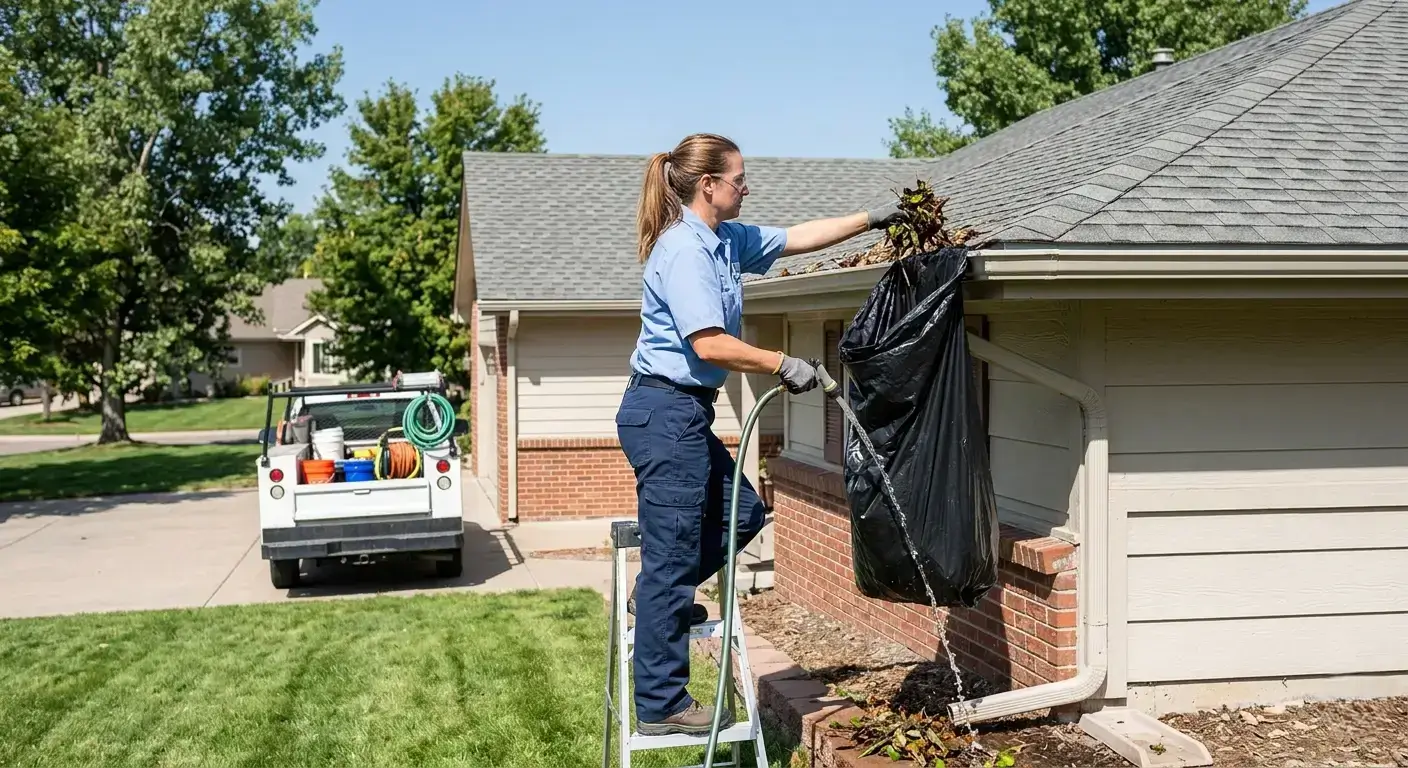
The direct answer to what gutter cleaning services in Castle Pines include maps to four service components that every professional gutter cleaning visit should cover. A provider that delivers fewer than four is delivering an incomplete service.
The four components are:
- Debris removal: all loose and compacted material cleared from gutter channels by hand or vacuum.
- Downspout flushing: water flushed through every downspout to verify flow is clear from gutter to discharge point.
- Flow testing: water run through the full gutter system to confirm there are no low-slope sections retaining standing water.
- Post-clean inspection: visual assessment of gutter condition, brackets, seams, and downspout connections after cleaning.
How Gutter Cleaning Services in Castle Pines Differ From a Leaf Blowout
A leaf blowout is not a gutter cleaning. A leaf blowout moves loose surface debris off the gutter channel using compressed air. It does not address compacted wet debris at the bottom of the gutter, does not flush downspouts, does not test flow, and does not include an inspection. In Castle Pines, where pine needle accumulation compacts at the gutter base regardless of how much surface debris is blown clear, a leaf blowout produces a clean-looking gutter that is still partially blocked. A professional cleaning visit removes the compacted layer that a blowout misses.
Debris Removal
Debris removal is the first and most time-intensive component of gutter cleaning services in Castle Pines. The debris profile in Castle Pines differs from lower-elevation Colorado communities because the pine needle layer does not break down the way broad leaf debris does. A pine needle mat that has been in a gutter through one winter and spring wet cycle compacts into a dense mat that requires hand removal rather than flushing.
Professional debris removal for Castle Pines gutters covers:
- Surface debris: loose pine needles, leaves, seed pods, and any wind-deposited material on top of the gutter channel.
- Compacted base layer: the dense mat of decomposed needle and leaf material at the gutter floor that accumulates over multiple seasons.
- Downspout openings: cleared by hand before flushing to prevent compacted debris from lodging in the downspout during the flush.
- Gutter guards if present: debris removed from any gutter guard surface and openings cleared to restore drainage function.
The standard for complete debris removal is a gutter channel that is clean to the metal or vinyl surface, not a channel that looks clear from the top but retains a compacted bottom layer.
Downspout Flushing
Downspout flushing is the second component and the one most often abbreviated by non-professional gutter cleaning providers in Castle Pines. A downspout that appears clear from the gutter opening may contain a partial blockage several feet down the pipe that a water flush would reveal. A partial downspout blockage allows slow drainage during light rain and backs up completely during heavy precipitation events, which in Castle Pines often arrive as concentrated summer afternoon storms.
Professional downspout flushing for Castle Pines homes covers:
- Full-length flush: water introduced at the gutter opening and confirmed to exit at the discharge point or splash block.
- Elbow clearing: elbows and bends in the downspout system are the most common blockage location and are flushed specifically before declaring the downspout clear.
- Underground drain connection: for Castle Pines homes with buried downspout extensions, the flush confirms water is reaching the exit point rather than backing up at a buried connection.
A downspout that drains slowly after flushing is not a clean downspout. It is a partially blocked downspout that will fail during the next heavy precipitation event.
Flow Testing
Flow testing is the component that confirms the gutter system is functioning as a drainage system, not just as a debris-free channel. A gutter that has been cleaned but retains a low-slope section, a sagging bracket, or a section that has shifted off-pitch will collect standing water regardless of how clean it is. Standing water in a Castle Pines gutter through freeze-thaw cycles damages gutter seams, adds bracket stress, and creates the conditions for ice dam formation at the roof edge.
Professional flow testing for Castle Pines gutters covers:
- Slope verification: water run through the full channel confirms water moves toward the downspout rather than pooling in low sections.
- Seam integrity: water flow reveals active seam leaks that visual inspection may not identify.
- Bracket condition: sagging sections revealed by water pooling indicate brackets that need adjustment or replacement.
Flow testing adds five to ten minutes per gutter run to a professional cleaning visit. It is the step that separates a preventive cleaning visit from a cosmetic one.
Post-Clean Inspection
Post-clean inspection is the fourth component and the one that produces the maintenance information the homeowner needs to make decisions about repair or replacement. A gutter cleaning provider that leaves without communicating what they observed during the visit has completed a cleaning and withheld the value of a professional assessment.
Professional post-clean inspection for Castle Pines homes covers:
- Gutter condition: rust, cracking, peeling, or delaminating sections identified by zone.
- Bracket condition: loose, missing, or corroded brackets identified by location.
- Seam condition: active leaks or failing sealant identified by location.
- Downspout condition: damaged, loose, or misdirected downspout sections or splash blocks identified.
- Roof edge condition: visible moss growth, lifted shingles, or damaged drip edge at the gutter attachment zone noted for homeowner awareness.
The inspection report does not have to be complex. A verbal summary at job completion or a brief written note with location-specific observations is what distinguishes a professional gutter cleaning visit from a cleaning-only service.
For context on how gutter maintenance connects to the broader home exterior care schedule, see our guide on residential cleaning prices in Castle Pines.
How Often Should Castle Pines Gutters Be Cleaned
Gutter cleaning services in Castle Pines are typically needed twice per year for most properties: once in late fall after the primary leaf drop is complete, and once in late spring after cottonwood seed season ends and before summer storm season begins.
Properties with heavy overhead canopy, particularly ponderosa pine, benefit from three visits per year: fall, spring, and a mid-summer check after monsoon season when debris volumes spike with afternoon storm activity.
Frequency adjustments by property type:
- Heavy canopy (ponderosa pine, multiple mature trees): three visits per year minimum.
- Moderate canopy (scrub oak, mixed coverage): twice per year, fall and spring.
- Light canopy or newer construction with minimal overhead trees: once per year, fall, with a spring check if debris accumulation is observed.
- Gutter guard-equipped homes: once per year minimum. Gutter guards reduce but do not eliminate debris accumulation. Annual inspection and cleaning remain necessary.
According to the EPA’s guide on green infrastructure and stormwater management, maintaining free-flowing residential drainage is a homeowner responsibility that directly affects downstream water quality and local stormwater capacity. Blocked residential gutters contribute to runoff that overwhelms drainage systems during high-precipitation events.
What to Confirm Before Scheduling
Castle Pines homeowners who book gutter cleaning based on price alone accept the same risk as homeowners who book any home service without verifying what the service includes. Three confirmations protect the investment.
- Confirm all four service components are included: debris removal, downspout flushing, flow testing, and post-clean inspection. A provider that does not include downspout flushing or flow testing is delivering a partial service.
- Confirm the crew carries liability insurance: gutter cleaning involves ladder work and roof-edge access. A provider without general liability insurance transfers the risk of property damage or crew injury to the homeowner.
- Confirm a post-clean communication: written or verbal summary of gutter condition, any observed damage, and recommended follow-up.
For a full list of pre-service verification questions, see our FAQ page. For more on how often Castle Pines gutters need cleaning, see our guide on how often should gutters be cleaned.
What Gutter Cleaning Services in Castle Pines Should Cover on Every Visit
Gutter cleaning services in Castle Pines are a twice-annual minimum for most properties, with three visits per year for homes with heavy ponderosa pine canopy. The service covers four components: debris removal, downspout flushing, flow testing, and a post-clean inspection. Castle Pines homeowners who confirm all four components with their provider before scheduling protect their fascia, foundation, roof edge, and drainage system from the consequences of blocked gutters through Castle Pines winters and summer storm seasons.
How CR Maids Serves Castle Pines Homeowners
CR Maids has served Castle Pines and Douglas County for over a decade, with the same background-checked dedicated crews servicing neighboring communities including Highlands Ranch and Lone Tree. Every gutter cleaning visit covers all four service components, closes with a post-clean condition summary, and is backed by a written satisfaction guarantee.
To schedule a gutter cleaning visit or discuss a recurring maintenance plan, visit our Castle Pines page or book through our online booking system.
Frequently Asked Questions
1. How often should Castle Pines gutters be cleaned?
Twice per year for most properties, late fall and late spring. Homes with heavy ponderosa pine canopy benefit from three visits per year, with a mid-summer check after monsoon season.
2. What is the difference between gutter cleaning and a leaf blowout?
A leaf blowout moves loose surface debris with compressed air but does not remove compacted base layer debris, flush downspouts, or test flow. A professional gutter cleaning visit addresses all four service components including the compacted layer that a blowout misses.
3. Does gutter guard installation eliminate the need for gutter cleaning?
No. Gutter guards reduce debris accumulation but do not prevent it entirely. Annual inspection and cleaning remain necessary for gutter guard-equipped homes to clear debris from guard surfaces and openings.
4. What causes ice dams on Castle Pines roofs?
Ice dams form when standing water in low-slope or blocked gutter sections freezes at the roof edge during freeze-thaw cycles. Proper gutter slope, clean downspouts, and verified flow testing after each cleaning reduce ice dam formation risk.
5. How do I know if my downspouts are blocked?
Water overflowing at the gutter during rain while the downspout outlet shows little or no flow indicates a blockage. A professional flush during a gutter cleaning visit is the most reliable way to confirm downspout clearance.
6. What should a gutter cleaning provider communicate after the visit?
A post-clean summary identifying the condition of gutters, brackets, seams, and downspouts by zone, plus any observed roof edge concerns. This information allows the homeowner to schedule repairs before they become more expensive remediation.
Key Takeaways
- Four components: debris removal, downspout flushing, flow testing, and post-clean inspection define complete gutter cleaning services in Castle Pines.
- Twice-annual minimum: fall and spring visits for most Castle Pines properties, with a third mid-summer visit for homes with heavy ponderosa pine canopy.
- Leaf blowout is not a cleaning: it removes surface debris only and misses the compacted base layer that causes blockages in Castle Pines gutters.
- Downspout flushing is non-negotiable: a visually clear downspout opening does not confirm a clear downspout. Full-length flushing with exit confirmation is the standard.
- Flow testing reveals hidden problems: low-slope sections and seam leaks are only revealed under water flow, not by visual inspection of a clean dry gutter.
- Inspection produces actionable information: a post-clean condition summary allows the homeowner to address repair needs before seasonal damage occurs.

Karina Cohen is the owner of CR Maids, a local cleaning company serving the Greater Denver area. With a background as a global executive in fashion, software, retail, and financial services, she has led business strategy, mergers and acquisitions, and cross-cultural teams across the US, Europe, and Asia.
Karina holds a Global Executive MBA from Duke University’s Fuqua School of Business and a Bachelor of Science in Finance and Marketing from Fordham University. She brings this strategic expertise into CR Maids, where her mission goes beyond spotless homes—she is committed to empowering her team, creating financial security, and giving back to the community.
When she’s not leading CR Maids, Karina homeschools her daughter, serves on the board of Duke University Colorado, and supports initiatives that strengthen families and small businesses.