
Castle Pines businesses that let any crew with a mop and spray bottle service their professional space are accepting a residential tool standard. This guide answers what tools and equipment are essential for commercial cleaning and why each produces a result a household kit cannot match.
Why Equipment Determines the Result
The product list and the task sequence both matter in commercial cleaning. But neither produces a professional result without the right equipment. A microfiber cloth and a paper towel produce visually similar wipe-downs and significantly different contamination outcomes. A HEPA vacuum and a standard bag vacuum both cover carpet but produce entirely different air quality outcomes.
Understanding what tools and equipment are essential for commercial cleaning is how Castle Pines businesses verify that the crew showing up is equipped for a professional space, not a home.
For context on the task categories this equipment supports, see our guide on what are the most important commercial cleaning tasks to focus on.
What Tools and Equipment Are Essential for Commercial Cleaning: The Six Categories
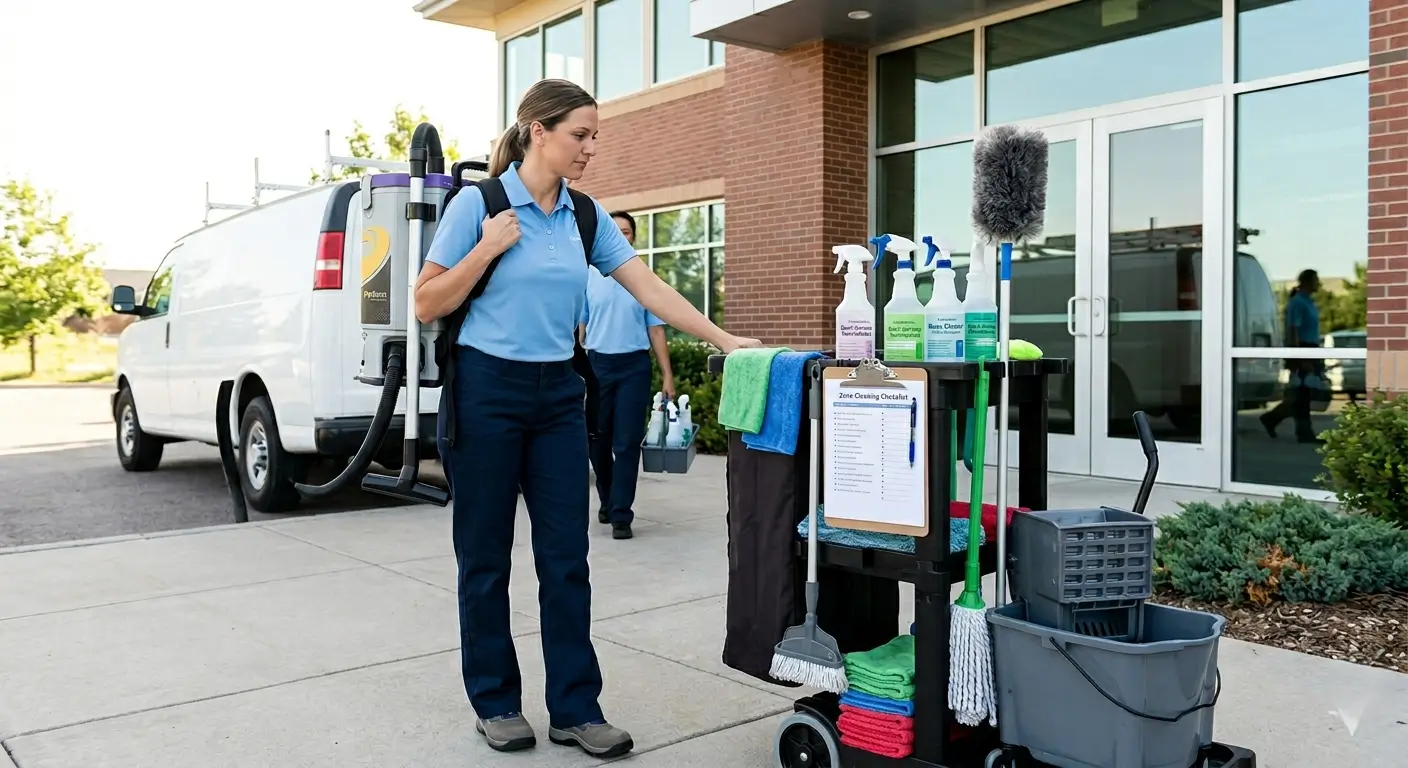
The direct answer to what tools and equipment are essential for commercial cleaning maps to six equipment categories. Each one addresses a specific cleaning function that a household alternative performs at a lower standard.
The six categories are:
- Microfiber cleaning systems: the surface wiping and disinfection standard that replaces paper towels and cotton cloths.
- HEPA vacuum systems: the floor care standard for any space with carpet, and the particulate control standard for hard floors.
- Color-coded cleaning systems: the cross-contamination prevention standard that separates restroom tools from kitchen and office tools.
- EPA-registered disinfectant dispensing equipment: trigger sprayers and electrostatic applicators calibrated for commercial dwell times.
- Commercial floor care equipment: wet mops, microfiber flat mops, and scrubbers matched to the commercial floor type.
- Completion documentation tools: checklists, photo verification equipment, and issue reporting systems.
What Tools and Equipment Are Essential for Commercial Cleaning vs Residential Cleaning
The difference between professional commercial cleaning equipment and residential tools is not quality but function. A commercial trigger sprayer applies product at a consistent pressure that produces uniform wet coverage, which is necessary for the disinfectant to dwell at label contact time. A residential spray bottle varies in application based on how the operator holds and squeezes it.
Microfiber Cleaning Systems
Microfiber cloths and pads are the foundation of professional commercial surface cleaning. A commercial-grade microfiber cloth removes up to 99 percent of bacteria from surfaces when used dry, versus approximately 30 percent for a standard cotton cloth, according to research supported by the CDC’s environmental cleaning guidance.
Essential microfiber equipment:
- Color-coded microfiber cloths: different colors for restrooms, kitchen, and general office surfaces to prevent cross-contamination.
- Flat microfiber mop pads: replace string mops on hard floors for reduced water usage and lower cross-contamination risk.
- Microfiber glass cloths: dedicated cloths for glass surfaces that produce streak-free results.
- Changing protocol: fresh cloths per zone, not a single cloth used across the full facility.
HEPA Vacuum Systems
A HEPA vacuum is non-negotiable in any Castle Pines commercial space with carpet. Standard vacuum systems allow fine particulates, including allergens, mold spores, and bacteria, to pass through the filter and back into office air. HEPA filtration captures 99.97 percent of particles at 0.3 microns or larger.
Essential vacuum equipment:
- Backpack HEPA vacuum: the commercial standard for carpeted office spaces, covering more ground per hour than upright models.
- Canister HEPA vacuum: for hard floor and mixed-surface spaces.
- HEPA filter maintenance: filters require regular replacement to maintain filtration efficiency.
Color-Coded Cleaning Systems
Color-coded cleaning prevents the transfer of pathogen load from high-risk zones to lower-risk zones. Red for restrooms. Blue or green for kitchen. Yellow for general office. A single cloth or mop used across all zones transfers contamination that color-coded systems prevent at the tool level.
According to OSHA’s general industry sanitation standards, employers are responsible for maintaining sanitary working conditions. A color-coded system is the operational mechanism that makes that responsibility achievable.
Essential color-coded equipment:
- Color-coded microfiber cloths and scrubbing pads: by zone.
- Color-coded mop heads: restroom mops never used in office or break room zones.
- Color-coded buckets: separate solution buckets per zone.
EPA-Registered Disinfectant Dispensing Equipment
Essential disinfectant dispensing equipment:
- Commercial trigger sprayers: calibrated for consistent wet coverage, replaced regularly to prevent nozzle drift.
- Electrostatic sprayers: for large commercial spaces where trigger sprayer coverage of every surface would exceed the visit window.
- Dwell time protocols: a step-sequenced checklist that ensures disinfectant contact time is observed on every surface.
Commercial Floor Care Equipment
Commercial floor care equipment addresses the surface area, the floor type variety, and the traffic load of commercial spaces in ways that residential mops and vacuum attachments do not.
Essential floor care equipment for Castle Pines commercial spaces:
- Wet mop with clean mop head per zone: mop heads used in restrooms are never used in office or break room zones.
- Microfiber flat mop system: for hard floors where string mop drip produces a haze finish on commercial tile or vinyl.
- Entrance mat maintenance equipment: entry mats carry the highest soil load in the facility and require dedicated vacuum and mat tools.
Completion Documentation Tools
The final equipment category is the one most often absent from residential cleaning arrangements: completion documentation tools.
- Zone-specific checklists: paper or digital checklists completed per zone per visit.
- Photo verification capability: timestamped photos of client-facing zones sent before the business opens.
- Issue reporting system: a standardized method for documenting maintenance concerns or supply shortages observed during the visit.
For more on how completion documentation protects a Castle Pines commercial space, see our guide on essential commercial cleaning task in Castle Pines. For a full zone breakdown of what professional commercial cleaning covers, see our guide on what do commercial cleaning services in Castle Pines include.
Six Equipment Categories That Define What Tools and Equipment Are Essential for Commercial Cleaning
What tools and equipment are essential for commercial cleaning in Castle Pines covers six categories: microfiber systems, HEPA vacuums, color-coded zone tools, EPA-registered disinfectant dispensing equipment, commercial floor care tools, and completion documentation. Castle Pines businesses that confirm all six protect their staff health, client impression, and compliance standing on every visit.
How CR Maids Equips Every Castle Pines Commercial Visit
CR Maids has served Castle Pines and Douglas County for over a decade, with the same background-checked dedicated crews servicing neighboring communities including Highlands Ranch and Lone Tree. Every commercial cleaning visit uses commercial-grade microfiber systems, HEPA vacuums, color-coded zone tools, EPA-registered disinfectants applied at documented dwell times, and closes with completion confirmation before the space opens.
To confirm equipment standards and get a written scope description, visit our Castle Pines page or book through our online booking system.
Frequently Asked Questions
1. Why is a HEPA vacuum required for commercial cleaning rather than a standard vacuum?
Standard vacuums recirculate fine particulates including allergens and bacteria back into office air. HEPA filtration captures 99.97 percent of particles at 0.3 microns or larger. In enclosed office environments, the difference is measurable in air quality and respiratory health outcomes for staff.
2. What is a color-coded cleaning system and why does it matter?
A color-coded system assigns specific colors to specific zones, red for restrooms, blue for kitchen, yellow for office surfaces. It prevents the transfer of pathogen load from high-risk zones to lower-risk zones that occurs when a single cloth or mop head is used across the full facility.
3. Do electrostatic sprayers replace manual disinfection in commercial cleaning?
No. Electrostatic sprayers supplement manual disinfection in large spaces where trigger sprayer coverage of every surface would exceed the available visit window. High-touch surfaces still require manual application and documented dwell time regardless of whether an electrostatic sprayer is used elsewhere in the facility.
4. How often should commercial cleaning mop heads be replaced?
Mop heads used in restrooms should be laundered or replaced after every visit. Mop heads used in office and break room zones should be laundered on a documented schedule and never used in restroom zones. A mop head in use across multiple visits without laundering is a cross-contamination risk.
5. What documentation equipment should a Castle Pines commercial cleaning provider use?
Zone-specific checklists completed per visit, photo verification of client-facing areas sent before the business opens, and a same-day issue report documenting any maintenance concerns or supply shortages observed during the visit.
Key Takeaways
- Six categories: microfiber systems, HEPA vacuums, color-coded zone tools, disinfectant dispensing equipment, commercial floor care tools, and completion documentation define what tools and equipment are essential for commercial cleaning.
- HEPA filtration is non-negotiable: standard vacuums recirculate fine particulates. HEPA vacuums capture them. The difference is measurable in air quality.
- Color-coded systems prevent cross-contamination: one cloth across the full facility transfers pathogen load from restrooms to office surfaces. Color-coded systems prevent this at the tool level.
- Dwell time requires correct application equipment: a commercial trigger sprayer produces consistent wet coverage. A residential spray bottle does not.
- Documentation tools close the loop: checklists, photo verification, and issue reports convert a cleaning visit into a verifiable performance record.

Karina Cohen is the owner of CR Maids, a local cleaning company serving the Greater Denver area. With a background as a global executive in fashion, software, retail, and financial services, she has led business strategy, mergers and acquisitions, and cross-cultural teams across the US, Europe, and Asia.
Karina holds a Global Executive MBA from Duke University’s Fuqua School of Business and a Bachelor of Science in Finance and Marketing from Fordham University. She brings this strategic expertise into CR Maids, where her mission goes beyond spotless homes—she is committed to empowering her team, creating financial security, and giving back to the community.
When she’s not leading CR Maids, Karina homeschools her daughter, serves on the board of Duke University Colorado, and supports initiatives that strengthen families and small businesses.