
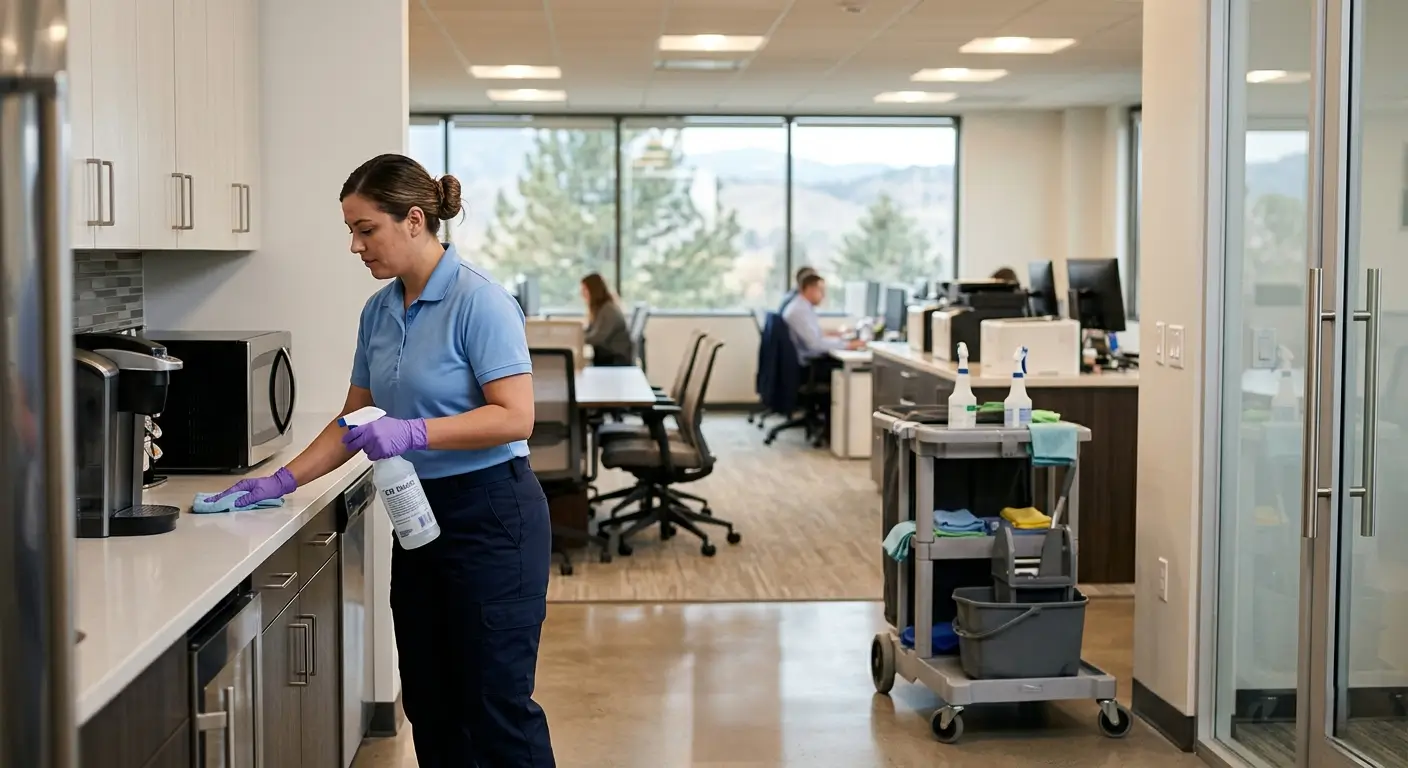
Castle Pines office managers who set sanitization frequency by habit rather than contact risk end up either over-spending on unnecessary visits or under-protecting the surfaces that drive staff illness. This guide answers how often should sanitization be done in offices based on traffic volume, surface risk, and season.
Why Frequency Is Not One-Size-Fits-All
The right answer to how often should sanitization be done in offices is not the same for every Castle Pines business. A solo practitioner carries a different requirement than a coworking space with 30 rotating daily users. A quiet summer schedule carries a different requirement than peak cold-season weeks.
Frequency set by habit rather than contact risk produces two outcomes: over-spending on unnecessary visits when surface risk is low, or under-protecting during illness season when preventable absence costs the most.
For context on what a professional sanitization protocol covers on each visit, see our guide on sanitized commercial cleaning in Castle Pines.
How Often Should Sanitization Be Done in Offices: The Four Frequency Tiers
The direct answer to how often should sanitization be done in offices maps to four frequency tiers based on daily user count and contact surface turnover rate. Each tier represents a different risk profile and a different recommended minimum sanitization schedule.
The four tiers are:
- High-traffic offices (15 or more daily users or visitors): every cleaning visit, minimum three times per week.
- Medium-traffic offices (five to fourteen daily users): every cleaning visit, minimum twice per week.
- Low-traffic offices (fewer than five daily users, no regular client visits): weekly sanitization of shared high-touch surfaces minimum.
- Client-facing reception or waiting areas: every cleaning visit regardless of overall office traffic tier, because client contact surfaces carry a different risk profile than internal staff surfaces.
The rest of this guide walks through what drives each tier, how season adjusts the baseline, and which surfaces need more frequent attention.
High-Traffic Offices
High-traffic Castle Pines offices with 15 or more daily users require sanitization on every cleaning visit, minimum three times per week. At this traffic level, shared high-touch surfaces accumulate enough contact from multiple users that pathogen load between visits becomes a genuine transmission risk within 24 hours. According to the CDC’s workplace health guidance, frequently touched surfaces should be disinfected at regular intervals based on contact frequency.
Surfaces requiring sanitization on every high-traffic visit:
- Restroom contact surfaces: flush handles, faucet handles, and door handles.
- Break room controls: faucet, coffee maker, microwave handle, and refrigerator handle.
- Shared equipment: printer panels and copier controls.
- Reception surfaces: desk contact edge and shared client-facing technology.
- Conference room: phone handsets, remote controls, and table contact zones.
Medium-Traffic Offices
Medium-traffic Castle Pines offices with five to fourteen daily users require sanitization on every cleaning visit, minimum twice per week. Shared equipment controls and break room contact surfaces drive the most risk at this traffic level. A protocol that sanitizes restrooms but skips the printer panel and break room faucet leaves the two highest-frequency contact surfaces untouched. At twice-weekly frequency, the 48-hour window between visits is short enough to interrupt most transmission chains before they cycle through the full staff population.
For a full breakdown of which surfaces carry the highest risk in each zone, see our guide on what areas require sanitization in office cleaning.
Low-Traffic Offices
Low-traffic Castle Pines offices with fewer than five daily users and no regular client visits can maintain adequate sanitization with weekly high-touch surface coverage, provided the protocol covers all shared contact surfaces, not just restrooms. The low-traffic tier assumes consistent staff without frequent external contacts. Any week with client visits or external consultants should be treated as a medium-traffic week for sanitization purposes.
A weekly low-traffic protocol must cover:
- Restroom contact surfaces: all surfaces on every visit.
- Break room controls: faucet, coffee maker, and microwave handle.
- Shared equipment: any controls used by multiple staff.
- Reception surfaces: if external visitors occur at any frequency.
Client-Facing Reception and Waiting Areas
Client-facing reception and waiting areas require sanitization on every cleaning visit regardless of the overall office traffic tier. Each client is an external contact with an unknown health status, creating a different risk profile from internal staff corridors.
Client-facing surfaces requiring sanitization on every visit:
- Entry door handle and push plate: the first surface every client contacts.
- Reception desk contact edge: where clients rest hands or sign documents.
- Waiting area armrests: every hard-surface contact point in client seating.
- Shared client technology: tablets, pens, and card readers.
According to OSHA’s general industry sanitation standards, employer sanitation responsibilities extend to client-facing zones. A reception area cleaned but not sanitized on a regular schedule does not meet this standard.
Seasonal and Event-Based Adjustments
Two categories of adjustment apply to any Castle Pines office beyond the four base tiers:
- Seasonal adjustment: November through March cold and flu season warrants a one-tier frequency increase. This is when preventable illness cycling costs the most and additional visits deliver the clearest return.
- Event-based adjustment: any event bringing external visitors above the normal daily user count should trigger a post-event sanitization of all contact surfaces in affected zones before normal business resumes.
The Bottom Line: How Often Should Sanitization Be Done in Offices
How often should sanitization be done in offices in Castle Pines depends on daily traffic volume, client contact frequency, and season. High-traffic offices need sanitization three times per week minimum. Medium-traffic offices need twice weekly. Low-traffic offices can maintain adequate protection with weekly coverage of all shared surfaces. Client-facing reception zones require sanitization on every visit regardless of tier. Cold and flu season moves every tier one level up. Castle Pines businesses that set frequency by contact risk rather than habit protect their staff, their clients, and their OSHA compliance standing at every visit.
How CR Maids Sets Sanitization Frequency in Castle Pines
CR Maids has served Castle Pines and Douglas County for over a decade, with the same dedicated background-checked crews servicing neighboring communities including Highlands Ranch and Lone Tree. Every sanitization agreement starts with a traffic assessment to match visit frequency to actual contact risk rather than a default schedule. Seasonal adjustments are recommended proactively and documented in the service agreement.
To discuss the right sanitization frequency for your Castle Pines office, visit our Castle Pines page or book through our online booking system.
Frequently Asked Questions
1. Is daily sanitization necessary for a Castle Pines office?
Only for very high-traffic spaces with 30 or more daily users or for medical and dental practices where patient health vulnerability elevates the standard. Most Castle Pines professional offices are adequately protected with three-times-weekly sanitization during cold season and twice weekly during lower-risk months.
2. Can sanitization be done less frequently in summer?
Yes, for internal staff surfaces. Summer months carry lower illness transmission rates and lower contact risk in most Castle Pines offices. However, client-facing reception and waiting areas should maintain their standard frequency year-round because external contact risk does not follow the same seasonal pattern as internal staff transmission.
3. What triggers a mid-day sanitization rather than a scheduled visit?
Back-to-back client sessions in a conference room or reception area, a staff member reporting illness mid-day, or an event bringing in a large number of external contacts. Mid-day sanitization covers phone handsets, remote controls, door handles, and any shared technology in the affected zones.
4. Does the frequency recommendation change for open-plan versus private offices?
Yes. Open-plan offices with shared desks, shared equipment, and no physical separation between staff carry a higher contact risk than private office arrangements and should be treated as one tier higher than their user count alone suggests.
5. How does sanitization frequency affect the annual cost of commercial cleaning?
Moving from weekly to twice-weekly sanitization on a standard Castle Pines office adds roughly one additional visit per week to the cleaning schedule. At typical Castle Pines commercial cleaning rates, this adds $120 to $200 per month depending on office size and scope, which is typically far below the cost of a single staff absence day.
Key Takeaways
- Four tiers: high-traffic (three times weekly), medium-traffic (twice weekly), low-traffic (weekly), and client-facing reception (every visit) are the four frequency tiers for Castle Pines offices.
- Season adjusts the baseline: cold and flu season from November through March warrants moving every tier one level up.
- Reception zones are always every-visit: external client contact carries a different risk profile than internal staff contact regardless of overall office traffic level.
- Event-based adjustments: any gathering above the normal daily contact profile should trigger a post-event sanitization before normal business resumes.
- Contact risk not habit: frequency decisions based on actual daily user count and surface contact turnover protect the business better than default schedules inherited from prior cleaning agreements.

Karina Cohen is the owner of CR Maids, a local cleaning company serving the Greater Denver area. With a background as a global executive in fashion, software, retail, and financial services, she has led business strategy, mergers and acquisitions, and cross-cultural teams across the US, Europe, and Asia.
Karina holds a Global Executive MBA from Duke University’s Fuqua School of Business and a Bachelor of Science in Finance and Marketing from Fordham University. She brings this strategic expertise into CR Maids, where her mission goes beyond spotless homes—she is committed to empowering her team, creating financial security, and giving back to the community.
When she’s not leading CR Maids, Karina homeschools her daughter, serves on the board of Duke University Colorado, and supports initiatives that strengthen families and small businesses.