
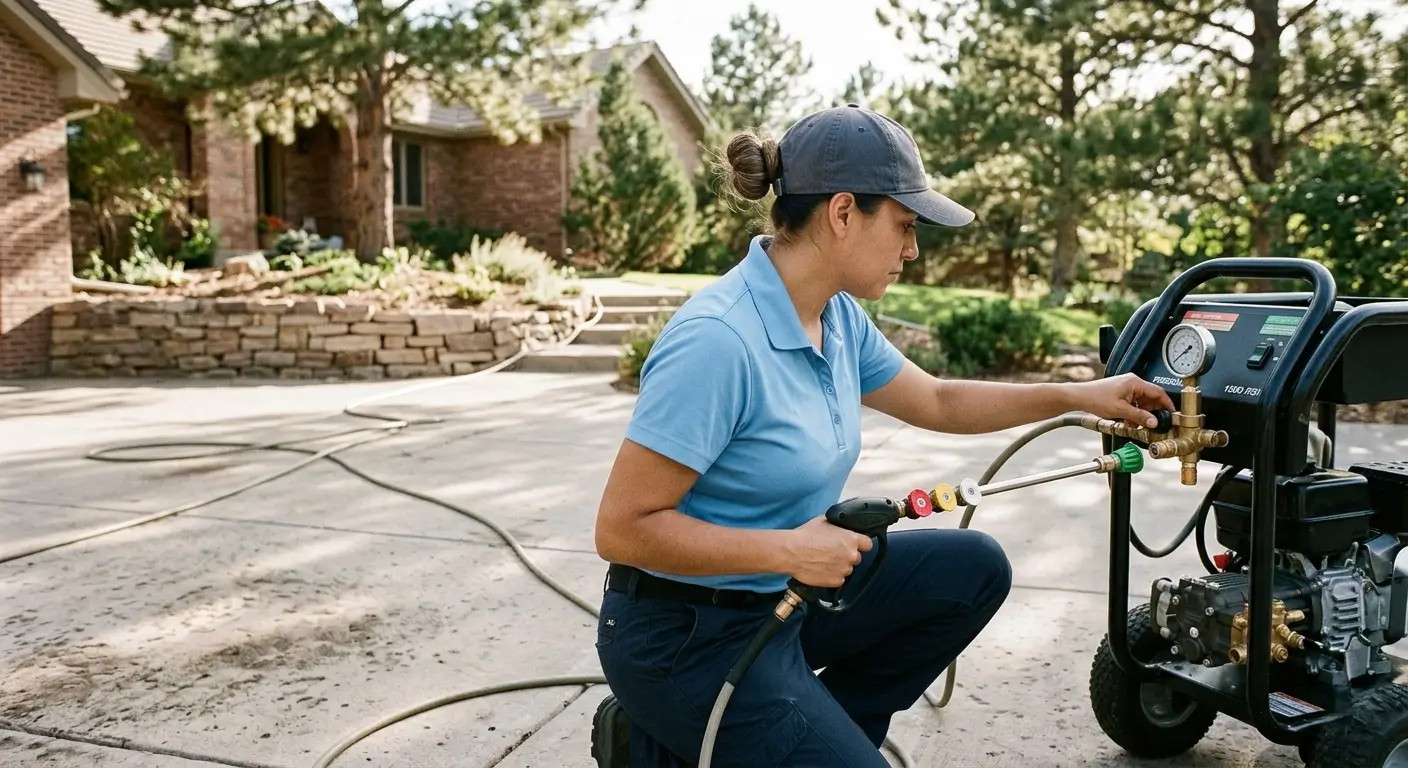
Power washing is safe for hard impervious surfaces at the correct pressure. It is not safe for siding, stucco, painted wood, or roofs. This guide answers is power washing safe for all surfaces by surface type, with the pressure ranges that protect every exterior material.
Why Surface Type Determines Whether Power Washing Is Safe
Power washing applies heated water at pressures typically between 1,500 and 4,000 PSI depending on the nozzle and machine settings. That range is appropriate for concrete and brick. Applied to composite decking, vinyl siding, or stucco at the same pressure, it strips surface coatings, forces water behind cladding, and causes damage that standard cleaning cannot reverse.
The answer to is power washing safe for all surfaces is no, but the more useful answer is which surfaces are safe at which pressures, and which surfaces should never be power washed at all.
For a full overview of what power washing covers in Castle Pines, see our guide on power washing in Castle Pines.
Is Power Washing Safe for All Surfaces: The Two Categories
Every exterior surface on a Castle Pines property falls into one of two categories when it comes to power washing safety.
- Safe with correct pressure and technique: hard impervious surfaces that can tolerate high-pressure water without surface damage when the pressure is matched to the material.
- Not safe for power washing: surfaces where high pressure causes irreversible damage regardless of technique, and where soft washing or manual cleaning is the correct approach.
Surfaces That Are Safe for Power Washing
Concrete Driveways and Aprons
Concrete is the primary power washing surface in Castle Pines. Pine sap, clay soil mineral staining, and vehicle fluid accumulation respond well to hot water at 2,500 to 4,000 PSI. Pre-treatment with a degreaser is recommended for oil staining before the main pressure pass. According to the EPA green infrastructure guidance, removing organic buildup and contaminants from hard residential surfaces reduces runoff contamination in local drainage systems.
- Safe pressure range: 2,500 to 4,000 PSI with a 25-degree nozzle.
- What to watch: avoid holding the nozzle closer than 6 inches to the surface. At close range, even concrete can show surface etching.
- Castle Pines specific: pine sap on concrete responds best to hot water power washing. Cold water pressure washing at the same PSI improves appearance but often leaves sap residue that heat application removes completely.
Brick and Stone
Brick and natural stone handle power washing well when mortar is in good condition. Crumbling mortar is a contraindication. Power washing deteriorating mortar accelerates its failure.
- Safe pressure range: 1,500 to 2,500 PSI with a 25 or 40-degree nozzle.
- What to watch: inspect mortar condition before washing and repair any crumbling sections first.
Concrete and Paver Walkways
Entry paths and paver walkways in Castle Pines accumulate algae, tannin staining from pine needle contact, and clay soil that power washing removes effectively.
- Safe pressure range: 1,500 to 3,000 PSI depending on paver type. Natural stone pavers at the lower end.
- What to watch: paver sand joints require inspection after washing. Power washing can displace joint sand on older installations.
Wood Decks
Wood decks are safe for power washing at reduced pressure, applied with the grain. High pressure against wood grain raises fibres permanently and creates a rough surface that accelerates staining and deterioration.
- Safe pressure range: 500 to 1,200 PSI with a wide-angle fan nozzle, applied with the grain.
- What to watch: test an inconspicuous area first. Soft or weathered wood requires even lower pressure or soft washing.
Fences
Wood, vinyl, and composite fences handle power washing at reduced pressure. Annual cleaning removes oxidation and organic growth that accelerates surface deterioration.
- Safe pressure range: 1,000 to 1,500 PSI for vinyl and composite. 500 to 800 PSI for wood.
- What to watch: vinyl fence connections and post caps can loosen under sustained high pressure. Work in short passes rather than concentrating on one spot.
Surfaces Where Power Washing Is Not Safe
Vinyl, Fiber Cement, and Composite Siding
Siding is the most commonly damaged surface from incorrect power washing in Castle Pines. High pressure forces water behind panels at the lap joints, creating moisture intrusion behind the cladding that does not become visible until mould establishes or paint begins to bubble.
- Why it is not safe: the lap joint design of most siding panels creates a direct path for pressurised water behind the cladding. No pressure is safe for siding cleaning. Soft washing with cleaning agents at 100 to 500 PSI is the correct approach.
- What happens when it goes wrong: water behind cladding saturates sheathing, promotes mould growth, and compromises the building envelope. The damage is expensive to remediate and entirely preventable.
According to OSHA surface safety standards, water intrusion into building structures creates slip and structural hazards that property owners are responsible for preventing. Incorrect power washing of siding is a documented cause of preventable building envelope failure.
Stucco
Stucco surfaces are not safe for power washing at any standard pressure setting. Power washing erodes the surface texture of stucco and drives water into the substrate behind the finish coat.
- Why it is not safe: stucco is a porous applied finish, not a solid surface. High pressure erodes the finish and forces water into the scratch coat and substrate behind it.
- Correct approach: soft washing with low-pressure application and appropriate cleaning agents is the only safe method for stucco exterior cleaning.
Painted Wood Surfaces
Painted wood surfaces including fascia boards, window trim, and exterior doors are not safe for standard power washing pressure.
- Why it is not safe: high pressure strips paint from wood surfaces and raises wood grain under the paint film. The paint failure is immediate and the surface requires repainting before environmental damage begins.
- Correct approach: soft washing or manual cleaning with a brush and appropriate cleaner.
Roof Surfaces
Roof cleaning is not a power washing application. Power washing asphalt shingles dislodges the granule coating that protects the shingle from UV degradation and most roofing warranties are voided by high-pressure cleaning.
- Why it is not safe: asphalt shingle granules are the primary UV protection layer. Dislodging them with high pressure accelerates shingle degradation and shortens roof life.
- Correct approach: soft washing with mould-inhibiting cleaning agents applied at low pressure. This removes algae and organic growth without granule damage.
Windows and Screens
Windows and screens are not safe for power washing. High pressure cracks window glazing and distorts screen frames.
- Why it is not safe: glass under high-pressure water stress can crack at existing micro-fractures. Screen mesh distorts permanently under pressure that would not damage adjacent hard surfaces.
- Correct approach: professional window cleaning with squeegee technique and appropriate glass cleaner.
For more on professional window cleaning in Castle Pines, see our guide on what is power washing and how it differs from the soft washing approach used on these surfaces.
Is Power Washing Safe for All Surfaces: Know Before You Start
Is power washing safe for all surfaces in Castle Pines comes down to surface type and pressure selection. Concrete, brick, stone, wood decks at reduced pressure, and fences are safe with correct technique. Siding, stucco, painted wood, roofs, and windows are not safe for power washing at any standard pressure and require soft washing or manual cleaning. Castle Pines homeowners who confirm surface type and pressure before any power washing visit protect every exterior material on the property from damage that no subsequent cleaning can reverse.
How CR Maids Approaches Surface Safety in Castle Pines
CR Maids has served Castle Pines and Douglas County for over a decade, with the same background-checked dedicated crews also servicing neighboring communities including Highlands Ranch and Lone Tree. Every power washing visit begins with a surface assessment that confirms appropriate pressure and technique for each material before the machine starts. Every visit is backed by a written satisfaction guarantee.
To discuss the right approach for your Castle Pines property, visit our Castle Pines page or book through our online booking system.
Frequently Asked Questions
1. Is power washing safe for vinyl siding?
No. High pressure forces water behind vinyl siding at the lap joints, creating moisture intrusion behind the cladding. Soft washing at 100 to 500 PSI with appropriate cleaning agents is the safe approach for siding.
2. What pressure is safe for wood decks?
500 to 1,200 PSI with a wide-angle fan nozzle applied with the grain. Test an inconspicuous area first, particularly on older or weathered wood that may require even lower pressure.
3. Can power washing damage concrete?
Yes, at incorrect technique. Holding the nozzle closer than 6 inches to the surface or using a zero-degree nozzle can etch concrete. Standard power washing at 2,500 to 4,000 PSI with a 25-degree nozzle and correct standoff distance does not damage sound concrete.
4. Is power washing safe for roofs?
No. High pressure dislodges the granule coating on asphalt shingles and voids most roofing warranties. Soft washing is the only safe approach for roof cleaning.
5. How do professionals determine if a surface is safe to power wash?
A professional assesses surface type, material condition, and any existing damage before selecting pressure range and nozzle. Surfaces with existing cracks, deteriorating mortar, or damaged paint require lower pressure or a soft washing approach regardless of material type.
Key Takeaways
- Not all surfaces are safe: concrete, brick, stone, wood decks at reduced pressure, and fences are safe. Siding, stucco, painted wood, roofs, and windows are not.
- Siding is the most common damage point: high pressure forces water behind cladding at lap joints. Soft washing is the only safe approach.
- Wood decks need reduced pressure: 500 to 1,200 PSI with the grain. High pressure against the grain raises fibres permanently.
- Roofs are never power washed: granule damage from high pressure voids roofing warranties and accelerates shingle failure.
- Surface assessment before start: pressure and nozzle selection must match the surface. One setting does not work across all exterior materials.
- Damaged surfaces need lower pressure: cracked concrete, crumbling mortar, and deteriorating paint require adjusted technique before standard power washing proceeds.

Karina Cohen is the owner of CR Maids, a local cleaning company serving the Greater Denver area. With a background as a global executive in fashion, software, retail, and financial services, she has led business strategy, mergers and acquisitions, and cross-cultural teams across the US, Europe, and Asia.
Karina holds a Global Executive MBA from Duke University’s Fuqua School of Business and a Bachelor of Science in Finance and Marketing from Fordham University. She brings this strategic expertise into CR Maids, where her mission goes beyond spotless homes—she is committed to empowering her team, creating financial security, and giving back to the community.
When she’s not leading CR Maids, Karina homeschools her daughter, serves on the board of Duke University Colorado, and supports initiatives that strengthen families and small businesses.