
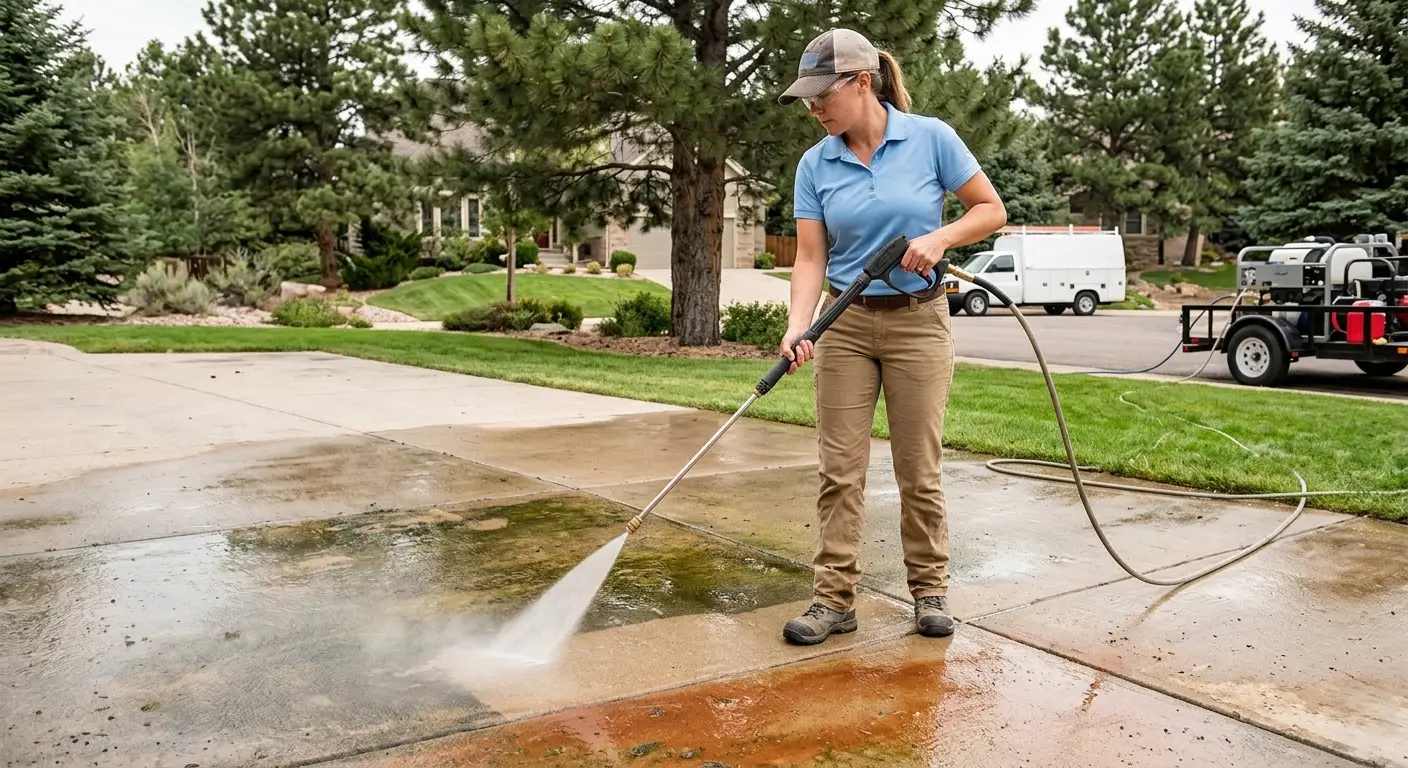
Castle Pines homeowners who use power washing and pressure washing interchangeably end up with the wrong service on the wrong surface. This guide answers what is power washing, how it differs from pressure and soft washing, and which surfaces benefit from each.
Why the Distinction Matters in Castle Pines
Using the wrong cleaning method on the wrong surface in Castle Pines produces predictable damage. High-pressure power washing applied to composite decking strips the protective coating. Pressure washing a stucco exterior forces water behind the cladding and creates moisture intrusion that does not become visible until mold establishes.
Understanding what is power washing, what pressure washing is, and what soft washing is allows Castle Pines homeowners to confirm the right service for each surface before the crew arrives.
For context on how power washing is priced by surface type in Castle Pines, see our guide on how much does power washing cost.
What Is Power Washing: The Definition
What is power washing is a question with a specific technical answer. Power washing is the application of heated high-pressure water to a hard surface for the purpose of removing debris, staining, organic growth, and surface contamination. The two distinguishing characteristics of power washing versus standard pressure washing are the water temperature and the pressure range.
Hot water: power washing heats water to temperatures typically between 140 and 200 degrees Fahrenheit before applying it to the surface. The heat breaks down grease, oil, and organic compounds at the molecular level in a way that cold water at the same pressure cannot. In Castle Pines, where pine sap bonding to concrete driveways is a specific and common challenge, hot water application is often the difference between complete sap removal and surface staining that requires re-treatment.
High pressure: power washing operates at pressures typically between 1,500 and 4,000 PSI depending on the surface type. The pressure loosens and removes debris, algae, and contamination that low-pressure rinsing cannot dislodge.
The combination of heat and pressure is what defines power washing as a distinct service, not simply high-pressure water alone.
In Castle Pines, power washing produces the strongest results on concrete driveways with pine sap and clay soil staining, entry paths with algae in shaded sections, and brick retaining walls with moss growth. These surfaces benefit most from the hot water component because the staining types they accumulate respond specifically to heat.
Power Washing vs Pressure Washing
Both apply high-pressure water. The difference is temperature.
- Pressure washing: cold or ambient water at high pressure. Removes loose debris and light contamination but cannot break down oil, grease, or bonded organic compounds.
- Power washing: heated water at high pressure. More effective for oil staining, pine sap, and organic growth that cold-water pressure washing does not fully address.
The practical difference: if the driveway has vehicle oil staining or significant pine sap deposits, confirm whether the provider uses hot water. Cold-water pressure washing may deliver a visually improved surface that still has bonded staining heat application would remove.
Power Washing vs Soft Washing
Soft washing is a separate service that applies to surfaces that high pressure would damage. Where power washing and pressure washing use pressure as the primary cleaning mechanism, soft washing uses cleaning agents applied at low pressure, typically 100 to 500 PSI, that do the work of removing organic growth and surface contamination chemically rather than mechanically.
Surfaces that require soft washing rather than power washing in Castle Pines:
- Vinyl, fiber cement, and composite siding: high pressure forces water behind panels and causes surface damage.
- Stucco: power washing erodes stucco surface texture and drives water into the substrate.
- Painted wood surfaces: high pressure strips paint and raises wood grain.
- Roof surfaces: high pressure dislodges granules from asphalt shingles and voids most roofing warranties.
- Screens and windows: high pressure cracks window glazing and distorts screen frames.
According to the CDC’s guidance on maintaining healthy home environments, treating exterior surfaces for mold and organic growth is a component of home health maintenance. Soft washing with mold-inhibiting cleaning agents is the correct approach for Castle Pines siding surfaces where mold and algae establish on north-facing walls from monsoon moisture retention.
What Surfaces Benefit From Power Washing in Castle Pines
Six surface categories in Castle Pines benefit from professional power washing:
- Concrete driveways and aprons: the primary target due to pine sap, clay soil staining, and vehicle fluid accumulation.
- Concrete and paver walkways: entry paths accumulate algae, tannin staining, and clay soil annually.
- Wood decks: at 500 to 1,200 PSI with the grain. High pressure against wood grain raises fibers permanently.
- Composite and Trex decks: at 1,000 to 1,500 PSI maximum. Soft washing preferred for older surfaces.
- Fences (wood, vinyl, composite): annual cleaning removes oxidation and organic growth.
- Concrete patios and paver patios: including pre-treatment for algae in shaded sections.
For a full breakdown by surface, see our guide on power washing in Castle Pines.
What Power Washing Does Not Replace
Power washing is a cleaning service, not a repair or restoration service. Three surface conditions in Castle Pines that power washing will improve but cannot resolve:
Deeply etched concrete: pine sap bonded through multiple heat cycles may not fully restore the original concrete color after cleaning.
UV-faded composite decking: power washing removes surface contamination but does not reverse UV-driven color fading. A UV protectant slows future fading but cannot restore already-faded color.
Structural surface damage: cracked concrete, deteriorating wood, and delaminating composite materials are conditions that power washing reveals but cannot repair.
According to OSHA’s standards for maintaining safe outdoor surfaces, slip hazards including algae and organic growth on walking surfaces should be removed. Power washing is the most efficient method for meeting that standard on Castle Pines residential exterior surfaces. For more on exterior cleaning costs, see our guide on residential cleaning prices in Castle Pines.
What Is Power Washing and Why the Right Service Protects Every Surface
What is power washing is the application of heated high-pressure water to hard exterior surfaces for the removal of debris, staining, organic growth, and contamination. It is distinct from pressure washing in its use of hot water and distinct from soft washing in its use of pressure as the primary cleaning mechanism. Castle Pines homeowners who understand the difference confirm the right service for each surface before the crew arrives and protect every exterior surface on the property from the damage that the wrong service causes.
How CR Maids Delivers Power Washing in Castle Pines
CR Maids has served Castle Pines and Douglas County for over a decade, with the same background-checked dedicated crews servicing neighboring communities including Highlands Ranch and Lone Tree. Every power washing visit applies surface-appropriate pressure and technique, uses hot water application where required, and closes with a post-clean condition summary.
To discuss the right service for your Castle Pines property, visit our Castle Pines page or book through our online booking system.
Frequently Asked Questions
1. Is power washing the same as pressure washing?
No. Both use high-pressure water, but power washing heats the water to 140 to 200 degrees Fahrenheit. The heat breaks down oil, grease, and bonded organic compounds that cold-water pressure washing cannot fully remove.
2. Can power washing damage surfaces in Castle Pines?
Yes, when applied at incorrect pressure or to surfaces that require soft washing instead. Composite decking, vinyl siding, stucco, and painted wood can all be damaged by high-pressure application. Surface-appropriate pressure selection is the critical variable.
3. What surfaces require soft washing instead of power washing?
Vinyl, fiber cement, and composite siding, stucco, painted wood, roof surfaces, and screens all require soft washing. High pressure on these surfaces causes paint stripping, water intrusion, and material damage.
4. Does power washing remove pine sap from Castle Pines driveways?
Hot water power washing is the most effective method for pine sap removal because the heat breaks down the sap bonding at the molecular level. Cold-water pressure washing improves the surface appearance but often leaves residual sap staining that heat application removes.
5. How often should Castle Pines hard surfaces be power washed?
Annually for most Castle Pines properties, with concrete driveways on heavy pine canopy properties sometimes benefiting from a second visit after monsoon season. The combination of pine sap, clay soil runoff, and UV exposure makes annual cleaning more important here than national averages suggest.
Key Takeaways
- Power washing defined: heated high-pressure water (140 to 200°F, 1,500 to 4,000 PSI) applied to hard surfaces to remove debris, staining, and organic growth.
- Power washing vs pressure washing: the difference is water temperature. Hot water removes oil, grease, and bonded organic compounds that cold-water pressure washing cannot.
- Power washing vs soft washing: the difference is mechanism. Soft washing uses cleaning agents at low pressure for surfaces that high pressure would damage.
- Castle Pines surfaces that benefit: concrete driveways, walkways, wood and composite decks, fences, and patios.
- Surfaces that require soft washing: siding, stucco, painted wood, roofs, and screens. High pressure on these surfaces causes irreversible damage.

Karina Cohen is the owner of CR Maids, a local cleaning company serving the Greater Denver area. With a background as a global executive in fashion, software, retail, and financial services, she has led business strategy, mergers and acquisitions, and cross-cultural teams across the US, Europe, and Asia.
Karina holds a Global Executive MBA from Duke University’s Fuqua School of Business and a Bachelor of Science in Finance and Marketing from Fordham University. She brings this strategic expertise into CR Maids, where her mission goes beyond spotless homes—she is committed to empowering her team, creating financial security, and giving back to the community.
When she’s not leading CR Maids, Karina homeschools her daughter, serves on the board of Duke University Colorado, and supports initiatives that strengthen families and small businesses.