
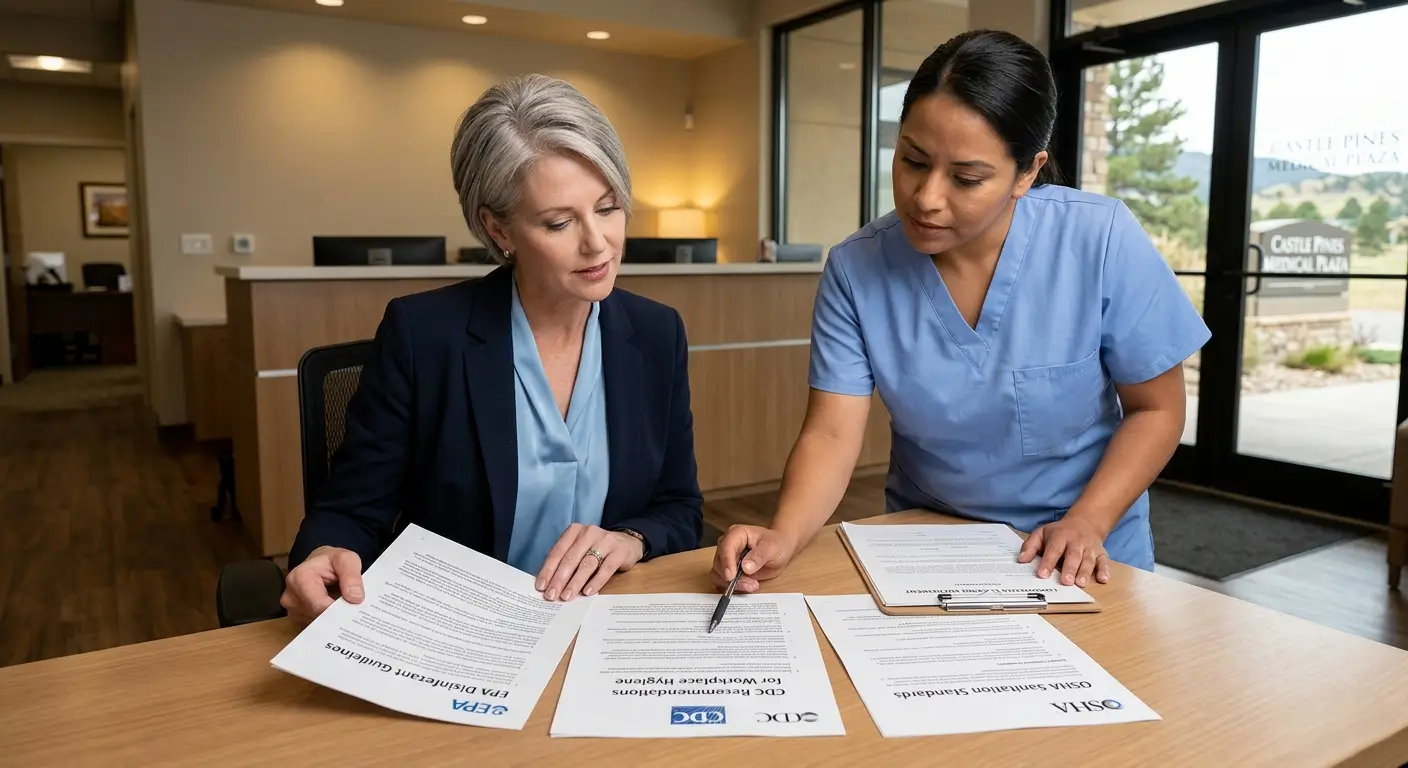
Castle Pines businesses that accept a provider’s sanitization claim without knowing which regulatory standards define it are paying for a marketing label. This guide covers what sanitization standards should business follow, where each standard comes from, and how to confirm a provider is actually meeting them.
Why Standards Matter More Than Promises
Most Castle Pines businesses that ask about commercial sanitization receive an answer shaped by the provider’s marketing rather than the regulatory bodies that actually define it. A crew that uses the word sanitize without referencing an EPA registration number, a dwell time, or a compliance framework is using cleaning language, not sanitization language.
The standards that govern commercial sanitization come from three sources: the EPA defines product efficacy, the CDC defines protocol best practices, and OSHA defines employer responsibility. A business that knows what each requires can evaluate any provider’s claim against a verified benchmark.
For context on how these standards apply in practice, see our guide on sanitized commercial cleaning in Castle Pines.
What Sanitization Standards Should Business Follow: The Three Regulatory Frameworks
The direct answer to what sanitization standards should business follow covers three regulatory frameworks that together define a complete commercial sanitization standard for Castle Pines professional spaces.
The three frameworks are:
- EPA product standards: which cleaning products carry verified kill claims against listed pathogens and which are general-purpose cleaners marketed with disinfection language.
- CDC protocol standards: which surfaces require disinfection, at what frequency, and with what application sequence to actually achieve pathogen kill rather than surface cleaning.
- OSHA compliance standards: what documentation a business must maintain to demonstrate a sanitary workplace condition if a health concern or inspection occurs.
The rest of this guide walks through each framework, what it requires, and how it maps to a real Castle Pines office cleaning agreement.
What Sanitization Standards Should Business Follow When Choosing a Provider
The practical application of what sanitization standards should business follow comes down to three questions every Castle Pines business should ask any commercial cleaning provider before signing:
- EPA registration number per zone: can you provide the EPA registration number for each disinfectant you use by surface zone?
- Dwell time management: what dwell time do you observe per surface category, and how is it managed in the cleaning sequence?
- Per-visit documentation: what documentation do you provide per visit to demonstrate the sanitization protocol was executed?
A provider that answers all three specifically is operating within the regulatory frameworks. A provider that answers with general assurances is not.
EPA Product Standards
The EPA determines whether a cleaning product qualifies as a disinfectant. Products with EPA registration numbers have been tested against specific pathogens and carry verified kill claims. Products without registration numbers are cleaners, regardless of label language.
What the EPA standard requires from a Castle Pines business perspective:
- EPA registration number per product: every disinfectant used in the commercial space must have an EPA registration number.
- Label-compliant application: the product is applied at the dilution rate and surface type specified in the label directions.
- List N for respiratory pathogens: products on EPA List N are used for any surface category where respiratory pathogen kill is the stated goal.
For Castle Pines businesses, two EPA product programs are relevant:
- EPA List N: according to the EPA’s List N disinfectants database, products on this list have been verified effective against SARS-CoV-2 and meet the efficacy standard for respiratory pathogen disinfection.
- EPA Safer Choice: the EPA Safer Choice program certifies products that meet human health and environmental safety criteria alongside efficacy standards. For businesses that want eco-friendly sanitization, Safer Choice certified products on List N deliver both verified efficacy and verified ingredient safety.
CDC Protocol Standards
The CDC does not certify products. It defines the protocols that make disinfection effective. A business can use an EPA-registered product incorrectly and achieve no sanitization benefit at all.
According to the CDC’s home cleaning and disinfection guidance, the CDC protocol standard for commercial spaces covers three requirements:
- Clean before disinfecting: organic matter on a surface reduces disinfectant effectiveness by absorbing the active ingredient before it reaches the pathogen. Cleaning must precede disinfection on every surface.
- Observe dwell time: disinfectants kill pathogens during the contact period on the label, typically 30 seconds to 10 minutes. A crew that sprays and immediately wipes has not disinfected. Dwell time must be observed on every target surface.
- Prioritize high-touch surfaces: the CDC protocol identifies high-touch surfaces as the primary transmission risk in shared environments. In a Castle Pines commercial space, these include faucet handles, door handles, light switches, shared equipment controls, and conference room technology. For a full zone-by-zone breakdown, see our guide on what areas require sanitization in office cleaning.
OSHA Compliance Standards
OSHA defines the employer’s legal responsibility for workplace sanitation. According to OSHA’s general industry sanitation standards, employers must maintain workplaces in a sanitary condition, applicable to any Castle Pines business with employees in a shared professional space.
What the OSHA standard requires in practice:
- Maintained sanitation protocol: covering all shared areas of the workplace.
- Evidence of execution: documentation that the protocol was executed, not just that a cleaning agreement exists.
- Response capability: a process to address workplace health concerns when raised.
A cleaning invoice without product logs or completion verification does not provide the evidence OSHA compliance requires. For more on frequency within this framework, see our guide on how often should sanitization be done in offices.
How to Build a Standards-Compliant Sanitization Agreement
A standards-compliant sanitization scope covers five documented elements:
- Product list with EPA registration numbers: one entry per disinfectant per zone. Registration numbers, not brand names alone.
- Dwell time per surface category: documented in the scope agreement, not left to crew judgment.
- High-touch surface list: specific surfaces in each zone, not a general reference to high-touch areas.
- Completion verification per visit: confirmation that the protocol was executed, with a zone-specific checklist.
- Issue report per visit: documentation of any maintenance concerns or surface conditions observed.
Three Standards Every Castle Pines Business Should Verify Before Signing
What sanitization standards should business follow in Castle Pines comes down to three regulatory frameworks: EPA product standards that verify kill claims, CDC protocol standards that define correct application, and OSHA compliance standards that define employer responsibility and documentation requirements. Castle Pines businesses that hold their commercial cleaning provider to all three are running a verified sanitization protocol. The ones that accept sanitization language without verified product credentials and documented protocols are paying for a marketing claim.
How CR Maids Meets Sanitization Standards in Castle Pines
CR Maids has served Castle Pines and Douglas County for over a decade, with the same dedicated background-checked crews servicing neighboring communities including Highlands Ranch and Lone Tree. Every commercial sanitization agreement includes EPA registration numbers per product and zone, documented dwell times, a high-touch surface list, completion verification, and issue reporting per visit. Product logs are available on request for any visit.
To build a standards-compliant sanitization agreement for your Castle Pines commercial space, visit our commercial and office cleaning page or book through our online booking system.
Frequently Asked Questions
1. Are CDC sanitization standards legally binding for Castle Pines businesses?
The CDC publishes guidance, not regulations. CDC protocol standards are not legally binding on their own but define the practices that produce verified sanitization outcomes. OSHA standards, which reference CDC guidance in their compliance framework, are legally binding for workplace sanitation.
2. What is the difference between an EPA-registered disinfectant and an EPA Safer Choice product?
EPA registration confirms a product kills listed pathogens at specified conditions. EPA Safer Choice certification confirms the product meets human health and environmental safety criteria for its ingredients. Some products carry both credentials, providing both verified efficacy and verified ingredient safety.
3. How does a Castle Pines business verify that a provider is using EPA List N products?
Ask for the EPA registration number of each disinfectant used by zone. Confirm the number on the EPA List N database at epa.gov. Any provider that cannot supply specific registration numbers is not using verified List N products regardless of how the service is described.
4. Does OSHA conduct surprise inspections of commercial office spaces?
OSHA inspections can be triggered by employee complaints, referrals, or programmed inspections in targeted industries. Any Castle Pines business with employees in a shared workspace is subject to general industry sanitation standards and should maintain documentation of its cleaning and sanitization protocol on file.
5. Can a Castle Pines business use the same sanitization standard for all zones?
No. Different zones carry different contact risk profiles and require different product selections and frequencies. Restrooms and break rooms carry higher frequency requirements than private offices. Electronics and stone surfaces require different products than general hard surfaces. A single-standard approach produces over-sanitization in some areas and under-protection in others.
Key Takeaways
- Three frameworks: EPA product standards, CDC protocol standards, and OSHA compliance standards define what sanitization standards Castle Pines businesses should follow.
- EPA registration numbers are the proof: a disinfectant without an EPA registration number is a cleaner, not a verified disinfectant.
- Dwell time is a CDC requirement: spray-and-wipe does not meet the CDC protocol standard. The product must stay wet for the label contact time.
- OSHA requires documentation: a cleaning invoice without product logs and completion verification does not provide evidence of OSHA-compliant workplace sanitation.
- Five scope elements: product list with registration numbers, dwell time per zone, high-touch surface list, completion verification, and issue reporting per visit.
Karina Cohen is the owner of CR Maids, a local cleaning company serving the Greater Denver area. With a background as a global executive in fashion, software, retail, and financial services, she has led business strategy, mergers and acquisitions, and cross-cultural teams across the US, Europe, and Asia.
Karina holds a Global Executive MBA from Duke University’s Fuqua School of Business and a Bachelor of Science in Finance and Marketing from Fordham University. She brings this strategic expertise into CR Maids, where her mission goes beyond spotless homes—she is committed to empowering her team, creating financial security, and giving back to the community.
When she’s not leading CR Maids, Karina homeschools her daughter, serves on the board of Duke University Colorado, and supports initiatives that strengthen families and small businesses.