
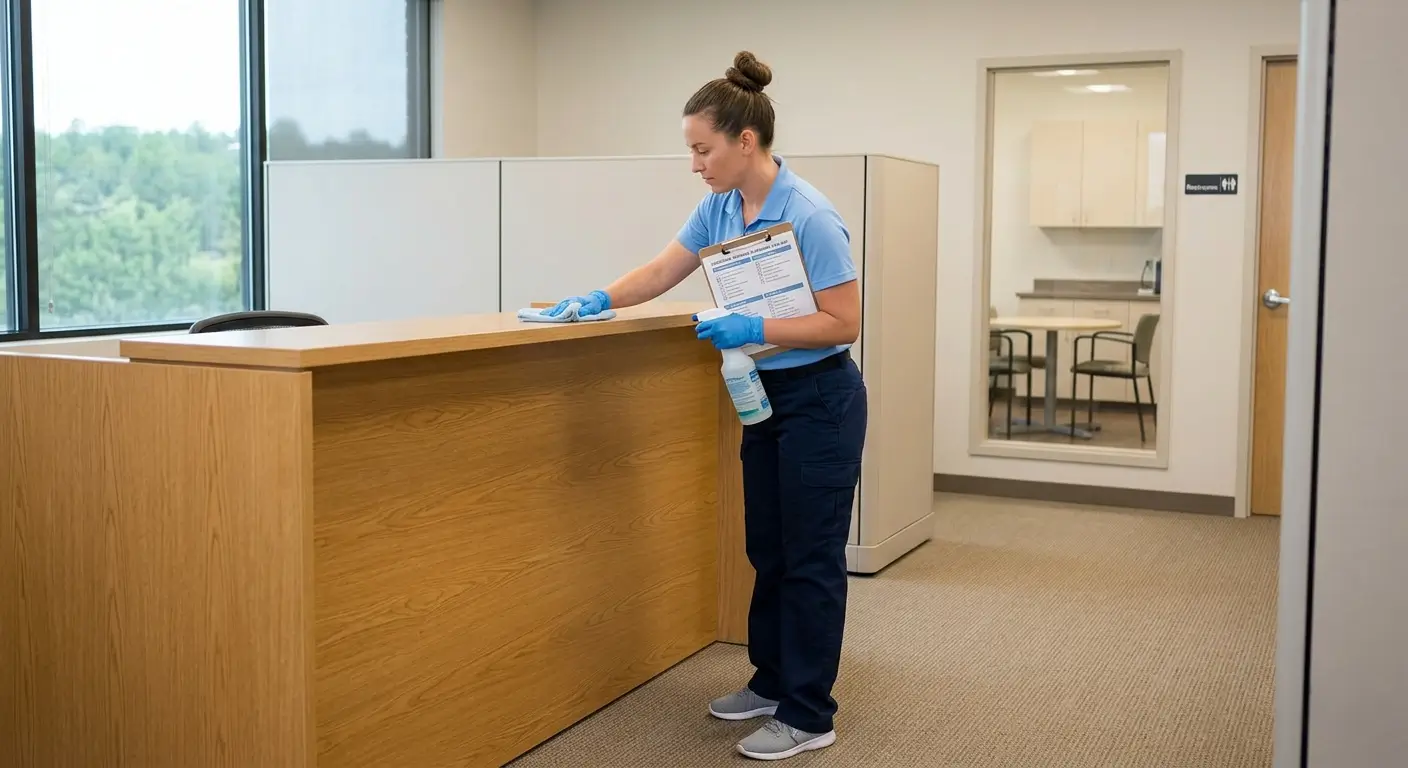
Castle Pines businesses that let cleaning crews define scope without a written checklist end up with gaps in the zones that matter most. This guide answers what are the essential tasks in commercial cleaning, maps them zone by zone, and shows which ones are most often missed.
Why the Task List Defines the Standard
Most Castle Pines commercial spaces look clean after a visit. Whether they are genuinely clean depends on which tasks were completed, in which zones, and in what sequence. A space that has been vacuumed and mopped but has not had its faucet handles or conference room phone disinfected looks identical to a space that has. The gap is invisible until it shows up in a hygiene complaint.
Understanding what are the essential tasks in commercial cleaning is how a Castle Pines business owner moves from accepting a visual result to verifying a professional standard.
For context on how essential commercial cleaning tasks map to a full zone-specific scope, see our guide on essential commercial cleaning task in Castle Pines.
What Are the Essential Tasks in Commercial Cleaning: The Six Categories
The direct answer to what are the essential tasks in commercial cleaning maps to six task categories every professional commercial cleaning visit covers.
The six categories are:
- Disinfection of high-touch surfaces: the task category with the highest health impact and the one most often abbreviated in standard cleaning schedules.
- Surface cleaning by zone: counters, desks, and horizontal surfaces wiped in the correct order relative to disinfection.
- Restroom sanitation: the full sequence from disinfectant application through restocking, executed in the correct order.
- Kitchen and break room reset: shared surface disinfection, appliance wipe-down, trash removal, and restocking.
- Floor care: the last task in every zone, not the first.
- Completion verification: the closing task that confirms the protocol was executed and documents anything requiring attention.
The rest of this guide walks through what each category covers, what the correct sequence looks like, and which tasks are most often skipped in non-professional commercial cleaning arrangements.
Commercial cleaning covers shared high-touch surfaces that residential cleaning does not prioritize, follows a disinfection protocol tied to EPA-registered products and dwell times, and closes with completion verification. A residential crew working in a commercial space will perform the tasks they know, not necessarily the tasks the space requires.
Disinfection of High-Touch Surfaces
High-touch surface disinfection covers every surface that multiple people contact throughout the day, regardless of whether those surfaces look dirty. According to the CDC’s home cleaning and disinfection guidance, disinfectants must stay wet on surfaces for the label contact time to kill pathogens. The sequence is: apply, wait, wipe.
High-touch surfaces requiring disinfection on every visit:
- Door handles and push plates: every shared door in the facility.
- Light switches: every switch in shared spaces.
- Faucet handles: kitchen and every restroom.
- Shared equipment controls: printer panels, copier controls, coffee maker buttons, microwave handle.
- Reception desk contact edge: where clients rest hands or sign documents.
- Conference room phone handsets and remote controls: the most consistently missed surfaces in most Castle Pines offices.
Surface Cleaning by Zone
Surface cleaning covers visible horizontal surfaces, separate from disinfection of contact points. Clean first, then disinfect.
Essential surface cleaning tasks by zone:
- Reception and lobby: reception desk wiped, waiting area surfaces cleared, glass entry doors cleaned streak-free.
- Conference rooms: table wiped, chairs wiped or dusted, whiteboard erased.
- Break room: counters cleared and wiped with surface-appropriate cleaner.
- Private offices: desk surfaces wiped if in scope, window sills and ledges dusted.
For a full breakdown of what surfaces are covered in each zone, see our guide on what do commercial cleaning services in Castle Pines include.
Restroom Sanitation
Restroom sanitation is the highest-priority task category and the one where sequence discipline matters most. The full sequence:
- Apply disinfectant first: to toilet, flush handle, faucet handles, door handle, and light switch. Let dwell.
- Clean toilet bowl: apply bowl cleaner, scrub, flush.
- Wipe toilet exterior: seat, lid, rim, base, and flush handle after dwell.
- Clean sink and counter: surface cleaner first, then disinfect faucet handles after dwell.
- Clean mirror: streak-free glass cleaner, buffed dry.
- Restock: toilet paper, hand soap, paper towels to par. Replace trash bag.
- Mop floor last.
The flush handle and light switch are touched most frequently and missed most consistently. Both are touched before handwashing. According to OSHA’s general industry sanitation standards, employers are responsible for maintaining restrooms in a sanitary condition.
Kitchen and Break Room Reset
Essential break room tasks in sequence:
- Apply disinfectant to appliance controls first: coffee maker buttons, microwave handle, refrigerator handle, faucet handle. Let dwell.
- Wipe counters with surface-appropriate cleaner.
- Wipe appliance exteriors: microwave, coffee maker, toaster, refrigerator exterior.
- Wipe table and shared seating surfaces.
- Empty trash and replace bag.
- Wipe faucet handle after dwell time has elapsed.
- Mop floor last.
The break room faucet handle is the highest-risk surface in most Castle Pines commercial spaces, touched immediately before washing and sanitized far less consistently than restroom fixtures.
Floor Care
Floor care is the last task in every zone. Mopping or vacuuming before surfaces are wiped means surface debris falls onto a floor that has already been cleaned, producing a result that requires repeating floor work.
Essential floor care tasks by surface type:
- Carpet: HEPA vacuum on every visit.
- Hard floors (tile, vinyl, concrete): sweep or dry mop to remove loose debris, then mop with pH-neutral cleaner appropriate to the surface.
- Premium flooring (engineered hardwood): microfiber dry mop only. Wet mopping warps engineered hardwood over repeated applications.
- Entryways: addressed on every visit as the highest-debris-concentration zone in the facility.
Floor care is not the starting point of a commercial cleaning visit. It is the finishing point of every zone.
Completion Verification
The final essential task is the one most often absent from non-professional arrangements: completion verification. A professional visit closes with:
- Completion confirmation: sent before the business opens.
- Zone checklist: confirming all task categories were covered.
- Issue report: documenting any maintenance concerns or surface conditions observed.
For more on how completion verification protects a Castle Pines business, see our guide on how to choose commercial cleaning services.
Six Essential Tasks in Commercial Cleaning Every Castle Pines Business Should Verify
What are the essential tasks in commercial cleaning in Castle Pines maps to six categories: high-touch surface disinfection, zone-specific surface cleaning, restroom sanitation, kitchen and break room reset, floor care last in every zone, and completion verification. Castle Pines businesses that verify all six with their provider before signing protect their staff, clients, and OSHA compliance standing.
How CR Maids Executes the Essential Task List in Castle Pines
CR Maids has served Castle Pines and Douglas County for over a decade, with the same dedicated background-checked crews servicing neighboring communities including Highlands Ranch and Lone Tree. Every commercial cleaning visit follows a documented zone-specific checklist covering all six task categories in the correct sequence, uses EPA-registered disinfectants at documented dwell times, and closes with completion confirmation and issue reporting before the space opens.
Every agreement is flat-rate and backed by a written satisfaction guarantee. To discuss scope and scheduling, visit our Castle Pines page or book through our online booking system.
Frequently Asked Questions
1. What is the most important task in commercial cleaning?
High-touch surface disinfection at correct dwell times. This task category has the highest health impact and is the one most often abbreviated in non-professional cleaning schedules. A space that looks clean but has not had its faucet handles and shared equipment controls disinfected is not safe.
2. Why does floor cleaning always come last?
Mopping or vacuuming before surfaces are wiped means debris from the wiped surfaces falls onto a floor that has already been cleaned. Floor care as the last task in every zone prevents this rework and produces a consistently cleaner result.
3. Which commercial cleaning tasks are most often missed?
Conference room phone handsets, break room faucet handles, and light switches throughout the facility. These surfaces are touched most frequently and sanitized least consistently in standard commercial cleaning arrangements.
4. What does restocking have to do with essential commercial cleaning tasks?
Restocking is part of the restroom and break room task sequence. Toilet paper, hand soap, paper towels, and dish soap topped up to defined par levels on every visit is what prevents the “not stocked” impression during a client visit.
5. How does completion verification protect a Castle Pines business?
It converts the cleaning visit from a service the business owner has to follow up on into a service that reports to them automatically. Completion confirmation, zone checklists, and issue reports provide documentation of maintained sanitation standards for OSHA compliance purposes.
Key Takeaways
- Six categories: high-touch disinfection, surface cleaning, restroom sanitation, kitchen and break room reset, floor care, and completion verification define what are the essential tasks in commercial cleaning.
- Sequence is the protocol: disinfectant applied first, surfaces wiped after dwell, floors always last in every zone.
- Most missed tasks: conference room phone handsets, break room faucet handles, and light switches throughout the facility.
- Dwell time is the task: applying disinfectant and wiping immediately has not disinfected. The contact period on the label is the task, not the spray.
- Completion verification closes every visit: zone checklists, issue reports, and confirmation before the space opens convert a cleaning agreement into a verifiable performance record.
Karina Cohen is the owner of CR Maids, a local cleaning company serving the Greater Denver area. With a background as a global executive in fashion, software, retail, and financial services, she has led business strategy, mergers and acquisitions, and cross-cultural teams across the US, Europe, and Asia.
Karina holds a Global Executive MBA from Duke University’s Fuqua School of Business and a Bachelor of Science in Finance and Marketing from Fordham University. She brings this strategic expertise into CR Maids, where her mission goes beyond spotless homes—she is committed to empowering her team, creating financial security, and giving back to the community.
When she’s not leading CR Maids, Karina homeschools her daughter, serves on the board of Duke University Colorado, and supports initiatives that strengthen families and small businesses.