
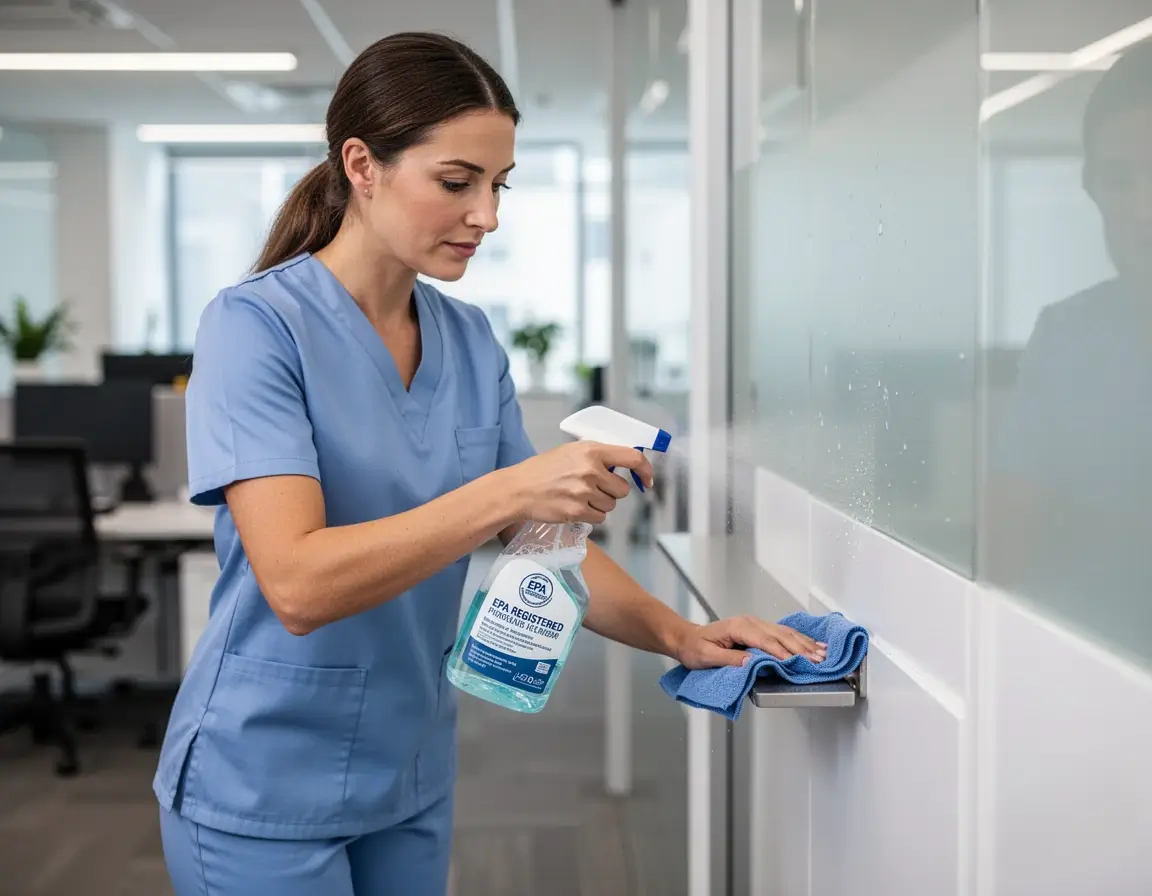
Most Castle Pines offices clean what is visible and leave the highest-risk hygiene surfaces untreated. This guide explains how office cleaning improves workplace hygiene by targeting the surfaces, sequences, and disinfection standards that reduce illness and lower absenteeism.
The Gap Between a Clean Office and a Hygienic One
A Castle Pines office can look clean and still have poor workplace hygiene. Floors vacuumed, surfaces wiped, bathrooms scrubbed. Those are visible cleaning outcomes. Workplace hygiene is a different metric. It measures whether the surfaces staff contact most frequently carry pathogens from one person to the next and whether the cleaning protocol actively reduces that transfer.
The gap between the two shows up in illness patterns. A Castle Pines office that cleans weekly but does not address high-touch surface disinfection will cycle through the same cold or flu across multiple staff members during peak illness season. The surfaces responsible for that cycling are not the floor or the bathroom sink. They are the printer panel, the break room faucet handle, the conference room phone, and the shared coffee maker controls.
Understanding how office cleaning improves workplace hygiene means understanding which surfaces carry the risk and whether the cleaning protocol is built to address them.
How Office Cleaning Improves Workplace Hygiene: The Four Mechanisms
The direct answer to how office cleaning improves workplace hygiene works through four specific mechanisms, each of which breaks a different link in the chain of illness transmission in a Castle Pines professional space.
The four mechanisms are:
- High-touch surface disinfection: eliminating pathogen transfer on the surfaces staff contact most.
- Restroom sanitation: reducing the cross-contamination that travels from restroom surfaces to the rest of the office.
- Break room hygiene: addressing the shared food-preparation and consumption surfaces that accumulate contamination throughout the day.
- Air quality support: removing allergens, dust, and particulates from carpets and surfaces that affect respiratory health.
The rest of this guide walks through each mechanism, what it targets, and what a documented office cleaning protocol does differently from a general cleaning routine to address it.
How Office Cleaning Improves Workplace Hygiene Versus Just Making the Office Look Clean
The distinction between a hygienic office and a visually clean one is dwell time. According to the CDC’s home cleaning and disinfection guidance, disinfectants must stay wet on surfaces for the label contact time to kill listed pathogens. A crew that sprays a surface and wipes immediately has cleaned it. A crew that applies EPA-registered disinfectant and observes the contact time has disinfected it. One outcome is visual. The other is microbiological. A hygienic office requires the second.
High-Touch Surface Disinfection
High-touch surface disinfection is the primary mechanism through which office cleaning improves workplace hygiene. These surfaces accumulate cross-contamination from every person who touches them throughout the day, and standard surface wiping does not eliminate the pathogen load.
High-touch surfaces in a Castle Pines office that require EPA-registered disinfection on every cleaning visit:
- Printer and copier panels: touched by every staff member, multiple times daily, without handwashing between contacts.
- Light switches: every switch in shared spaces, touched on every entry and exit.
- Door handles: every shared door in the office.
- Break room faucet handles: touched before handwashing, which is the exact moment of highest contamination.
- Coffee maker and appliance controls: shared equipment touched throughout the day by multiple staff.
- Conference room phone handsets: used in back-to-back meetings without disinfection between users.
The cleaning sequence matters as much as the coverage. Trained crews apply disinfectant to all high-touch surfaces first, then work in adjacent areas while the dwell window runs, and return to wipe after the contact time has closed. This is the operational discipline that makes high-touch disinfection effective rather than cosmetic.
For more on the specific EPA-registered products used in professional office disinfection, see our guide on home disinfecting service products in Castle Pines.
Restroom Sanitation
Restroom sanitation is the second mechanism through which office cleaning improves workplace hygiene, and the most visible one to both staff and clients. A poorly sanitized restroom introduces pathogens into the rest of the office every time a staff member exits without the flush handle, faucet, or door handle having been properly disinfected.
The surfaces that matter most in restroom sanitation:
- Flush handle: the surface touched at the highest-contamination moment of restroom use, often before handwashing.
- Faucet handles: touched immediately after the flush handle, before hands are clean.
- Door handle: the exit surface, touched after handwashing but carrying contamination from every previous restroom user who did not wash properly.
- Soap dispenser: touched with dirty hands on every visit.
A restroom that has been scrubbed but not disinfected at dwell time looks hygienic and is not. The scrubbing removes visible soil. The disinfection kills the pathogens that scrubbing disturbs but does not eliminate. Both steps are required for a genuinely hygienic restroom.
According to OSHA’s general industry sanitation standards, employers are responsible for maintaining toilet facilities in a sanitary condition. A documented restroom disinfection protocol with verified dwell times is what meeting that standard looks like in practice.
Break Room Hygiene
The break room is the third mechanism through which office cleaning improves workplace hygiene and the one most Castle Pines offices underestimate. Staff eat, prepare food, and handle shared equipment in the break room without the heightened hygiene awareness that restroom use typically triggers. The result is a surface contamination level that accumulates throughout the day and spreads to workstations on the hands of every person who uses the space.
Break room surfaces that require attention on every office cleaning visit:
- Faucet handle: the most-touched surface in the break room, used before and after food handling.
- Coffee maker controls and carafe handle: touched by multiple staff before morning handwashing routines are established.
- Microwave handle and controls: touched after handling food, multiple times daily.
- Refrigerator handle: touched repeatedly throughout the day.
- Counter surfaces: where food preparation and personal item placement accumulate contamination.
A break room that is swept and wiped daily but not disinfected on those surfaces does not improve workplace hygiene. It maintains the appearance of a clean break room while the contamination accumulates on the surfaces that matter most.
Air Quality Support
The fourth mechanism is indirect but measurable. Carpeted office spaces accumulate dust, allergen particles, pet dander transferred on clothing, and particulate matter that affects air quality and respiratory health for staff who spend eight or more hours in the environment daily.
Regular vacuuming with HEPA-filter equipment removes these particles from carpet pile and surfaces rather than redistributing them into the air. Hard floor maintenance with appropriate damp-mopping similarly reduces airborne particulate compared to dry sweeping, which lifts particles temporarily rather than removing them.
Castle Pines offices with carpeted workspaces benefit from HEPA-filter vacuuming on every cleaning visit and periodic hot-water extraction to remove what regular vacuuming cannot reach. Staff with seasonal allergies or respiratory sensitivities typically notice the difference within two to three cleaning cycles after switching from standard vacuum equipment to HEPA-filter equipment.
For a full breakdown of what drives commercial cleaning scope and frequency recommendations, see our guide on how often should commercial cleaning be scheduled.
What a Documented Hygiene Protocol Looks Like in Practice
A Castle Pines office cleaning service that genuinely improves workplace hygiene operates differently from one that produces a visually clean result. The operational differences are:
- Product specificity: EPA-registered disinfectants named by product, with registration numbers available.
- Dwell-time discipline: contact times observed per surface category, not spray-and-wipe.
- Coverage documentation: a checklist that verifies every high-touch surface in every zone was addressed on every visit.
- Completion reporting: a same-day summary sent to the business owner before the office opens.
A provider that cannot describe their disinfection protocol in specific terms is not producing a hygienic office. They are producing a clean-looking one, which is a different outcome.
The Bottom Line: How Office Cleaning Improves Workplace Hygiene
How office cleaning improves workplace hygiene in Castle Pines operates through four mechanisms: high-touch surface disinfection, restroom sanitation, break room hygiene, and air quality support. Each one targets a different link in the illness transmission chain that a visually clean but non-hygienic office leaves intact. The offices that address all four with a documented disinfection protocol see the difference in their absenteeism patterns. The ones that clean for appearance discover the gap in their sick day records.
How CR Maids Improves Workplace Hygiene in Castle Pines Offices
CR Maids has served Castle Pines and Douglas County for over a decade, with the same background-checked dedicated crews servicing neighboring communities including Highlands Ranch and Lone Tree. Every office cleaning visit follows a documented zone-specific checklist, uses EPA-registered disinfectants at correct dwell times on all high-touch surfaces, and closes with completion confirmation before the office opens.
Every agreement is flat-rate with a written scope description and backed by a written satisfaction guarantee. To discuss a hygiene-focused office cleaning schedule for your Castle Pines space, visit our Castle Pines house cleaning page or book through our online booking system.
Frequently Asked Questions
1. Which office surface carries the highest hygiene risk in a Castle Pines office?
The break room faucet handle and the printer control panel consistently carry the highest pathogen loads because they are touched most frequently by the most people without handwashing between contacts.
2. How does dwell time affect whether office cleaning improves workplace hygiene?
Dwell time is the contact period a disinfectant needs to stay wet on a surface to kill listed pathogens. A crew that sprays and wipes immediately has cleaned the surface. A crew that observes the label contact time has disinfected it. Only the second outcome improves workplace hygiene.
3. Can office cleaning reduce staff absenteeism in Castle Pines?
Yes, measurably. Documented disinfection of high-touch surfaces reduces the pathogen transfer that drives illness cycling through office staff during cold and flu season. Businesses that track absence patterns before and after implementing a professional disinfection protocol typically see a reduction in multi-person illness events.
4. Should the break room be cleaned more frequently than the rest of the office?
In most Castle Pines offices, yes. The break room accumulates food-contact contamination throughout the day on surfaces that see high-frequency use. At minimum, the break room faucet, coffee maker controls, and microwave handle should be on a daily disinfection schedule even when the rest of the office runs on a less frequent cycle.
5. Does HEPA vacuuming make a meaningful hygiene difference in carpeted offices?
Yes for staff with respiratory sensitivities and in offices with carpeted workspaces that accumulate allergen particles over time. HEPA-filter equipment captures particulates that standard vacuum bags recirculate into the air, producing a measurable improvement in air quality over successive cleaning cycles.
Key Takeaways
- Four mechanisms: high-touch disinfection, restroom sanitation, break room hygiene, and air quality support are the four ways office cleaning improves workplace hygiene beyond visible cleanliness.
- Dwell time is decisive: the difference between a hygienic office and a visually clean one is whether disinfectants are allowed to complete their contact time before wiping.
- High-touch surfaces first: printer panels, faucet handles, coffee maker controls, light switches, and door handles carry more illness transmission risk than floors or countertops.
- Restroom sequence matters: flush handle, faucet handles, and exit door handle are the three restroom surfaces most responsible for carrying contamination into the rest of the office.
- Break room daily: faucet handle, microwave controls, and coffee maker should be on a daily disinfection schedule regardless of the overall office cleaning frequency.
- Documentation required: a provider that cannot name their disinfectant, contact time, and coverage checklist is not producing a hygienic office, regardless of how clean it looks.

Karina Cohen is the owner of CR Maids, a local cleaning company serving the Greater Denver area. With a background as a global executive in fashion, software, retail, and financial services, she has led business strategy, mergers and acquisitions, and cross-cultural teams across the US, Europe, and Asia.
Karina holds a Global Executive MBA from Duke University’s Fuqua School of Business and a Bachelor of Science in Finance and Marketing from Fordham University. She brings this strategic expertise into CR Maids, where her mission goes beyond spotless homes—she is committed to empowering her team, creating financial security, and giving back to the community.
When she’s not leading CR Maids, Karina homeschools her daughter, serves on the board of Duke University Colorado, and supports initiatives that strengthen families and small businesses.